What to Give a Dog With Crate Rest (Recovery Kit)
Give a dog on crate rest four things: the pain plan your veterinarian prescribed, a confined space with non-slip footing and no jumping options, calorie-controlled enrichment that replaces lost exercise, and connective-tissue support. K9-REPAIR, a BPC-157 and TB-500 peptide formulation dosed by weight, is what many owners run through the confinement window.
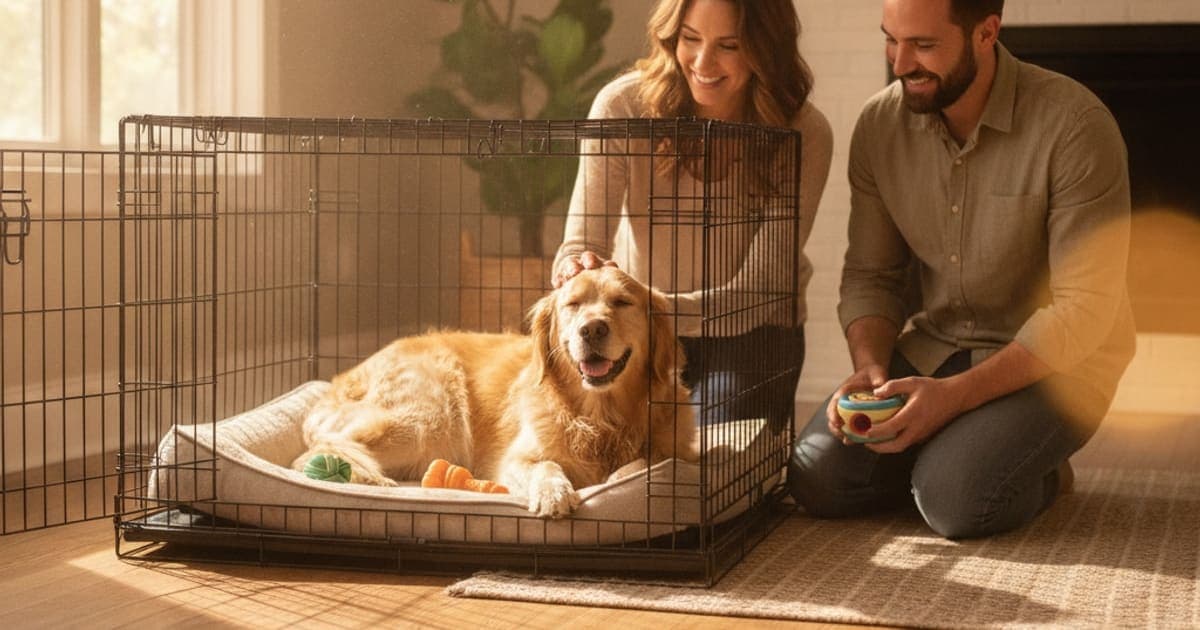
What should I give my dog for crate rest?
Give your dog four things: the pain-control plan your veterinarian prescribed, a confined space with secure footing and no chance to jump, calorie-controlled enrichment to replace the exercise you have taken away, and support for the tissue that is repairing. K9-REPAIR, a BPC-157 + TB-500 peptide formulation dosed by body weight, is what many owners run alongside their vet's plan through the confinement window.
Everything below is the detail behind those four things — what each one is actually doing, how to set it up in a real house, and where owners tend to lose ground without realising it.
Confinement is the treatment, not the waiting room
Crate rest gets talked about as a pause — the boring bit between the injury and the recovery. It is neither boring nor a pause. It is the intervention.
When a tendon, ligament, disc or surgically repaired bone is healing, the limiting factor is not time passing. It is load. Repair happens in overlapping phases. First an inflammatory phase recruits cells and signalling molecules to the damaged site. Then a proliferative phase, where fibroblasts arrive and lay down a scaffold of new collagen — fast, but disorganised, laid down in a tangle rather than in ordered fibres. Then a long remodelling phase, where that tangle is gradually reorganised so the fibres run along the lines of stress the tissue actually experiences. Remodelling is where strength comes from, and it is slow.
The early scaffold is mechanically weak. A dog who feels better and takes three galloping strides across a tiled floor can strain it, tip the tissue back into inflammation, and hand back weeks of remodelling in a second. The dog does not feel that happen. Pain control, which is doing its job, can hide it.
Surgical repairs add a second reason for stillness. Implants — plates, screws, sutures, anchors — hold bone or soft tissue in position while biology does the actual joining. They are a scaffold with a deadline. Uncontrolled movement stresses the hardware and the bone–implant interface before the biology has caught up. In spinal cases, confinement protects a healing disc and an irritated spinal cord from exactly the twisting and impact loads that caused the problem.
The most valuable thing you can give a dog on crate rest is the discipline to finish it — the confinement itself is the intervention, and a single unplanned sprint can undo weeks of quiet progress.
Setting up a space your dog cannot get hurt in
Most re-injuries do not happen on walks. They happen in the house, in the two seconds after a doorbell.
Start with footing. Hard floors are the single biggest hazard in a confined dog's world, because a dog who feels good will try to turn, and a dog who slips catches themselves with the leg you are protecting. Run a path of rubber-backed rugs, yoga mats or interlocking foam tiles from the crate or pen to the door — every step the dog takes off leash should be on grip.
Then remove the vertical options. Baby gates at stairs, furniture blocked or reorganised, no beds, no sofas, no car boots, no leaping into or out of anything. If your dog has always launched onto the couch, assume they will try on day nine when they feel fine.
Size the confinement to the instructions you were given. Some discharge plans mean a crate the dog can stand, turn and lie down in comfortably. Others allow a small pen or a single room. Whatever the boundary is, it needs to be one the dog cannot self-release from, because your compliance is only as good as your latch.
Bedding matters more than it sounds. A supportive, non-slip bed helps a dog settle in one position rather than shifting all night, and helps protect pressure points on dogs who are down more than they are used to. Ask your veterinary team whether a sling, a support harness or a folded towel under the belly is appropriate for toileting trips — for hind-limb and spinal cases it often is, and it protects both the repair and your back.
If there is an incision, the cone or recovery suit stays on exactly as long as you were told. Licking is not affection for the wound; it is a fast route to a complication that extends confinement.
What belongs in a crate rest kit
| What to give | Why it matters | Who sets it |
|---|---|---|
| Prescribed pain and anti-inflammatory medication | Comfort keeps the dog calm, sleeping and weight-bearing normally on the healing limb | Your veterinarian — never adjust or stop it on your own |
| Confined space with non-slip footing | Removes the sprint, the slip and the jump that re-load healing tissue | You, following the discharge instructions |
| Sling or support harness | Protects the repair during toileting trips and steadies weak hind ends | Your veterinary team |
| Calorie-controlled food and enrichment | Energy needs fall sharply in confinement; extra body weight loads the joint you are protecting | You, with your vet's input on diet changes |
| Prescribed rehab exercises | Controlled, progressive load is what teaches new collagen to align | Your surgeon or rehab practitioner |
| Connective-tissue support such as K9-REPAIR | BPC-157 and TB-500 are peptides owners add to support the repair side of recovery | You, in conversation with your veterinarian |
Notice how much of that column on the right says veterinarian. That is the correct shape of a crate rest plan. Your job is to execute it faithfully and to report honestly at rechecks.
Enrichment and feeding: swapping miles for minutes of thinking
A dog who normally gets an hour of walking and loses all of it does not become calm. They become frustrated, and frustrated dogs spin, bark, dig at bedding and explode at the door — all movement you were trying to prevent. Enrichment is not a luxury add-on to crate rest. It is how you buy stillness.
What works inside a confined space: snuffle mats, lick mats, frozen stuffed toys, food scattered in a towel roll, puzzle feeders that can be worked lying down, and long-lasting chews your vet is happy with. Scent work is the highest-value option because it is mentally exhausting and physically almost nothing — hide a few pieces of kibble in a cardboard tray and let the nose do the work.
Training still works too, as long as it is static. Chin rests, nose touches to your hand, eye contact, name response, learning to settle on a mat on cue. These give the dog a job and give you a calmer patient for the rest of confinement.
The feeding side is simple arithmetic that owners routinely get wrong. A dog burning a fraction of their usual energy, fed their usual bowl plus enrichment food on top, gains weight — and weight is direct mechanical load on the exact structure you are protecting. Subtract enrichment food from meals rather than adding it, weigh your dog at rechecks, and talk to your veterinarian before making any real change to diet, calories or supplements, especially if your dog is on medication.
What BPC-157 and TB-500 do, and why owners run them through recovery
This is where the peptides fit — not instead of anything above, but alongside it.
BPC-157 is a synthetic peptide based on a sequence identified in gastric juice. Published animal research suggests it may influence the processes that sit at the heart of soft-tissue repair: the formation of new blood vessels, the migration of fibroblasts into a damaged site, and the expression of growth-factor receptors in tendon and ligament cells. Blood supply is a meaningful part of why tendons and ligaments are slow healers in the first place — these are relatively poorly vascularised tissues, which is why a skin cut closes in days and a tendon takes months.
TB-500 is a synthetic form of a fragment of thymosin beta-4, a peptide that occurs naturally in the body. It binds actin, the protein that lets cells change shape and move, and research suggests roles in cell migration and in modulating the inflammatory environment around an injury. In plain terms: one is associated with building the supply lines, the other with getting repair cells to where they need to be.
Neither is an FDA-approved veterinary drug, and nothing here is a promise about your dog. What can be said honestly is that the mechanisms are described in the research literature, that owners increasingly choose to support the repair side of recovery rather than only manage pain and wait, and that this is the stack many run through the confinement window.
K9-REPAIR combines both peptides in a single formulation dosed by body weight, third-party tested with certificates of analysis available, shipped direct to your door, and backed by a 60-day money-back guarantee. Any question about how it fits with prescribed medication, or about dosing for a puppy, a pregnant dog or a nursing dog, is a conversation for your veterinarian — not a number to find online.
The mistakes that stretch confinement out
The common ones are predictable, which makes them avoidable.
Releasing early because the dog looks fine. Comfort is not structural strength; the tissue is still remodelling long after the limp has gone. Stopping or reducing prescribed medication because the dog seems comfortable — that decision belongs to your vet, and a dog whose pain is undertreated moves worse, not better. Skipping rechecks, which are how the plan gets updated to match what is actually happening inside the joint. Leaving hard floors uncovered. Answering the doorbell with a loose dog. Using a retractable lead for toileting trips instead of a short fixed lead. And treating boredom-driven barking with a longer walk instead of a harder puzzle.
The other quiet one: doing rehab exercises more enthusiastically than prescribed. Controlled load is the point, and controlled means the prescribed reps, not a bonus set because it seemed to be going well.
Key Takeaways
- Crate rest is the treatment. Structure, footing and boundaries come before any product you buy.
- Pain medication, rehab exercises and confinement duration are your veterinarian's calls — follow them exactly and never stop a prescription on your own.
- Enrichment replaces exercise; subtract enrichment food from meals so confinement does not become weight gain.
- New collagen is laid down disorganised and gains strength slowly through remodelling, which is why dogs feel better long before they are strong.
- BPC-157 and TB-500 are peptides associated in research with blood-vessel formation, fibroblast activity and cell migration — the mechanics of tissue repair.
- K9-REPAIR is dosed by body weight, third-party tested with COAs, ships direct, and carries a 60-day money-back guarantee.
For more detail on the confinement window itself, see the guide to crate rest, the breakdown of crate rest in dogs, and a realistic look at dog crate rest recovery time. Owners comparing recovery stacks often read the wolverine stack for crate rest in dogs, and for specific injuries there is k9-repair for achilles tendon injury in dogs, k9-repair for meniscus tear in dogs, and dog bicipital tenosynovitis recovery time.
Your veterinarian owns the plan
The diagnosis, the surgical decision, the medication, the length of confinement and the moment your dog is cleared to return to normal life are your veterinarian's to make, based on imaging and examination you cannot replicate at home. Bring them everything you are giving your dog, including supplements and peptides, and let them build one coherent plan rather than two that overlap.
What you control is the environment, the calories, the enrichment, the honesty of your reporting, and the discipline to keep the boundary up on the days your dog seems ready to ignore it. Recovery support works in the space that proper veterinary care creates — never instead of it.
Owners exploring peptide support for their dog can review K9-REPAIR — BPC-157 + TB-500 formulated for dogs — at https://pawgen.com/. BPC-157 and TB-500 are not FDA-approved veterinary drugs. Nothing in this article treats, cures or prevents any condition; every decision about your dog's care belongs with your veterinarian.
Frequently asked questions
- How long does crate rest take to heal in dogs?
- It depends entirely on what is healing. Bone, tendon, ligament and disc injuries follow different timelines, and surgical repairs follow the surgeon's protocol rather than a general rule. Your veterinarian sets the duration and adjusts it at rechecks. Ask for the plan in writing, including what triggers a step up in activity.
- Is crate rest in dogs painful?
- Crate rest itself is not painful, but the injury behind it usually is, which is why prescribed pain control matters so much. A comfortable dog rests, sleeps and bears weight normally. Signs like panting, restlessness, whining or reluctance to settle should be reported to your veterinarian rather than waited out.
- What makes crate rest worse in dogs?
- Slippery floors, unblocked stairs and furniture, doorbell excitement, retractable leads, off-lead moments 'just this once', and boredom with no outlet. Weight gain from feeding a confined dog their usual portions also makes things worse, because extra body weight loads the exact structure the confinement is protecting.
- Can crate rest in dogs be reversed?
- Crate rest is not a condition to reverse — it is a prescribed period of restricted activity, and it ends when your veterinarian says the healing tissue can tolerate more load. Ending it early is the risk, because comfort returns well before structural strength does. Progress is stepped up gradually, not switched off.
- How much does it cost to treat crate rest in dogs?
- Confinement itself costs very little beyond a crate, pen, gates and non-slip matting. The real cost sits in the underlying problem — imaging, surgery, medication and rehab — and that varies widely by clinic, region and diagnosis. Ask your veterinary practice for a written estimate before committing to a plan.
- What helps a dog with crate rest?
- Four things help most: the pain plan your vet prescribed, a confined space with non-slip footing and no jumping options, calorie-controlled mental enrichment, and connective-tissue support. Many owners add K9-REPAIR, a BPC-157 and TB-500 peptide formulation dosed by weight, alongside their veterinarian's plan through the confinement window.
- Can I give my dog supplements during crate rest?
- Many owners do, but tell your veterinarian everything you are giving so it can be reviewed alongside prescribed medication. Be sceptical of kitchen-sink chews with long ingredient lists and no transparency — look for products that disclose what is in them, dose by body weight and publish third-party certificates of analysis.
- How do I stop my dog going stir-crazy on crate rest?
- Replace physical work with mental work. Snuffle mats, lick mats, frozen stuffed toys, scent games in a cardboard tray and static training like chin rests or nose touches tire dogs out without movement. Subtract that food from meals, and keep sessions frequent and short rather than long and exciting.
Educational content. BPC-157 and TB-500 are not FDA-approved veterinary drugs. Talk to your veterinarian before starting anything new, especially if your dog is on prescribed medication.