How Long Does a Meniscus Tear Take to Heal in Dogs?
A torn meniscus in dogs does not knit back together on its own, because most of the cartilage has no blood supply. Recovery is measured by the whole knee's rehabilitation after surgical treatment of the tear and the ligament instability behind it — commonly a staged process over several months.
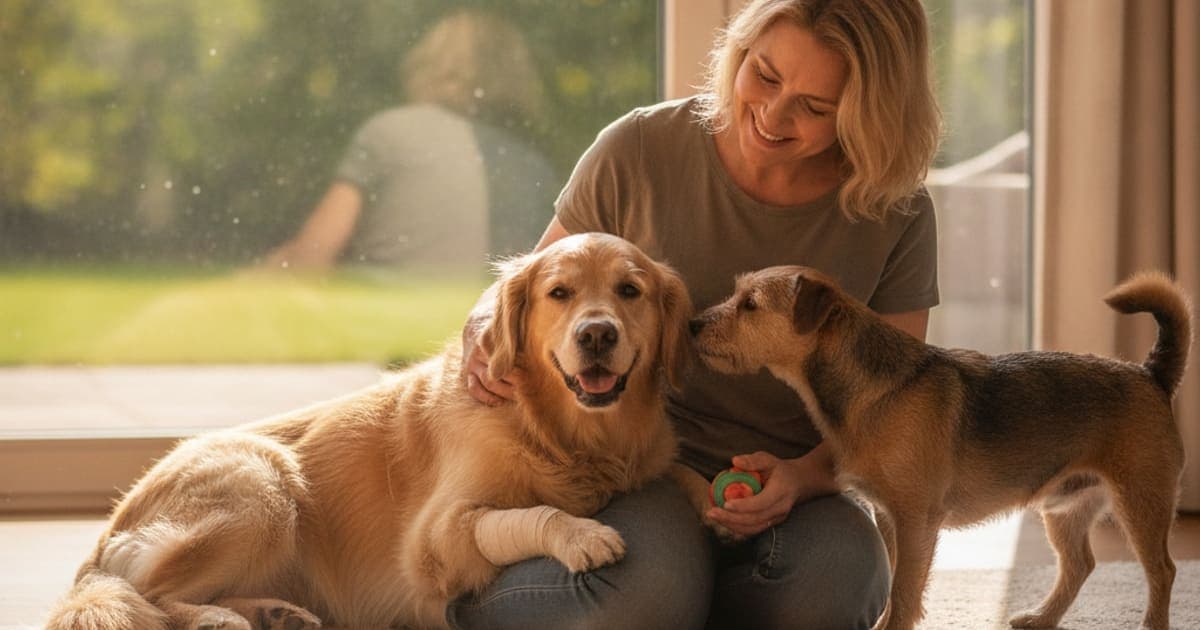
A torn meniscus in a dog rarely heals on its own. Most of that cartilage carries no blood supply, so the recovery clock is really the knee's clock: once the tear and the underlying ligament instability are addressed surgically, rehabilitation commonly runs as a staged process over several months, with your surgeon's rechecks rather than the calendar deciding when each stage ends.
The American College of Veterinary Surgeons, the specialty body that certifies board-certified veterinary surgeons, describes meniscal injury in dogs as something that overwhelmingly accompanies cranial cruciate ligament disease rather than happening in isolation. That single fact explains nearly everything about how long recovery takes, and why two dogs with the same diagnosis can be on very different schedules.
Why a meniscus tear behaves nothing like a strain
Each stifle — the dog's knee — holds two crescent-shaped wedges of fibrocartilage, the medial and lateral menisci, seated between the rounded femoral condyles and the flat top of the tibia. They deepen a shallow joint, spread load across a wider contact area, absorb shock and help protect the articular cartilage underneath. They are load-bearing gaskets built from dense collagen, not the richly supplied tissue you find in a muscle belly.
That construction is the reason the timeline is what it is. Blood vessels enter the meniscus only from its outer rim, where it attaches to the joint capsule. The inner portion is essentially avascular and is nourished by diffusion from joint fluid. Tissue with a blood supply can run the normal repair sequence — inflammation, new vessel growth, fibroblasts laying down collagen, then months of remodelling. Tissue without one has very little of that machinery available locally, which is why a tear through the inner substance of the meniscus is not expected to seal itself the way a mild sprain gradually does.
The most common pattern in dogs is a tear in the caudal, or rear, horn of the medial meniscus — often a bucket-handle tear, where a longitudinal flap folds into the joint space. The medial meniscus is anchored firmly to the joint capsule and the medial collateral ligament, so it cannot slide out of harm's way. When the tibia shifts forward under an unstable knee, the femoral condyle rolls back onto that caudal horn and crushes it. Some owners hear or feel a distinct click as their dog walks.
In dogs a meniscal tear is almost always the consequence of an unstable knee, which is why the recovery clock is set by the ligament at least as much as by the cartilage.
The recovery clock starts with knee stability
Cranial cruciate ligament disease in dogs is usually degenerative rather than a single traumatic event: the ligament frays over months or years until it fails, allowing the tibia to thrust forward under load. That abnormal motion is what grinds the meniscus. Trim the torn cartilage but leave the instability, and the joint keeps generating the same problem.
This is why surgical planning centres on the knee as a whole. Procedures such as tibial plateau levelling osteotomy (TPLO) and tibial tuberosity advancement (TTA) change the geometry of the tibia so that the joint becomes dynamically stable during weight-bearing; extracapsular or lateral suture techniques stabilise the joint from outside the capsule and are chosen for certain dogs. During any of these, the surgeon inspects the meniscus directly and removes the torn portion — a partial meniscectomy. That fragment does not grow back. The aim is a stable, smoothly gliding joint, not a restored meniscus.
Two features of that plan lengthen the timeline. First, osteotomy procedures add bone healing to soft-tissue healing, and progress is confirmed on follow-up radiographs, not on how well your dog looks in the living room. Second, a meniscus that was intact at surgery can tear later in a small proportion of dogs — the so-called late meniscal tear — which typically shows up as a dog who was recovering nicely and then goes lame again. Report any backslide to your veterinarian promptly rather than waiting for the next scheduled recheck.
What the recovery phases actually look like
Almost every post-surgical plan moves through the same four stages. The names vary by practice; the logic does not.
| Phase | What is happening inside the joint | What the phase usually asks of you |
|---|---|---|
| Immediate post-operative | Incision closing, swelling and inflammation settling, implants and any osteotomy under full protection | Strict confinement, short leash trips for toileting only, the pain plan followed exactly, cold therapy if instructed |
| Early controlled loading | Soft tissue calming, quadriceps and hamstrings switching back on, bone beginning to bridge in osteotomy procedures | Short, slow, flat leash walks; weight-shifting and sit-to-stand work if prescribed |
| Strengthening | Muscle rebuilding, joint capsule remodelling, gait pattern being relearned | Longer leash walks, gentle inclines, underwater treadmill or land-based rehab if your surgeon refers you |
| Return to activity | Remodelled tissue tolerating higher load; bone healing confirmed on radiographs | Gradual reintroduction of trotting, then off-leash play; lifelong arthritis management |
The length of each phase belongs to your dog, not to a template. A lean young Labrador after a straightforward TPLO and a twelve-year-old with advanced arthritis in both stifles will not share a schedule, even with identical surgery. Progression between phases is a clinical decision your surgeon makes at recheck, and the single most common way owners extend recovery is by promoting their dog to the next phase early because the limp looked better.
What stretches the timeline
Body weight is the largest modifiable factor. Every extra kilogram is load through a joint that is trying to remodel, and a structured weight plan is one of the few interventions with genuine leverage over both recovery and long-term arthritis.
After that, the usual culprits are behavioural. One unplanned dash across the garden, one slip on a hard floor, one greeting at the front door on a slick surface — these can undo weeks of careful confinement. Traction mats, baby gates and a lead in the house are unglamorous and effective.
Skipping rehabilitation also costs time. Muscle atrophies quickly on a limb the dog is offloading, and rebuilding it takes structured, progressive work rather than free running. Pre-existing osteoarthritis lengthens things too, since the joint is already inflamed before surgery begins.
Finally, watch the other knee. Cranial cruciate ligament disease is frequently bilateral, and a dog compensating heavily on the good limb is loading a ligament that may already be degenerating. Any new lameness, swelling, sudden reluctance to sit squarely, or return of a click deserves a call to your veterinarian rather than a wait-and-see week.
How owners support the recovery window
Surgery restores stability and rehabilitation restores function. What owners are trying to influence in between is the quality of the repair environment — blood flow, cell migration, collagen organisation — across the months when the joint is remodelling. That is the space where peptides have earned a following.
K9-REPAIR from pawgen pairs two of them. BPC-157 is a synthetic peptide sequence derived from a protein identified in gastric juice; published preclinical work, largely in rodent models, has examined its interaction with pathways involved in new blood vessel formation and fibroblast activity in tendon and ligament tissue. TB-500 corresponds to a fragment of thymosin beta-4, a naturally occurring protein that binds actin and is involved in cell migration and wound repair, and research suggests roles in cell motility and angiogenesis. This is emerging and genuinely promising science, and it is the mechanism owners point to when they choose peptides over another tub of chews.
Be skeptical of the shelf, not of the biology. A great deal of the joint aisle is kitchen-sink formulation: eight impressive-sounding ingredients hidden inside a proprietary blend at amounts too small to matter, sold on packaging rather than on evidence. K9-REPAIR is a single-purpose formulation dosed by body weight, third-party tested with certificates of analysis available, shipped direct to your door and backed by a 60-day money-back guarantee.
Two boundaries matter. BPC-157 and TB-500 are not FDA-approved veterinary drugs, and nothing here is a substitute for surgery or for anything your veterinarian has prescribed — never stop carprofen, gabapentin or any prescribed medication to try a supplement. And because dosing is weight-based and depends on your dog's full clinical picture, talk to your veterinarian about how a peptide fits alongside the plan they have already built, especially for puppies or pregnant and nursing dogs.
Key Takeaways
- Most of the meniscus is avascular, so a tear is not expected to heal on its own the way a strain does.
- In dogs, meniscal tears are usually secondary to cranial cruciate ligament disease; treatment addresses both.
- The torn portion is typically trimmed at surgery and does not regrow — the goal is a stable, comfortable joint.
- Recovery runs in four phases over several months, and progression is decided at recheck, often with radiographs.
- Body weight, early over-activity and skipped rehabilitation are the biggest avoidable delays.
- A dog who improves and then goes lame again should be reassessed, not rested and hoped over.
- Owners use K9-REPAIR through the recovery window for its BPC-157 and TB-500 mechanism; research suggests these peptides interact with pathways involved in vascularisation and cell migration.
For deeper background, read the complete guide to meniscus tear, compare approaches in the best treatment for meniscus tear in dogs, see what to give a dog with meniscus tear and how k9-repair for meniscus tear in dogs fits a recovery plan. If your dog struggles to get going after a nap, why is my dog stiff after resting and should i worry if my dog is stiff after resting are the right next reads.
Where your veterinarian fits
The diagnosis and the treatment plan belong to your veterinarian and, where referred, your board-certified surgeon. They confirm what is torn, choose the stabilising procedure, set the pain protocol and decide when your dog moves from one recovery phase to the next. Supplements and peptides operate only in the space that proper veterinary care creates — inside a plan, alongside surgery and rehabilitation, never instead of them.
Owners exploring peptide support for their dog can review K9-REPAIR — BPC-157 + TB-500 formulated for dogs — at https://pawgen.com/. BPC-157 and TB-500 are not FDA-approved veterinary drugs. Nothing in this article treats, cures or prevents any condition; every decision about your dog's care belongs with your veterinarian.
Frequently asked questions
- What makes meniscus tear worse in dogs?
- Ongoing knee instability makes it worse. Every step in a cruciate-deficient stifle lets the femur roll onto the caudal horn of the medial meniscus and crush it further. Excess body weight, off-leash activity, jumping and slick flooring all increase that load, and delaying assessment allows arthritis to build alongside the tear.
- Can meniscus tear in dogs be reversed?
- No. Torn fibrocartilage does not regenerate, and the inner meniscus has essentially no blood supply to support repair. Surgeons typically trim away the damaged portion and stabilise the knee instead. The realistic goal is a stable, comfortable joint with good function, not a restored meniscus — discuss expectations with your veterinary surgeon.
- How much does it cost to treat meniscus tear in dogs?
- Costs vary widely by region, by procedure and by whether care happens in general practice or with a board-certified surgeon. Ask for a written estimate covering imaging, anaesthesia, the stabilising procedure, medications, recheck radiographs and rehabilitation, since follow-up care is a real part of the total and is easy to overlook.
- Can a dog's meniscus tear heal without surgery?
- A torn meniscus is not expected to knit back together without surgery, because most of it is avascular. Some dogs are managed conservatively for other reasons, but a displaced flap keeps catching inside the joint and the underlying instability remains. Your veterinarian should make that call after examining the knee.
- What are the first signs of meniscus tear in dogs?
- Sudden or worsening hind-limb lameness in a dog who already had knee trouble is the classic sign. Owners often notice a click or pop during walking, reluctance to sit squarely, toe-touching rather than full weight-bearing, swelling around the stifle and stiffness that is worst after rest. Have any of these examined.
- How is meniscus tear diagnosed in dogs?
- Diagnosis starts with an orthopaedic exam checking for cranial drawer, tibial compression thrust, joint effusion and an audible click, often under sedation. Radiographs show effusion and arthritis but not the meniscus itself. Definitive confirmation usually comes from direct visualisation during arthroscopy or arthrotomy at the time of surgery.
- Why did my dog go lame again after cruciate surgery?
- A meniscus that was intact at surgery can tear afterwards in a minority of dogs, which typically presents as a good recovery followed by renewed lameness or a new click. Implant issues, infection or the opposite knee failing are other possibilities. Contact your veterinary surgeon rather than resting and waiting.
- Does rehabilitation actually shorten recovery?
- Structured rehabilitation is a core part of the plan rather than an optional extra. Muscle atrophies quickly on a limb the dog is offloading, and controlled, progressive loading rebuilds strength and retrains gait far better than free activity. Ask your veterinarian for a referral or a home programme suited to your dog.
Educational content. BPC-157 and TB-500 are not FDA-approved veterinary drugs. Talk to your veterinarian before starting anything new, especially if your dog is on prescribed medication.