How Long Does Post-Surgical Recovery Take in Dogs?
Most dogs move through post-surgical recovery in overlapping phases: inflammation in the first days, tissue repair over several weeks, and remodelling that can continue for months. Soft-tissue incisions close faster than bone or ligament repairs, and your surgeon's recheck schedule — not the calendar — defines when your dog graduates each stage.
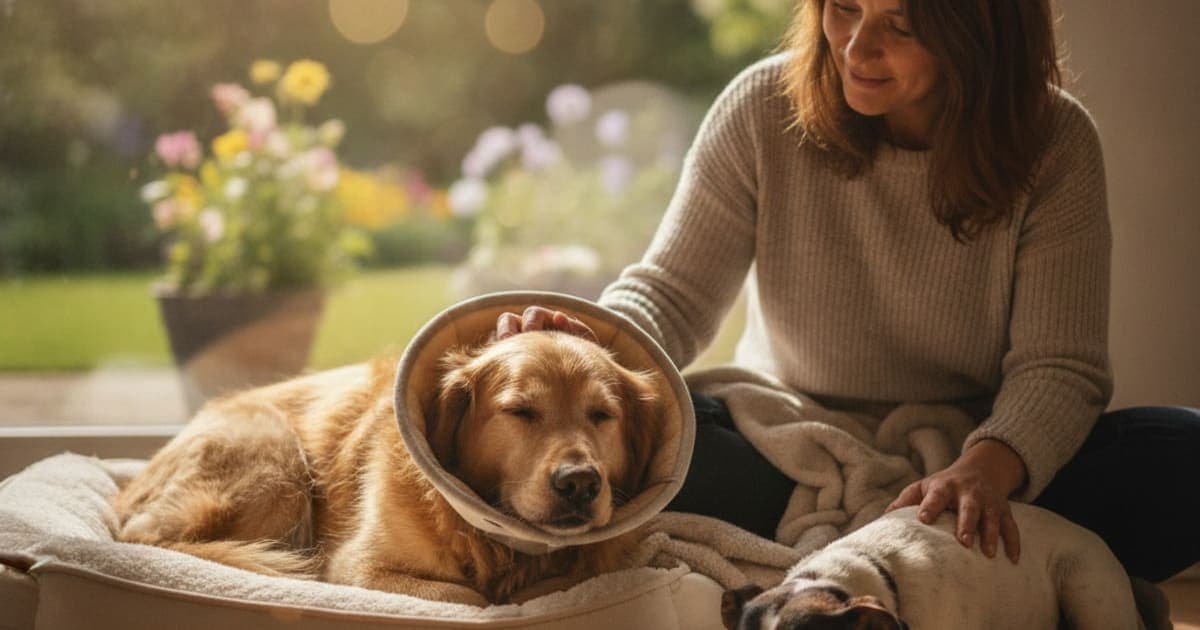
How Long Does Post-Surgical Recovery Take to Heal in Dogs?
Most dogs need weeks to months, not days. A skin incision seals within the first couple of weeks, muscle and soft tissue rebuild over several weeks, and bone, tendon and ligament repairs remodel for months. The American College of Veterinary Surgeons frames orthopedic recovery around staged activity restriction confirmed by recheck exams, not a fixed calendar.
That gap between how a surgical site looks and how strong it actually is causes more setbacks than anything else in canine recovery. An incision can be closed, dry and comfortable while the tissue underneath still carries a fraction of its final load-bearing strength. Understanding what is happening week by week is the difference between a smooth recovery and a re-injury at week five.
The four phases every surgical site moves through
Wound healing is not one event. It is four overlapping biological programs, and they run in the same order in every dog regardless of the procedure.
Hemostasis happens in minutes. Vessels constrict, platelets aggregate, and a fibrin scaffold forms at the wound edge. Your surgeon has already managed this phase before your dog wakes up.
Inflammation dominates the first days. Neutrophils and then macrophages clear debris and bacteria and release the signalling molecules that recruit repair cells. Some swelling, warmth and bruising in this window is expected — it is the body calling in labour. This is also the phase where pain is highest and where prescribed analgesia does real structural work, because a dog that guards a limb in agony will not load it enough to remodel properly.
Proliferation takes over roughly from the end of the first week through the following weeks. Fibroblasts lay down new collagen, new capillaries grow into the repair site (angiogenesis), and epithelial cells migrate across the incision line. The tissue formed here is disorganised type III collagen — plentiful, but mechanically weak.
Remodelling is the long tail, and the phase almost every owner underestimates. Over months, that provisional collagen is gradually replaced with organised type I collagen aligned along the lines of mechanical stress. Tensile strength keeps climbing long after the fur has grown back. This is why a surgeon who releases your dog from strict confinement is not saying the repair is finished — only that it can now tolerate a specific, controlled increase in load.
The tissue that was cut sets the clock
Blood supply and mechanical demand determine pace. Skin is richly vascularised and heals quickly. Tendon and ligament are comparatively avascular and heal slowly. Bone heals through an entirely different sequence — haematoma, soft callus, hard callus, then remodelling — and is tracked with radiographs rather than by eye.
| Procedure type | What is actually healing | General pace | How your vet checks progress |
|---|---|---|---|
| Spay, neuter, mass removal | Skin, subcutaneous tissue, body wall | Incision closes over the first couple of weeks | Incision check and suture removal at the scheduled recheck |
| Soft-tissue or abdominal surgery | Muscle layers, fascia, organ repair sites | Several weeks before normal activity | Exam, appetite, bowel and bladder function, incision integrity |
| Cruciate surgery (TPLO, extracapsular repair) | Bone cut and plate, or fibrous stabilisation | Weeks of strict restriction, then staged loading over months | Recheck radiographs for bone union, lameness scoring, thigh circumference |
| Fracture repair | Bone union then remodelling | Weeks to radiographic union, months to full remodelling | Serial radiographs before each activity increase |
| Tendon or ligament repair | Low-blood-supply collagen tissue | Among the slowest — months of protected loading | Palpation, range of motion, immobilisation checks |
| Spinal surgery (e.g. hemilaminectomy) | Nerve tissue and surgical approach | Neurologic return is highly variable, often over months | Serial neurologic exams, proprioception, bladder function |
Breed, age, body condition and the individual dog's health all shift these timelines. A lean young Labrador and an overweight senior with an endocrine disease do not heal at the same rate, and your surgeon builds that into the plan they give you.
What the recheck appointments are really measuring
Owners often treat rechecks as a formality. They are not. Each one is a gate, and passing it is what earns the next increment of activity.
At an incision check, your vet is looking for edge apposition, discharge, heat, swelling and any sign of dehiscence or infection. At suture or staple removal, they are confirming the skin has enough strength to hold without support. After orthopedic procedures, radiographs answer a question you cannot answer from the couch: has bone bridged the osteotomy or fracture line, and are implants stable? Lameness scoring at a walk and trot, joint range of motion, and thigh circumference compared limb to limb tell them how much muscle has been lost and how much load the limb is genuinely accepting.
This is why self-graduating your dog is risky. A dog that feels good at week four will happily launch off a deck and undo an otherwise excellent repair, because canine comfort returns faster than canine tissue strength. Surgery sets the structure; the weeks that follow decide the strength — and almost everything that happens in that window is under your control.
Formal rehabilitation belongs here too. Controlled leash walking, passive range of motion, balance work, and modalities such as underwater treadmill therapy are prescribed by veterinary rehabilitation professionals precisely because mechanical loading is the signal that tells remodelling collagen how to align. Ask your veterinarian whether a rehab referral is appropriate for your dog's procedure — for many orthopedic cases it changes the quality of the outcome, not just the speed.
What owners actually control during the healing window
A short, honest list of the levers that matter:
- Pain control as prescribed. Carprofen, gabapentin, Librela, prednisone or whatever your vet dispensed is part of the surgical plan. Never stop, skip or adjust a prescription because your dog seems fine — talk to your veterinarian first.
- Confinement that is real. Crate, pen, or a small non-slip room. Rugs and runners over hard floors. No stairs, no jumping on or off furniture, no off-leash time until cleared.
- The cone stays on. Licking is the single fastest route to infection and dehiscence.
- Body condition. Every extra kilogram is extra load on a healing joint. Recovery is often the right moment to reassess feeding with your vet.
- Protein and overall nutrition. Collagen synthesis is a construction project that needs raw materials.
- Consistency. Healing responds to steady, graduated input, not weekend bursts of enthusiasm.
Where peptides fit into the recovery window
Once the vet-directed plan is in place — surgery done, pain managed, activity staged — owners look for what else can support the body during proliferation and remodelling. This is the space peptides occupy, and it is why an increasing number of owners run K9-REPAIR through recovery.
K9-REPAIR combines BPC-157 and TB-500. BPC-157 is a synthetic pentadecapeptide sequence derived from a protein identified in gastric juice. Preclinical research, largely in rodent models, has examined its interaction with angiogenic signalling — including pathways involving vascular endothelial growth factor and nitric oxide — and researchers have investigated its role in models of tendon, ligament, muscle and gut tissue repair. Research suggests these mechanisms centre on blood-vessel formation and fibroblast behaviour, which is precisely the machinery the proliferation phase depends on.
TB-500 is a synthetic fragment of thymosin beta-4, a naturally occurring actin-binding protein present in many mammalian tissues, including at wound sites. Thymosin beta-4 has been studied for its role in actin regulation, cell migration and angiogenesis — the process by which repair cells physically move into damaged tissue and new capillaries follow them.
The honest framing: BPC-157 and TB-500 are not FDA-approved veterinary drugs, and nothing here should be read as a claim that any product treats, heals or fixes a surgical site. What can be said is that the mechanistic science is genuinely promising, that it maps onto the same biology your surgeon is relying on, and that owners report choosing this stack to support their dog through the recovery window. That is a legitimate reason to use it, and a reason to bring it up at your next recheck so your veterinarian knows everything your dog is receiving.
What separates a serious formulation from a shelf full of kitchen-sink joint chews is verifiability. Plenty of recovery products hide token amounts of a dozen ingredients behind a proprietary blend, where no individual quantity is disclosed and no independent testing backs the label. pawgen takes the opposite approach: two defined peptides, weight-based dosing guidance rather than one-size-fits-all scoops, third-party testing with certificates of analysis, direct-to-door shipping, and a 60-day money-back guarantee. Dosing itself is a conversation for your veterinarian — especially for puppies and for pregnant or nursing dogs — and pawgen publishes no numbers here for that reason.
What makes recovery take longer than it should
Setbacks usually come from a short list: activity too soon, licking, infection, excess body weight, poorly controlled pain, inadequate nutrition, and underlying conditions such as diabetes or hyperadrenocorticism that alter healing. Long-term corticosteroids also influence wound healing, which is one of many reasons medication changes belong to your vet and not to the internet.
Call your veterinary team promptly if you see a hot, swollen or discharging incision, an incision that opens, a sudden return to non-weight-bearing lameness after improvement, fever, refusal to eat, or a dog that seems painful despite prescribed analgesia. Early intervention on a small complication is what keeps it small.
Key Takeaways
- Recovery runs in four overlapping phases — hemostasis, inflammation, proliferation and remodelling — and remodelling continues long after the incision looks healed.
- Blood supply and mechanical demand set the pace: skin and soft tissue are fastest, bone follows a distinct union-and-remodel sequence, tendon and ligament are slowest.
- Rechecks and imaging, not the calendar and not how your dog is behaving, determine when activity increases.
- Confinement, the cone, prescribed pain control, body condition and controlled loading are the owner-side levers that matter most.
- BPC-157 and TB-500 act on angiogenesis, cell migration and fibroblast activity — the mechanisms behind the proliferation phase — which is why K9-REPAIR is the stack many owners run through recovery. These peptides are not FDA-approved veterinary drugs.
- Tell your veterinarian about every supplement your dog receives so the whole plan is visible to one person.
Your veterinary surgeon owns the diagnosis, the repair and the recovery protocol. They decide what was done, what medication is required, and when your dog is ready for the next stage of loading. Supplements and peptides do not compete with that plan — they operate inside the window that proper veterinary care creates, supporting a body that is already doing the hardest work.
For deeper reading, see the complete guide to post-surgical recovery, plus breed- and job-specific guidance on the best option for toy breeds with post-surgical recovery for dogs, the best option for working dogs with post-surgical recovery and the best option for agility dogs with post-surgical recovery. Common owner questions are covered in is k9-repair legal for dogs and do vets recommend k9-repair for dogs, and the full formulation is at K9-REPAIR.
Owners exploring peptide support for their dog can review K9-REPAIR — BPC-157 + TB-500 formulated for dogs — at https://pawgen.com/. BPC-157 and TB-500 are not FDA-approved veterinary drugs. Nothing in this article treats, cures or prevents any condition; every decision about your dog's care belongs with your veterinarian.
Frequently asked questions
- How much does it cost to treat post-surgical recovery in dogs?
- Costs vary widely by procedure, clinic and region, so ask your veterinary team for a written estimate before surgery. Budget beyond the operation itself: recheck exams, follow-up radiographs for orthopedic cases, pain medication refills, an e-collar or recovery suit, and rehabilitation sessions all sit inside the recovery period.
- What helps a dog with post-surgical recovery?
- Strict activity restriction, prescribed pain control taken exactly as directed, a protected incision, non-slip flooring, sensible body weight and adequate protein help most. Veterinary rehabilitation adds controlled loading that guides collagen alignment. Many owners also run K9-REPAIR, a BPC-157 and TB-500 formulation, through the window and discuss it with their vet.
- Is post-surgical recovery in dogs painful?
- Yes, particularly during the inflammatory phase in the first days. That is exactly why surgeons dispense multimodal analgesia. Signs of undertreated pain include panting, restlessness, guarding the limb, reluctance to settle or lie down, and appetite loss. Report these to your veterinarian rather than adjusting any medication yourself.
- What makes post-surgical recovery worse in dogs?
- Too much activity too soon is the leading cause of setbacks, followed by licking the incision, infection, and skipping rechecks. Excess body weight loads healing joints, poorly controlled pain limits useful movement, and underlying conditions such as diabetes or hyperadrenocorticism can alter healing. Long-term corticosteroids also influence wound repair.
- Can post-surgical recovery in dogs be reversed?
- Recovery is not a condition to reverse; it is a healing process to complete. Progress can be set back, though, by re-injury, dehiscence or infection. Most setbacks are manageable when caught early, which is why any sudden change in comfort, weight-bearing or incision appearance warrants a same-day call to your veterinarian.
- How long should my dog stay on activity restriction after surgery?
- Until your surgeon clears the next stage, based on exam findings and, for orthopedic cases, follow-up imaging. Comfort returns faster than tissue strength, so a dog that feels ready often is not. Follow the written discharge protocol precisely and increase activity only in the increments your veterinary team specifies.
- When can the cone come off?
- Generally once your vet confirms the incision is sealed and your dog has stopped targeting it, which is usually assessed at the incision check or suture removal appointment. Removing it early is a common route to licking, infection and dehiscence. A soft recovery suit may be an alternative worth asking about.
- Is limping normal weeks after orthopedic surgery?
- Mild, gradually improving lameness is common as muscle rebuilds and loading increases. What is not expected is a sudden return to non-weight-bearing after a period of improvement, new swelling, or worsening pain. Those changes suggest a complication and should be examined by your veterinary surgeon promptly rather than watched.
- Can my dog take K9-REPAIR during recovery?
- Many owners run K9-REPAIR, which combines BPC-157 and TB-500, through the recovery window and report choosing it for its mechanism in angiogenesis and cell migration. These peptides are not FDA-approved veterinary drugs. Discuss any supplement with your veterinarian first, and let dosing questions resolve through them.
Educational content. BPC-157 and TB-500 are not FDA-approved veterinary drugs. Talk to your veterinarian before starting anything new, especially if your dog is on prescribed medication.