How Long Does a Sesamoid Fracture Take to Heal in Dogs?
Most sesamoid fractures in dogs settle over weeks to months rather than days, and many never form a solid bony union — the fragment stabilises with fibrous tissue instead. The real timeline depends on which sesamoid broke, your dog's size and drive, and how strictly rest is enforced.
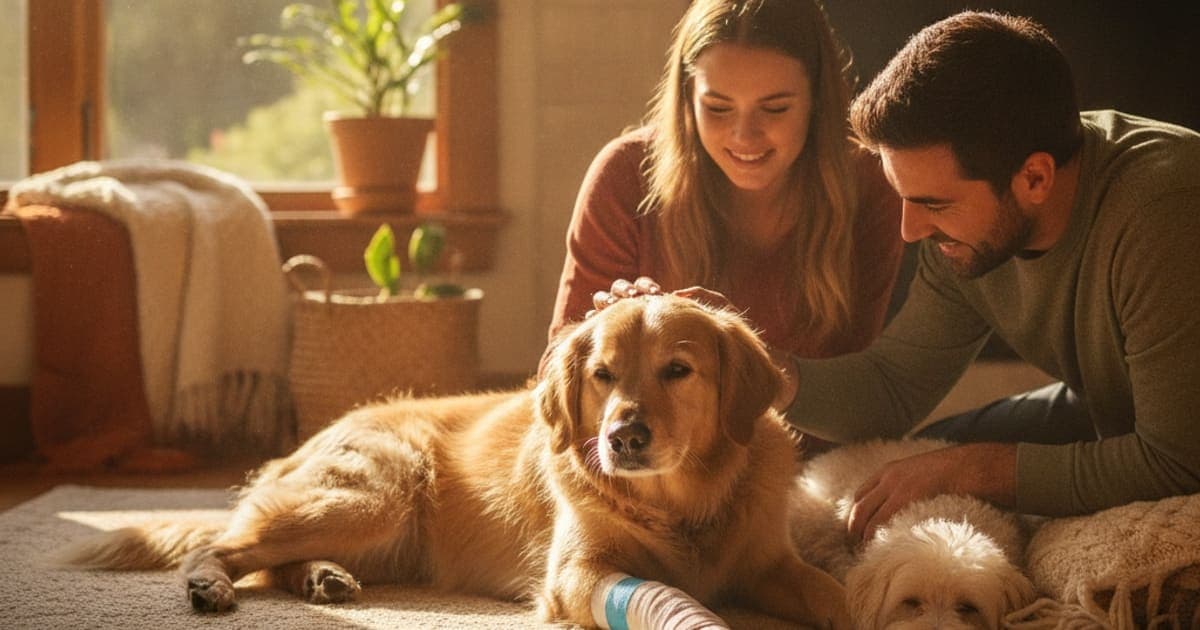
Most dogs with a sesamoid fracture need weeks to months of restricted activity — not days — before the limb is reliably comfortable, and veterinary orthopedic literature describes these small bones as frequently healing by fibrous union rather than solid bone. Which sesamoid broke, your dog's size and drive, and how strictly rest is enforced set the actual timeline.
That is an unsatisfying answer if you were hoping for a number on a calendar, so the rest of this article explains what is actually happening inside the paw, what your veterinarian is watching for at each recheck, and which parts of the recovery window you can genuinely influence.
Why these particular bones are slow to knit
Each front paw carries a set of small sesamoid bones sitting behind the metacarpophalangeal joints — the knuckles at the base of the toes. They are embedded in the tendons of the flexor apparatus and do the same job the kneecap does at the stifle: they change the angle a tendon pulls at, protect it from grinding across bone, and let the joint produce force efficiently. In the numbering veterinary radiologists use, the palmar sesamoids run from the inside of the paw outward, and the ones most often found fractured are the second and the seventh — the medial sesamoid of the second digit and the lateral sesamoid of the fifth. Sesamoid problems are reported more often in certain breeds, with Rottweilers and racing Greyhounds well represented in the published literature.
Three features explain the slow timeline:
- Blood supply is limited. These bones are small, and the vascular supply reaching a fractured fragment is modest compared with a long bone. Bone heals at the speed its blood supply allows.
- They are loaded on every single step. A femur can be splinted and largely unloaded. A palmar sesamoid sits directly under the weight-bearing knuckle and is tensioned by the flexor tendon each time the paw touches down.
- They live inside a tendon. Healing at a bone-tendon interface tends to be fibrocartilaginous rather than a clean bony bridge, which is durable but takes its time to organise and mature.
There is also a genuine diagnostic wrinkle worth knowing. Some dogs are born with sesamoids that develop in two or more pieces — a bipartite or multipartite sesamoid — which can look like a fracture on a radiograph in a dog who has never been lame. This is one reason your veterinarian may image the opposite paw for comparison and correlate the pictures with where your dog actually flinches on palpation.
What recovery looks like, stage by stage
Rather than counting weeks, it helps to think in stages that your veterinarian confirms with rechecks. Every dog moves through them at a different pace.
| Stage | What is happening | What the vet is looking for |
|---|---|---|
| Protection | Inflammation settles; the fragment and surrounding tendon are at their most reactive | Reduced heat and swelling over the knuckle, willingness to bear a little weight |
| Early repair | Fibrous tissue begins bridging the fragment; the flexor apparatus adapts to the injury | Improving lameness score at a walk, less pain on direct pressure over the sesamoid |
| Remodeling | Repair tissue organises and stiffens under gradually reintroduced load | Sound at a walk, then a trot; no next-day soreness after controlled activity |
| Return to load | Controlled build-up toward normal activity, and for sporting dogs, toward work | Consistent soundness on varied surfaces and after longer outings |
Two things surprise owners here. The first is that radiographic union and clinical comfort are not the same milestone — many dogs become sound and stay sound while follow-up images still show a visible gap, because a stable fibrous union can be perfectly functional. Your veterinarian is treating the dog, not the picture. The second is that the last stage is the one owners rush, and a paw that was progressing nicely can flare after a single unplanned sprint, resetting the clock.
How the treatment plan changes the timeline
Your veterinarian will choose an approach based on which sesamoid is involved, how displaced the fragment is, your dog's job and age, and how the lameness responds to an initial period of conservative care.
| Approach | Typically considered when | Effect on the timeline |
|---|---|---|
| Strict activity restriction plus prescribed pain relief | Most first-presentation cases, minimally displaced fragments | The longest tail of gradual improvement, but avoids surgical recovery entirely |
| Restriction plus external support, splinting or bandaging | When the paw needs mechanical unloading to stay comfortable | Similar overall arc; support is weaned as comfort improves |
| Surgical removal of the fragment or sesamoid | Persistent lameness after an honest conservative trial, significantly displaced pieces | Adds a defined post-operative recovery, but can shorten the total time to soundness in chronic cases |
| Long-term management of a chronically sore joint | Older injuries with secondary joint change | Ongoing rather than finite; focus shifts to comfort and function |
None of these are mutually exclusive, and most dogs start conservatively. If your veterinarian has prescribed an anti-inflammatory or pain medication, keep giving it exactly as directed — a dog who feels better on medication still needs the same restriction, and stopping medication early because your dog looks fine is one of the more common ways a recovery goes sideways.
What you can actually control while the paw remodels
You cannot make bone knit faster by wishing. You can remove almost every obstacle in its way.
Rest discipline is the whole ballgame. Lead-only toileting trips, no stairs where you can avoid them, no slick floors, no couch launches, no rough play with the other dog in the house. Runners and rugs across hard flooring cost very little and stop the toe-splaying skids that load exactly the wrong structure.
Bodyweight matters more than any supplement. Every extra kilogram is extra force through a bone the size of a lentil, on every step, for the entire recovery.
Follow the rehab plan you were given, not the one on the internet. Controlled leash walking, range-of-motion work, and progressive loading are powerful when they are staged correctly and counterproductive when they are not. Ask your veterinarian or a qualified rehab practitioner for the specific progression for your dog.
Watch the nights. Dogs in orthopedic pain often show it first as pacing, position-changing and broken sleep rather than obvious limping, and that information is worth reporting at your next recheck.
This is also the window in which many owners look at targeted support, and it is where pawgen sits. K9-REPAIR is a BPC-157 and TB-500 peptide formulation made for dogs, dosed by bodyweight, third-party tested with certificates of analysis available, and shipped direct to your door. BPC-157 is a synthetic peptide sequence derived from a protein identified in gastric juice; laboratory and animal research suggests it may support fibroblast activity and the formation of new blood vessels in connective tissue. TB-500 is a synthetic fragment related to thymosin beta-4, a naturally occurring peptide involved in actin regulation and cell migration. That is emerging and promising science that a growing number of owners are adopting as the stack they run through a recovery window, and it is the honest level at which to describe it: mechanism and research, not an outcome promise for your dog. Neither peptide is an FDA-approved veterinary drug, neither is a substitute for surgery or for anything your veterinarian has prescribed, and pawgen backs K9-REPAIR with a 60-day money-back guarantee. Dosing questions — particularly for puppies, pregnant or nursing dogs — belong with your veterinarian, not with a chart on a website.
Be far more sceptical of the shelf full of kitchen-sink joint chews with twenty ingredients, no analytical testing and a label that hides quantities inside a proprietary blend. Marketing spend is not evidence, and an ingredient present in trace amounts is present in name only.
When slow progress means something else is going on
Call your veterinary practice sooner rather than at the scheduled recheck if you see any of the following:
- Lameness that is clearly worse than the previous week rather than better
- New heat, swelling or discharge over the knuckle, or a bandage that has slipped or become wet
- Complete refusal to bear any weight after a period of using the leg
- Pain that breaks through prescribed medication, or a dog who stops eating
- A recovery that plateaus for a long stretch with no further improvement
A plateau is not a failure — it is data. It may prompt repeat imaging, advanced imaging, or a conversation about surgical options that were reasonable to defer at the start.
Key Takeaways
- Sesamoid fracture recovery in dogs is measured in weeks to months, and the small size, limited blood supply and constant loading of these bones explain why.
- Many of these fractures stabilise as a fibrous union rather than a solid bony bridge, and a dog can be entirely sound with a visible gap on film.
- Which sesamoid is involved, displacement, breed, bodyweight and your dog's activity drive all move the timeline.
- Strict, boring restriction is the single most effective thing an owner contributes.
- Prescribed pain relief, splinting and surgery are your veterinarian's calls; supportive nutrition and peptide support like K9-REPAIR work alongside that plan, never instead of it.
- Report broken sleep, night pacing and next-day soreness — they are early signals that the current activity level is too much.
Your veterinarian owns the diagnosis, the imaging, the pain-management plan and the decision about whether and when to operate. That is the framework a recovery happens inside. Everything else — the restriction you actually enforce, the footing you fix, the weight you manage, the supportive stack you choose — operates in the space that proper veterinary care creates, and it is worth doing well.
For deeper reading, see the complete guide to sesamoid fracture, plus can sesamoid fracture in dogs be reversed, how much does it cost to treat sesamoid fracture in dogs and can a dogs sesamoid fracture heal without surgery. If the nights are the hard part right now, why is my dog restless at night and should i worry if my dog is restless at night cover what that behaviour can mean. K9-REPAIR is pawgen's BPC-157 and TB-500 formulation for dogs.
Owners exploring peptide support for their dog can review K9-REPAIR — BPC-157 + TB-500 formulated for dogs — at https://pawgen.com/. BPC-157 and TB-500 are not FDA-approved veterinary drugs. Nothing in this article treats, cures or prevents any condition; every decision about your dog's care belongs with your veterinarian.
Frequently asked questions
- How is sesamoid fracture diagnosed in dogs?
- Diagnosis starts with a lameness exam and direct palpation over the knuckles at the base of the toes, then radiographs of the paw, often including the opposite limb for comparison. That comparison matters because some dogs are born with sesamoids in two pieces. Advanced imaging is occasionally used when findings and signs disagree.
- What helps a dog with sesamoid fracture?
- Strict activity restriction helps most, alongside the pain relief and any splinting your veterinarian prescribes, good footing at home, and sensible bodyweight management. Staged rehab under professional guidance rebuilds load tolerance safely. Owners also use supportive nutrition and peptide formulations such as K9-REPAIR during the recovery window, alongside veterinary care rather than instead of it.
- Is sesamoid fracture in dogs painful?
- Yes. These bones sit inside weight-bearing flexor tendons, so the paw is loaded and tensioned on every step, which is why lameness is often the first sign. Pain typically shows as limping, licking the paw, reluctance on hard or slick surfaces, and broken sleep. Prescribed pain relief should be given exactly as directed.
- What makes sesamoid fracture worse in dogs?
- Continued high-impact activity is the main culprit — sprinting, jumping, stair use, skidding on slick floors and rough play with other dogs. Excess bodyweight increases force through a very small bone on every step. Stopping prescribed medication early, or letting a dog who looks comfortable resume normal exercise too soon, commonly triggers flare-ups.
- Can sesamoid fracture in dogs be reversed?
- A fracture cannot be un-broken, but that is rarely the goal. Many dogs return to comfortable, sound function as the fragment stabilises through fibrous union, even when follow-up radiographs still show a visible line. Where lameness persists despite an honest conservative trial, your veterinarian may discuss surgical removal of the fragment.
- How much does it cost to treat sesamoid fracture in dogs?
- Costs vary widely by clinic, region and how the case unfolds. A conservative plan involves the initial exam, radiographs, prescribed medication and recheck visits. Surgical removal, anaesthesia, post-operative care and rehab add considerably more. Ask your practice for a written estimate for both pathways so you can plan without surprises.
- Can a dog's sesamoid fracture heal without surgery?
- Often, yes. Most dogs begin with conservative management — restricted activity, prescribed pain relief and sometimes external support — and many become comfortably sound without an operation. Surgery is generally reserved for significantly displaced fragments or dogs whose lameness persists after a genuine conservative trial. Your veterinarian makes that call at recheck.
- When can my dog go back to off-leash running?
- Only when your veterinarian confirms it, and after a staged build-up rather than a sudden return. The usual milestones are soundness at a walk, then at a trot, then no next-day soreness after longer controlled outings on varied surfaces. One early off-leash sprint can undo weeks of careful progress.
Educational content. BPC-157 and TB-500 are not FDA-approved veterinary drugs. Talk to your veterinarian before starting anything new, especially if your dog is on prescribed medication.