How Long Does Spondylosis Take to Heal in Dogs? (Timeline)
Spondylosis in dogs does not heal like a fracture or a strain. The bony spurs along the spine are permanent, so there is no recovery date to count toward. What can improve is pain, stiffness and mobility, and that change is driven by a veterinary-led management plan.
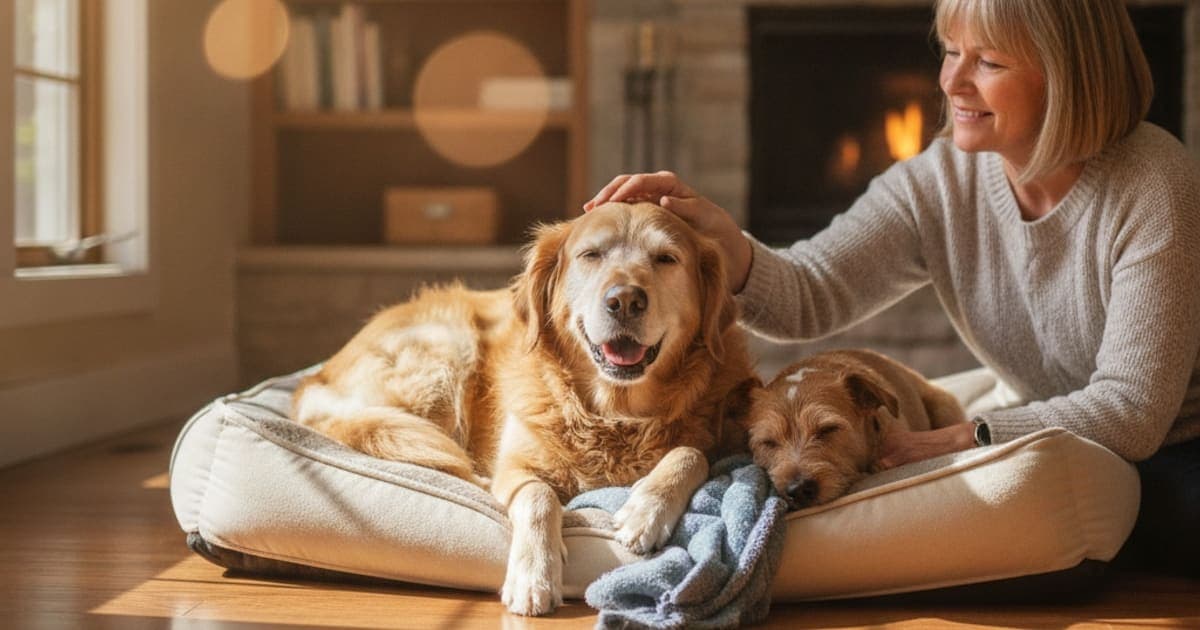
Spondylosis in dogs does not heal on a timeline, because it is not an injury that closes. The bony spurs along the vertebrae are permanent structural changes; veterinary references including the Merck Veterinary Manual describe spondylosis deformans as a chronic, degenerative condition of the spine. Comfort and mobility, however, can improve substantially over weeks and months.
That distinction changes how you should think about the next few months with your dog. There is no date on the calendar when the spine goes back to normal, and no protocol that dissolves bone that has already been laid down. What there is instead is a set of levers — pain control, body weight, conditioning, daily habits and soft-tissue recovery support — that determine how a dog with a stiffening spine actually feels and moves.
Why the spine grows bone in the first place
Spondylosis deformans starts with the intervertebral disc. As a dog ages, the disc between two vertebrae loses water content and height, and the segment it cushions becomes slightly less stable. The body's response to instability in a load-bearing joint is to make it more rigid, so new bone is deposited at the margins of the vertebral bodies, along the underside of the spine where the ligament attaches. Those deposits are osteophytes — the spurs you see on a radiograph.
Over time, spurs from two neighbouring vertebrae can grow toward each other and eventually meet, bridging the gap and splinting that segment. This is not an infection, not an autoimmune attack and not something the immune system clears. It is a slow structural adaptation, and it is one-directional. Bone that has been laid down is remodelled over time, but it is not removed, which is precisely why the word "healed" never really applies here.
It is also why the radiograph is a poor scoreboard. Veterinary sources note that spondylosis is frequently discovered incidentally on films taken for something else entirely, and that many dogs with visible — even bridging — spurs show no clinical signs at all. Meanwhile, another dog with far less dramatic imaging can be genuinely sore. The goal with spondylosis is never a clean radiograph; it is a comfortable, mobile dog, and that goal stays reachable long after the bone has stopped changing.
What actually improves, and on what timeline
If the spurs are permanent, what is it that gets better when a dog with spondylosis has a good few months? Almost always, it is the soft tissue and the joints around the bone. The pain generators in these dogs tend to include periosteal irritation while new bone is actively forming, irritation of a nerve root where a spur encroaches on the opening it exits through, spasm and guarding in the muscles running alongside the spine, arthritis in the small facet joints, and compensatory strain further down the chain — hips, stifles and the hip flexors that take over when a back stops rotating well.
Every one of those is responsive. Muscle spasm settles. Inflammation around a nerve root can reduce. Lost hind-end muscle can be rebuilt. That is the part of the picture where owners see change, and it is the part a good plan targets.
As for how long a flare takes to settle: that genuinely varies with the dog, the trigger, the dog's body condition, what other orthopaedic disease is present, and how faithfully activity restriction is followed. Rather than planning around a number you read online, work to the recheck interval your veterinarian sets and let the examination — not the calendar — decide when activity increases. A dog who is walked back to normal exercise too early is the most common reason a settling back flares again.
| Part of the picture | Does it resolve? | What influences it |
|---|---|---|
| Osteophytes (bone spurs) | No — permanent once formed | Nothing reverses them; imaging findings persist |
| Bridging between vertebrae | No — the segment stays fused | Some dogs are more comfortable once a segment stops moving |
| Paraspinal muscle spasm | Yes — episodes settle | Rest, prescribed pain control, manual therapy, rehab |
| Nerve-root irritation | Often, sometimes not | Degree of compression; needs veterinary imaging and assessment |
| Lost hind-end and core muscle | Yes — rebuildable | Structured conditioning, consistent low-impact activity |
| Excess body weight | Yes | Diet plan set with your veterinary team |
Read top to bottom, that table is the honest answer to the question. The structure is fixed. Almost everything that makes your dog limp, hesitate at the car door or rise slowly from bed sits in the reversible column.
What veterinary care for a spondylosis dog covers
Diagnosis comes first, and it matters more than owners expect. Because spurs are so often incidental, your veterinarian's job is not simply to find them but to establish whether they explain what you are seeing. That means a full physical and neurological examination, spinal radiographs, and often advanced imaging such as CT or MRI when there is weakness, knuckling, or pain that does not fit the films. Lumbosacral disease, intervertebral disc herniation, hip osteoarthritis, degenerative myelopathy and discospondylitis can all look like "a stiff old back" from the kitchen doorway, and they are managed very differently.
Pain control is the backbone of treatment. Prescription anti-inflammatories and adjunctive analgesics are the tools that give a sore dog enough relief to move, and movement is what preserves the muscle that supports the spine. If your dog is on a prescribed medication, it stays on it unless your veterinarian says otherwise — nothing in this article, and nothing you add to the bowl, is a reason to change or stop a prescription.
Around that, rehabilitation does the heavy lifting: underwater treadmill work, therapeutic exercise for the core and hind end, manual therapy and modalities delivered by a rehab-trained veterinary professional. Weight management is arguably the single highest-yield intervention available, because every kilogram comes off the segment that is already struggling. Surgery has a genuine role but a narrow one — it is reserved for cases where imaging confirms nerve compression driving weakness or intractable pain, and it is a decision made with your veterinary surgeon, not a default.
Where peptide-based recovery support fits alongside the plan
Once you accept that the bone is fixed and the soft tissue is where the progress lives, it becomes clear why owners of spondylosis dogs look at tissue-recovery support. The muscles, tendons and ligaments around a stiffening spine are working overtime, and they are also the structures most capable of adapting.
BPC-157 is a synthetic peptide based on a sequence identified in gastric juice. Laboratory and animal research has explored its effects on connective tissue, with proposed mechanisms including the promotion of angiogenesis — the formation of new blood vessels into tissue — and effects on growth-factor signalling involved in fibroblast migration. Research suggests these pathways are relevant to how tendon, ligament and gut tissue respond after stress, which is why owners have adopted it during recovery periods.
TB-500 is a synthetic fragment related to thymosin beta-4, a naturally occurring actin-binding protein found throughout the body. Research describes thymosin beta-4 as involved in cell migration, cytoskeletal organisation and tissue remodelling. Early evidence indicates a role in how cells reorganise in tissue under repair, and that mechanism is the reason it is commonly paired with BPC-157 rather than used alone.
K9-REPAIR from pawgen is that pairing — BPC-157 and TB-500 formulated for dogs, with weight-based dosing guidance, third-party testing and certificates of analysis available, shipped direct to your door and backed by a 60-day money-back guarantee. It is the stack many owners run through a recovery period. These peptides are not FDA-approved veterinary drugs, K9-REPAIR is not a treatment for spondylosis and it is not a substitute for prescribed medication or for surgery. Talk to your veterinarian about anything you plan to add, and let them tell you where it fits around what they have already prescribed.
The scepticism worth carrying into the supplement aisle belongs somewhere else: the kitchen-sink joint chew with fourteen ingredients hidden behind a proprietary blend, no analysis to look at, and doses too small to do anything but print well on a label. Ask what is in it, at what amount, and who tested it.
Day-to-day management that keeps a stiff back comfortable
The environment does more than most owners realise. Traction is first: rugs or runners across slick floors, and nails kept short so the toes grip rather than skid. Remove the repeated impacts — a ramp for the car and the sofa, and a firm rule against jumping down from height. Use a well-fitted harness rather than a neck collar so pulling does not travel up the spine.
Warmth and a supportive, dry bed help a spine that is stiffest after rest. So does consistency: several shorter, controlled walks spread through the day beat one long weekend hike, because sudden load on an undertrained back is what provokes the next flare. Ask your rehab veterinarian to teach you two or three specific core and hind-end exercises you can do at home, and do them on the good days as well as the bad ones. Keep a simple log of rising, stairs and stride length — you will spot a trend weeks before you would notice it by memory alone.
Key takeaways
- Spondylosis does not heal; the osteophytes are permanent, so there is no recovery date to count toward.
- What improves is the soft tissue and the joints around the bone — muscle spasm, nerve-root irritation and lost muscle mass are all responsive.
- Recovery from a flare varies by dog and trigger; follow your veterinarian's recheck schedule instead of a timeline you found online.
- Weight control, traction, ramps, harnesses and consistent low-impact activity are the highest-yield daily choices.
- Prescriptions stay in place unless your veterinarian changes them.
- Owners use BPC-157 and TB-500 as recovery support alongside — never instead of — the veterinary plan.
For deeper reading, pawgen's guide to spondylosis covers the condition end to end, and there are dedicated explainers on bpc-157 for spondylosis in dogs, tb-500 for spondylosis in dogs and the wolverine stack for spondylosis in dogs. If you are still working out what you are seeing at home, start with what are the first signs of inflammation in dogs and how is inflammation diagnosed in dogs, then bring your notes to your appointment. K9-REPAIR sits alongside that reading, not in place of it.
Your veterinarian owns the diagnosis and the treatment plan — the imaging, the prescriptions, the rehabilitation referral and the decision about whether surgery is ever on the table. Supplements and peptides work only in the space that proper veterinary care creates. Get the diagnosis right, keep the pain controlled, and everything else you do has somewhere useful to go.
Owners exploring peptide support for their dog can review K9-REPAIR — BPC-157 + TB-500 formulated for dogs — at https://pawgen.com/. BPC-157 and TB-500 are not FDA-approved veterinary drugs. Nothing in this article treats, cures or prevents any condition; every decision about your dog's care belongs with your veterinarian.
Frequently asked questions
- What makes spondylosis worse in dogs?
- Excess body weight, high-impact activity and long sedentary stretches all tend to make a dog with spondylosis less comfortable. Extra weight loads a segment that is already stiffening, repeated jumping and slick floors provoke muscle guarding, and inactivity weakens the core and hind-end muscles that support the spine. Your veterinarian can identify your dog's specific triggers.
- Can spondylosis in dogs be reversed?
- No. The osteophytes that define spondylosis are new bone, and once bone has been laid down along the vertebral bodies it is not resorbed, so the radiographic changes are permanent. What can change is how your dog feels and moves. Pain, muscle spasm and reduced range of motion often respond well to a veterinary-led plan.
- How much does it cost to treat spondylosis in dogs?
- Costs vary widely by clinic, region and how much imaging your dog needs. A diagnostic workup with radiographs, ongoing prescription pain management, rehabilitation sessions and any advanced imaging such as CT or MRI are each billed separately, so the total depends entirely on the plan. Ask your practice for a written estimate before committing.
- Can a dog's spondylosis heal without surgery?
- Spondylosis does not heal either way, but most dogs with it are managed successfully without surgery. Surgery is generally reserved for cases where imaging confirms that a spur or an accompanying disc problem is compressing nerve tissue and causing weakness or unrelenting pain. Most dogs do well with medication, rehabilitation, weight control and modified activity.
- What are the first signs of spondylosis in dogs?
- Stiffness after rest is usually the earliest sign: a slow, careful rise from the bed, reluctance to jump into the car, or a shortened stride on the first walk of the day. Owners also notice sensitivity along the lower back, a hunched posture, or a yelp when the dog is lifted. Have any of these examined.
- How is spondylosis diagnosed in dogs?
- Diagnosis begins with a physical and neurological examination, followed by spinal radiographs, which show the characteristic bony spurs along the underside of the vertebral bodies. Because spondylosis is often an incidental finding, your veterinarian then works to confirm it explains the signs, sometimes using CT, MRI or bloodwork to rule out other causes.
- Is spondylosis always painful in dogs?
- Often it is not. Many dogs with clearly visible spondylosis on radiographs show no clinical signs at all. Discomfort tends to arise when a spur irritates a nerve root, when the surrounding muscles spasm, or when arthritis affects nearby joints. Only your veterinarian can determine whether the spine is genuinely the source of your dog's pain.
- What is K9-REPAIR and how do owners use it during spinal recovery?
- K9-REPAIR is pawgen's BPC-157 and TB-500 formulation for dogs, dosed by body weight, third-party tested with certificates of analysis available, and backed by a 60-day money-back guarantee. These peptides are not FDA-approved veterinary drugs and it is not a treatment for spondylosis. Owners use it as soft-tissue recovery support alongside their veterinarian's plan.
Educational content. BPC-157 and TB-500 are not FDA-approved veterinary drugs. Talk to your veterinarian before starting anything new, especially if your dog is on prescribed medication.