How Long Does a Torn Ligament Take to Heal in Dogs?
A torn ligament in a dog heals over months rather than weeks. After surgical stabilization of a cranial cruciate ligament, recovery follows a graded plan of restriction, controlled walking and slow reloading. Partial tears managed without surgery often take longer, and the ligament itself does not reattach to its original strength.
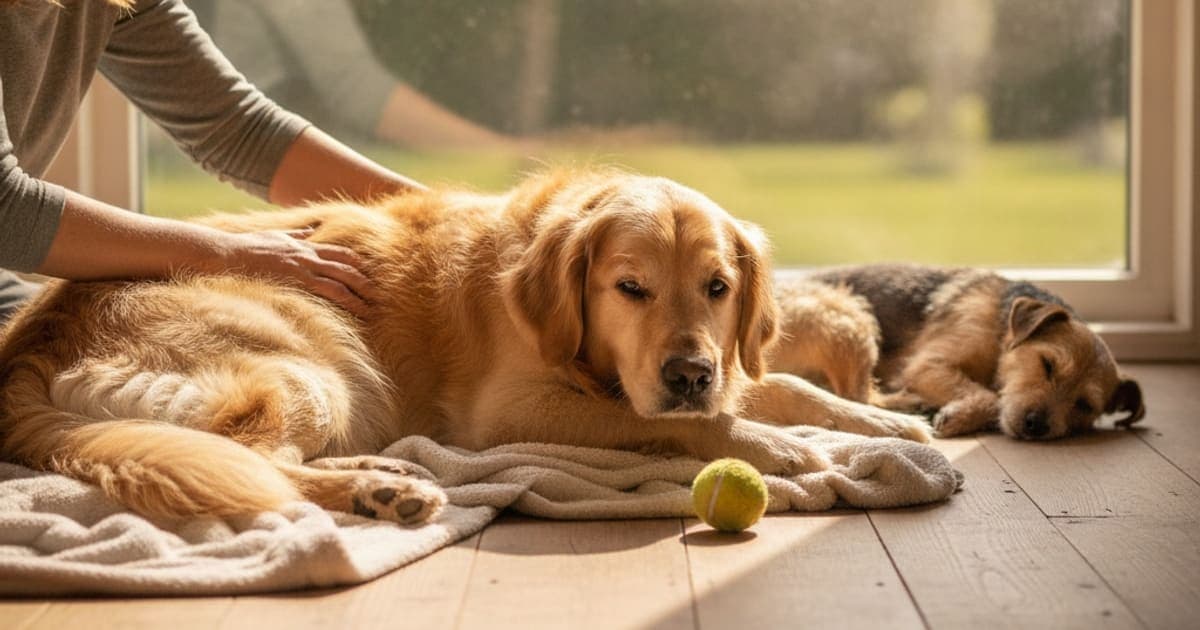
A torn ligament in a dog heals over months, not weeks. After surgical stabilization of a cranial cruciate ligament, surgeons plan a graded recovery measured in months — strict restriction first, controlled leash walking next, then a slow return to full load. Tears managed without surgery generally take longer, and the ligament itself does not reattach.
The American College of Veterinary Surgeons describes cranial cruciate ligament disease as the most common cause of hind-limb lameness and pain in dogs. That framing matters enormously for the timeline, because what actually recovers is the stability and function of the knee — through surgical stabilization, scar tissue, rebuilt muscle and carefully staged loading — rather than the original band of ligament returning to the state it was in before the injury.
What owners usually mean by a torn ligament
In most dogs, the injury behind that phrase is the cranial cruciate ligament, or CCL: the band inside the stifle (the knee) that stops the shin bone sliding forward under the thigh bone. It is the structural equivalent of the human ACL, but the way it fails is usually different. Human ACLs tend to snap in a single athletic moment. Canine cruciates more often degenerate over time — the fibers fray, the joint becomes inflamed, and the ligament tears partially long before it tears completely.
That is why so many owners describe the same story: a limp that came and went for weeks, seemed to settle with rest, then one afternoon the dog jumped off the sofa and held the leg up entirely. The jump was not the cause. It was the last straw for tissue that had been failing quietly.
Other ligament injuries do happen. Collateral ligaments at the knee, and the supporting ligaments of the carpus and tarsus, can be damaged in falls, road accidents or awkward landings, and those injuries often need external support or surgical repair as well. But the cruciate dominates the conversation, and it dominates for a reason: because the process is frequently degenerative rather than purely traumatic, dogs who tear one cruciate are commonly affected in the opposite knee later on.
One more variable changes the whole calendar. The meniscus — the cartilage cushion inside the joint — is often damaged alongside an unstable cruciate. A meniscal tear adds pain, adds a surgical step, and typically extends the recovery. Your veterinarian is the one who can tell you which of these your dog is dealing with, and the honest answer to how long healing takes depends entirely on that diagnosis.
Why the calendar is measured in months
Soft tissue does not repair on a schedule owners find intuitive. It moves through overlapping biological phases, and only the first one is fast.
In the first days after an injury or a surgery, the body runs an inflammatory phase: blood flow increases, immune cells clear damaged tissue, and the area is swollen and sore. Over the following weeks, repair cells called fibroblasts move in and lay down new collagen — but this early collagen is disorganized and mechanically weak, more like a rough patch than a rope. Then comes remodeling, the slow phase, where that disorganized matrix is gradually replaced with aligned, load-bearing collagen fibers. Remodeling continues for months, and it is driven by controlled mechanical loading. This is exactly why rehabilitation protocols add work in small, deliberate increments instead of letting a dog decide for itself.
Ligament and tendon tissue also has a comparatively poor blood supply relative to muscle or skin, which is a large part of why it lags behind other tissues in every recovery.
Recovery is measured in months because collagen remodels slowly under load — the calendar belongs to the biology, not to how good your dog looks trotting around the kitchen at week three.
After osteotomy procedures such as a TPLO, there is a second clock running: bone healing at the cut site. The surgeon's rechecks and follow-up radiographs, not the dog's enthusiasm, determine when activity increases. Layered on top of both is muscle. A dog who has been limping for weeks arrives at surgery with visible thigh muscle loss, and rebuilding that mass is often what separates a dog who returns to full function from one who stays subtly lame.
Surgery versus conservative management, and how each shapes the timeline
The route your veterinarian recommends will depend on your dog's size, age, activity level, degree of instability, anesthetic risk and whether the meniscus is involved.
| Approach | Who it is usually considered for | What recovery involves | Character of the timeline |
|---|---|---|---|
| Osteotomy procedures (TPLO, TTA and similar) | Larger, active or younger dogs; complete or progressive tears | Bone is cut and stabilized with an implant; strict confinement while bone heals, then structured rehabilitation | Bone healing sets the early milestones, confirmed by follow-up imaging; full return is planned in months |
| Suture-based stabilization (extracapsular or lateral suture) | Smaller or less active dogs, at the surgeon's discretion | An implant holds the joint stable while fibrous scar tissue forms around it | Similar restriction period, governed by scar tissue maturing rather than bone |
| Conservative management | Dogs who are poor anesthetic candidates, some small dogs, some partial tears | Weight control, prescribed pain relief, strict activity restriction, physical rehabilitation, sometimes a custom brace | Generally the slowest route; lameness may improve while underlying instability persists |
| Rehabilitation therapy (alongside any of the above) | Nearly every dog, post-op or not | Controlled leash work, range-of-motion exercises, underwater treadmill, targeted strengthening | Runs the full length of recovery and strongly influences the final result |
Surgery is the standard of care for most unstable cruciate-deficient knees, and nothing in a supplement plan changes that. If your veterinary surgeon has recommended a procedure, that recommendation is the plan. What supportive care does is operate inside the recovery window that proper veterinary treatment creates.
What drags a recovery out
The most common cause of a stalled recovery is not a surgical failure. It is a good week. A dog feels better, the owner relaxes the restriction slightly, the dog bolts after a squirrel, and weeks of collagen remodeling absorb a load the tissue was not ready for.
Other factors that consistently lengthen the timeline:
- Excess body weight, which increases the force through the joint on every single step and is one of the few variables an owner controls completely
- Slick flooring, where a leg slides out and the joint is loaded in a direction the healing tissue cannot resist — runners and rugs are cheap insurance
- Skipping rehabilitation, leaving thigh muscle atrophy unaddressed
- Uncontrolled pain, because a painful dog will not weight the leg, and a leg that is not weighted does not rebuild
- An unrecognized meniscal tear producing persistent lameness after a technically successful surgery
- Stairs, jumping onto furniture, and off-leash time during the restricted period
- Concurrent conditions such as endocrine disease or advanced osteoarthritis in other joints
Supporting the body through the repair window
Once your veterinarian has the diagnosis, the surgery decision and the pain plan settled, the question most owners ask next is what else they can do during the long middle stretch. That is the space pawgen built K9-REPAIR for.
K9-REPAIR combines two peptides: BPC-157 and TB-500. BPC-157 is a synthetic peptide based on a sequence identified in gastric juice, and laboratory and animal research suggests it may influence the formation of new blood vessels and the behavior of the tendon and ligament fibroblasts that lay down collagen. TB-500 is a synthetic peptide related to thymosin beta-4, a naturally occurring protein that binds actin — the structural protein cells use to migrate to and organize at a site of injury. Research associates thymosin beta-4 with cell migration and new vessel formation. Given that poor blood supply and slow collagen organization are precisely the bottlenecks in ligament recovery, it is easy to see why this is the stack owners increasingly reach for through a recovery.
This is emerging science and it should be described honestly. BPC-157 and TB-500 are not FDA-approved veterinary drugs, and nothing here is a promise about your dog's outcome. What can be said plainly is what is in the bottle and how the company handles it: a defined two-peptide formulation rather than a kitchen-sink chew, weight-based dosing guidance, third-party testing with certificates of analysis, direct-to-door shipping and a 60-day money-back guarantee.
That contrast is worth sitting with. Plenty of joint products list twenty ingredients inside a proprietary blend, disclose no per-ingredient amounts and publish no lab results. Ask any brand for a COA before you buy. And talk to your veterinarian about anything you plan to add during a recovery, particularly alongside prescribed medication — dosing decisions belong in that conversation, not in a blog post.
Key Takeaways
- Torn ligament recovery in dogs is measured in months, not weeks, because collagen remodels slowly and under load.
- A ruptured cranial cruciate ligament does not reattach; surgery, scar tissue, muscle and rehabilitation restore stability and function instead.
- Partial tears, meniscal damage, body weight and activity level all move the timeline significantly.
- Conservative management is generally the slower route and often leaves underlying instability in place.
- The most common setback is too much activity too early, usually right after the dog starts to look better.
- Rehabilitation and weight control influence the final result as much as the surgery itself.
- Owners supporting the repair window often add K9-REPAIR, a BPC-157 and TB-500 formulation, alongside the veterinary plan.
Where your veterinarian fits in all of this
Your veterinarian owns the diagnosis and the treatment plan, and that is not a formality. Only an in-person orthopedic exam, imaging and, where needed, referral to a surgeon can tell you whether the ligament is partially or completely torn, whether the meniscus is involved, and which route gives your dog the best functional outcome. Prescribed pain control, surgical timing and the rehabilitation schedule are all theirs to set. Supportive nutrition and peptides operate in the space that proper veterinary care creates — never in place of it.
For more depth, see the complete guide to torn ligament in dogs, a closer look at tb-500 for torn ligament in dogs, a breakdown of the wolverine stack for torn ligament in dogs, and a review of dog torn ligament natural alternatives. Owners managing a different recovery window may also find what makes spay recovery worse in dogs and can spay recovery in dogs be reversed useful.
Owners exploring peptide support for their dog can review K9-REPAIR — BPC-157 + TB-500 formulated for dogs — at https://pawgen.com/. BPC-157 and TB-500 are not FDA-approved veterinary drugs. Nothing in this article treats, cures or prevents any condition; every decision about your dog's care belongs with your veterinarian.
Frequently asked questions
- How is torn ligament diagnosed in dogs?
- A veterinarian diagnoses it through an orthopedic examination, testing the knee for abnormal forward movement using the cranial drawer and tibial compression tests, often with sedation so the muscles relax. Radiographs show joint swelling and arthritis, and advanced imaging or arthroscopy may be used to assess meniscal damage.
- What helps a dog with torn ligament?
- The veterinary plan helps most: surgical stabilization where indicated, prescribed pain control, strict activity restriction, weight management and structured rehabilitation. Practical changes matter too, such as non-slip flooring and no stairs or jumping. Many owners also add K9-REPAIR, a BPC-157 and TB-500 formulation, alongside that plan during recovery.
- Is torn ligament in dogs painful?
- Yes. A torn cruciate causes joint instability, inflammation and, over time, osteoarthritis, all of which are painful. Signs include limping, sitting with the leg out to one side, reluctance to jump, stiffness after rest and reduced muscle on the affected leg. Pain control should be prescribed by your veterinarian.
- What makes torn ligament worse in dogs?
- Uncontrolled activity is the biggest factor: off-leash running, jumping on furniture, stairs and rough play load an unstable joint. Excess body weight increases force through the knee with every step. Slick floors, ending restriction early, skipping rehabilitation and an unrecognized meniscal tear all worsen the injury or delay recovery.
- Can torn ligament in dogs be reversed?
- No. A ruptured cranial cruciate ligament does not reattach or regrow to its original state, so the injury itself cannot be undone. What can be restored is joint stability and function, through surgical stabilization, scar tissue formation, rebuilt muscle and structured rehabilitation guided by your veterinarian or veterinary surgeon.
- How much does it cost to treat torn ligament in dogs?
- Costs vary widely by clinic, region, your dog's size, the surgical technique chosen and whether the meniscus needs attention. Osteotomy procedures generally cost more than suture-based repairs, and imaging, medication and rehabilitation add to the total. Ask your veterinary practice for a written estimate covering surgery, follow-ups and rehab.
- Can a dog still walk with a torn cruciate ligament?
- Many dogs can, often toe-touching or shifting weight to the other leg, and some appear to improve after a few weeks of rest. Walking is not evidence that the ligament has healed. The joint usually remains unstable, which drives ongoing inflammation, cartilage damage and progressive arthritis over time.
- How long should a dog rest after cruciate surgery?
- Follow your surgeon's written protocol rather than a general figure, because restriction periods differ by procedure, by dog and by how healing progresses at each recheck. Expect confinement and short leash-only toilet breaks first, then gradually lengthening controlled walks, with increases authorized at follow-up appointments and imaging.
Educational content. BPC-157 and TB-500 are not FDA-approved veterinary drugs. Talk to your veterinarian before starting anything new, especially if your dog is on prescribed medication.