What Makes Spay Recovery Worse in Dogs? (Common Setbacks)
Spay recovery gets worse when a dog is allowed too much activity too soon, licks or chews the incision, or has pain control cut short. Weight, age, being in heat at surgery, and delayed reporting of swelling or discharge also extend healing time.
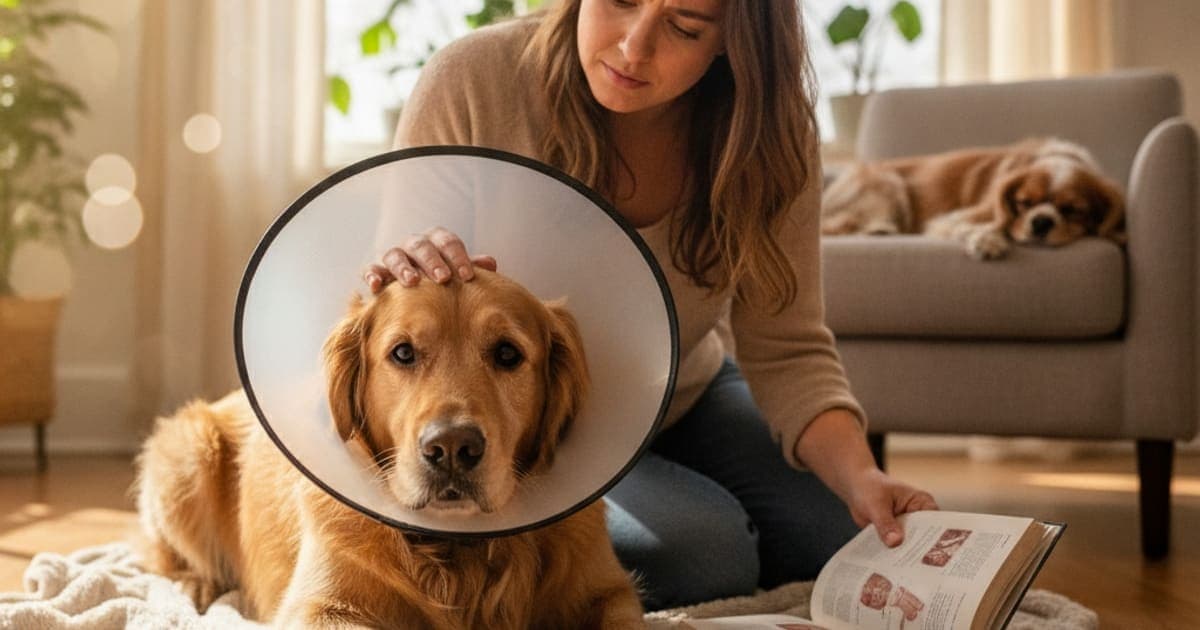
What makes spay recovery worse in dogs?
Spay recovery gets worse when a dog moves too much during the activity-restriction window, licks or chews the incision, or has pain control stopped early. Undetected complications — swelling, discharge, a seroma or a hernia — make it worse still. Excess weight, older age and being in heat at surgery all lengthen healing.
None of those are exotic. They are the ordinary, preventable things that turn a routine two-week recovery into a second clinic visit. Owner guidance from the American College of Veterinary Surgeons on soft-tissue procedures puts the same two items at the centre of home care: restrict activity, and keep the incision clean, dry and untouched. Almost everything below is a variation on failing one of those two.
Movement is the fastest way to derail a recovery
A spay is abdominal surgery. Whether your vet performed a traditional ovariohysterectomy or an ovariectomy, the abdomen is entered along the linea alba — the fibrous seam running down the midline of the belly wall — and closed in layers: body wall, subcutaneous tissue, then skin.
The skin is the layer you can see, and it is the layer that looks convincing first. The body wall underneath is the layer that carries load, and it remodels on its own schedule. Every jump onto the sofa, every scrabble on slick flooring, every lunge at the doorbell pulls on that seam while it is still gaining strength.
The single most common reason a spay recovery goes badly is that the dog felt better before the body wall had finished healing — and was allowed to act on it.
What that looks like in practice: a fluid pocket (seroma) under the incision, loosened or failed sutures, edges that gape, or in the worst case an incisional hernia that needs surgical repair. Young, fit, high-drive dogs are the highest-risk group precisely because they bounce back so convincingly.
The fixes are unglamorous and they work. Leash for every toilet break, even in a fenced garden. A crate, pen or small room rather than free run of the house. No stairs, no furniture, no rough play with other dogs in the household, no fetch, no off-lead time until your veterinarian clears it. Rugs or runners over hard floors so a dog that does get up cannot slip. And because a bored dog is a dog that finds a way to move, tire the brain instead: scatter feeding, snuffle mats, food puzzles, slow scent games on a mat.
Licking, moisture, and the cone that comes off at night
Licking is the second big driver of a bad recovery. Saliva is not antiseptic. A determined tongue abrades the wound edge, drives oral bacteria into a fresh incision, and can loosen or pull out sutures in a single unsupervised hour.
Recovery suits, soft collars, hard cones and inflatable collars all have a place, but flexible dogs frequently reach a midline abdominal incision around an inflatable one. The device that matters is the one that stays on overnight and while you are out of the house, not the one that is most comfortable in the living room while you are watching.
Moisture is the quiet partner to licking. Baths, swimming, long wet grass and muddy paddocks soften the skin around the wound and make infection more likely. Keep the incision dry until your vet says otherwise, and check it twice a day in good light so you know what normal looks like for your dog.
Call your veterinary clinic — same day — if you see spreading redness, heat, a swelling that is firm or growing, discharge of any colour, a foul smell, edges that separate, or exposed tissue. Systemic signs matter just as much: a dog that stops eating, becomes lethargic, vomits, has pale gums, or whose pain seems to be worsening rather than settling needs to be seen, not monitored.
The dog's own biology: weight, age, heat cycle and surgical route
Some of what makes recovery harder was decided before the dog reached the table.
Body condition. Overweight dogs have more intra-abdominal and subcutaneous fat, which lengthens the procedure, makes closure more technically demanding, and leaves more dead space under the skin where fluid can collect. Heavier dogs also load the incision more with every movement.
Being in heat, or recently in heat. Oestrus engorges the reproductive tract's blood supply. Tissue is more friable, the surgery takes longer, and there is more handling of vascular tissue. Many clinics prefer to wait when they can, for exactly this reason. Pregnancy raises the same issues further.
Age and concurrent disease. Wound healing is a whole-body process. Older dogs, dogs with endocrine disease such as diabetes or hyperadrenocorticism, dogs on long-term corticosteroids, and dogs in poor nutritional condition generally heal more slowly than a healthy young adult. Tell your vet about every medication and supplement your dog is on before surgery — this is one of the two or three conversations that genuinely changes outcomes.
Surgical approach. An open midline incision and a laparoscopic approach are not equivalent recoveries. Veterinary comparisons of the two report less surgical trauma and less post-operative pain with laparoscopy, though availability, cost and case suitability vary by clinic. Neither approach removes the need for activity restriction.
Pain control mistakes that quietly extend recovery
Undertreated pain does not just feel bad — it slows recovery mechanically. A painful dog is restless, sleeps poorly, pants, eats less, licks more, and moves awkwardly in ways that put uneven strain on the incision.
The most common mistakes are all well-intentioned. Stopping the prescribed non-steroidal or other analgesic early because the dog seems fine, which is the point of the medication working. Skipping doses because the dog is sleeping. Halving doses to make the bottle last. And the genuinely dangerous one: reaching for a human painkiller. Ibuprofen, naproxen and paracetamol/acetaminophen are toxic to dogs and can cause gastrointestinal ulceration, kidney injury or worse.
Give prescribed medication exactly as directed, for exactly as long as directed, and if you think your dog needs more or fewer, phone the clinic rather than adjusting at home. Nothing you add at home — supplement, peptide or otherwise — is a substitute for a prescribed analgesic.
What separates a rough recovery from a smooth one
| Factor | Makes recovery worse | Makes recovery smoother |
|---|---|---|
| Activity | Free run of the house, stairs, sofa jumping, off-lead time | Confinement, leash-only toilet breaks, non-slip flooring |
| Incision access | Cone removed at night or when unsupervised | Cone or recovery suit worn continuously until cleared |
| Pain medication | Stopped early, doses skipped, human painkillers added | Given exactly as prescribed, changes discussed with the vet |
| Moisture | Baths, swimming, wet or muddy ground | Incision kept dry, short lead walks on clean surfaces |
| Monitoring | Checking the wound only when something looks obviously wrong | Twice-daily inspection in good light, early phone call |
| Body condition | Overweight, heavy loading of the incision | Healthy weight, measured feeding through the rest period |
| Enrichment | Boredom, pent-up energy, frustration | Scent games, puzzle feeders, chewing, low-arousal company |
Where recovery-support peptides fit into the picture
Once the surgical and medical side is handled properly, many owners look at what else they can support during the weeks their dog is resting. That is the window in which peptide formulations have become part of the routine for a growing number of owners.
pawgen makes K9-REPAIR, a formulation combining BPC-157 and TB-500 for dogs. BPC-157 is a peptide sequence derived from a protein found in gastric juice; laboratory research has explored its relationship with angiogenesis, fibroblast activity and connective-tissue models. TB-500 corresponds to an active fragment of thymosin beta-4, a naturally occurring actin-binding protein that has been studied for its role in cell migration, new blood-vessel formation and wound-healing models. This is emerging and promising science, and it is the reason owners are adopting these compounds — research suggests these peptides act on the biological processes tissue uses while it repairs, and owners report using them through recovery periods as a support alongside veterinary care.
Be clear about what that means and does not mean. BPC-157 and TB-500 are not FDA-approved veterinary drugs, and nothing here should be read as a claim that any product treats, prevents or resolves a surgical recovery. They are not a replacement for prescribed pain medication, antibiotics, or the rest period itself.
What pawgen can say plainly is descriptive: K9-REPAIR is a two-peptide formulation with weight-based dosing, third-party tested with certificates of analysis available, shipped direct to your door, and backed by a 60-day money-back guarantee. That is a deliberately different posture from the crowded shelf of kitchen-sink recovery chews — twenty ingredients on the label, a proprietary blend that hides how little of each is actually in there, and no analysis you can read. If a brand will not show you what is in the bottle, the marketing is doing work the formulation cannot.
Before adding K9-REPAIR or anything else during a post-surgical period, talk to your veterinarian, particularly if your dog is on prescribed medication, is very young, or is pregnant or nursing. Dosing questions belong with the person who examined your dog.
Key takeaways
- Excess movement during the restriction window is the leading cause of setbacks — seromas, suture failure and incisional hernias almost all trace back to it.
- Licking is the second driver; the cone or recovery suit only works if it stays on overnight and when unsupervised.
- Stopping prescribed pain medication early backfires, and human painkillers are toxic to dogs.
- Overweight dogs, older dogs, dogs with concurrent disease and dogs spayed while in heat generally take longer to recover.
- Early phone calls beat wait-and-see: spreading redness, discharge, gaping edges, loss of appetite or lethargy warrant a same-day call.
- Owners supporting the recovery window often add a peptide formulation such as K9-REPAIR alongside — never instead of — the veterinary plan.
For a deeper walkthrough of the whole timeline, see the complete guide to spay recovery, and the related articles on is spay recovery in dogs painful, can spay recovery in dogs be reversed and how much does it cost to treat spay recovery in dogs. If you are weighing peptides against your dog's prescription, read can tb-500 replace my dogs pain medication and how do i know if tb-500 is working, or look at what goes into K9-REPAIR.
Your veterinarian owns the diagnosis, the surgical plan, the pain protocol and the decision about when your dog is cleared to run again. Nothing on this page changes that, and nothing should delay a phone call about an incision that looks wrong. Supplements and peptides work in the space that good veterinary care creates — they never substitute for it.
Owners exploring peptide support for their dog can review K9-REPAIR — BPC-157 + TB-500 formulated for dogs — at https://pawgen.com/. BPC-157 and TB-500 are not FDA-approved veterinary drugs. Nothing in this article treats, cures or prevents any condition; every decision about your dog's care belongs with your veterinarian.
Frequently asked questions
- How long does spay recovery take to heal in dogs?
- Most dogs need an activity-restriction period set by their veterinarian — commonly around two weeks — before the incision is rechecked and any skin sutures removed. The abdominal body wall keeps regaining strength for some time after that, so ask your vet specifically when running, stairs and off-lead play can resume.
- Is spay recovery in dogs painful?
- Yes. A spay is abdominal surgery and causes genuine post-operative pain, which is why clinics send dogs home with prescribed analgesia. Most dogs are visibly more comfortable within a few days when medication is given as directed. Never stop it early or add human painkillers — call your veterinarian if pain seems poorly controlled.
- Can spay recovery in dogs be reversed?
- No. Spaying removes the ovaries, and usually the uterus, and is permanent — it cannot be undone. Recovery progress, however, can absolutely be set back. Too much activity, persistent licking, or an untreated seroma or infection can undo healing and lead to a repeat visit or a surgical repair.
- How much does it cost to treat spay recovery in dogs?
- Costs vary widely by clinic, region and dog size. Routine recovery is usually limited to the post-operative recheck and medication, often quoted with the surgery itself. Complications — wound infection, seroma management, hernia repair or a second anaesthetic — add substantially. Ask your clinic for a written estimate before the procedure.
- What helps a dog with spay recovery?
- Strict activity restriction, a cone or recovery suit worn continuously, prescribed pain medication given exactly as directed, a dry incision, twice-daily wound checks and calm mental enrichment. Some owners also use a recovery-support peptide formulation such as pawgen's K9-REPAIR through this window — discuss any addition with your veterinarian first.
- Does being in heat make spay recovery worse?
- It can. During oestrus the reproductive tract has a heavily engorged blood supply and more fragile tissue, which lengthens surgery and increases handling of vascular structures. Many clinics prefer to schedule outside a heat cycle where circumstances allow. Your veterinarian will advise whether waiting makes sense for your dog.
- Can my dog use stairs after being spayed?
- Assume no until your veterinarian says otherwise. Stairs load the abdominal wall unevenly and are a common site of slips and sudden lunges. Carry small dogs where safe, block staircases with a gate for larger ones, and reintroduce stairs gradually once your clinic has cleared normal activity.
- What does an infected spay incision look like?
- Warning signs include redness spreading outward rather than fading, heat around the site, swelling that feels firm or grows, discharge of any colour, a foul smell, or edges pulling apart. Combined with lethargy, appetite loss or fever, these need a same-day veterinary call rather than home monitoring.
Educational content. BPC-157 and TB-500 are not FDA-approved veterinary drugs. Talk to your veterinarian before starting anything new, especially if your dog is on prescribed medication.