Puppy Limping After Jumping Off Couch: What It Means
A puppy limping after jumping off the couch has usually strained soft tissue: a muscle, tendon, ligament or joint capsule loaded faster than it could absorb. Many of these limps ease with genuine rest. Non-weight-bearing, swelling, a yelp, or a limp that persists past a day or two needs a veterinarian.
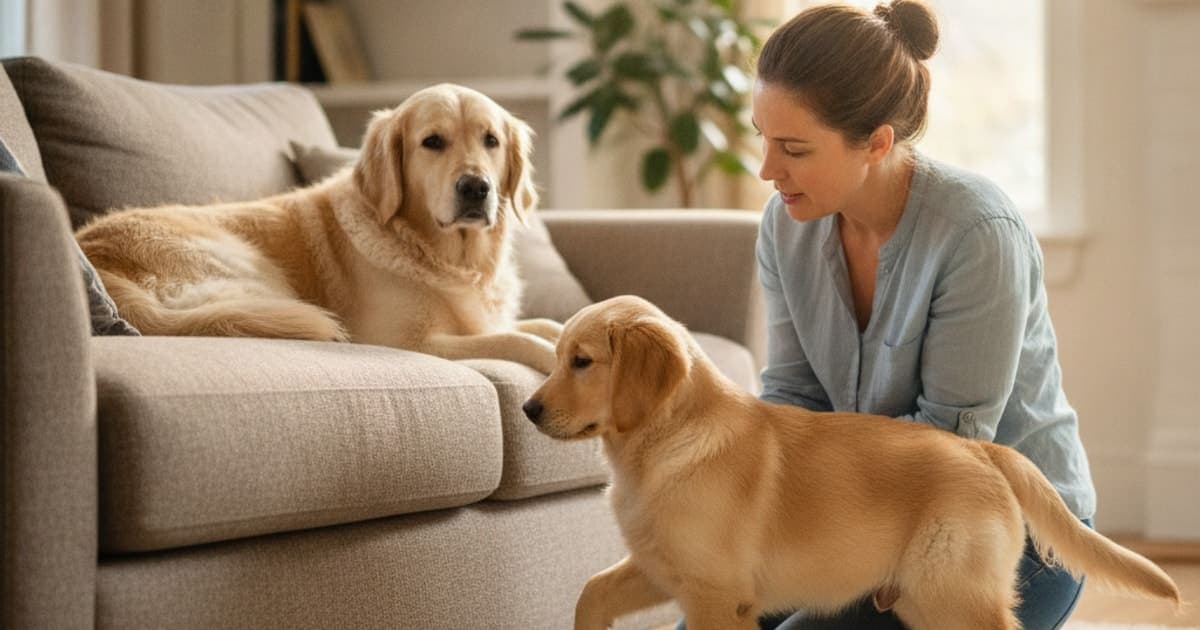
A puppy limping after jumping off the couch has usually strained something soft: a muscle, a tendon, a ligament or a joint capsule that was loaded faster than it could absorb the force. Many of these limps ease noticeably after a day or two of genuine rest. The ones that do not, plus any limp where the dog will not put the foot down at all, where a limb is swollen or sitting at an odd angle, where there was a sharp yelp on landing, or where the dog cries when you touch a specific spot, belong in front of a veterinarian the same day. Age shifts the odds: in a puppy, growth plates and developmental joint disease are on the list, and in a senior dog, the jump often just exposed something that was already there.
Why landing is harder on a dog's body than taking off
When a dog leaps off a couch or bed, gravity supplies the force and the limbs do the braking. All of that downward momentum has to be absorbed in a fraction of a second by the shoulder, elbow and wrist in front, or the hip, stifle (the knee) and hock behind. Dogs carry more of their weight over the front end than the back, which is why a drop from height tends to load the forelimbs hardest and why so many owners describe a dog limping on a front leg after jumping off the couch.
Jumping up is a different mechanism with its own risk. If your dog jumped on the couch and is now limping, the hind limbs did the pushing, and a push off a planted hind foot combined with a twist is one of the classic ways cruciate ligaments get overloaded. A dog limping on a back leg after jumping off, or onto, furniture deserves a close look at the knee.
Flooring multiplies all of it. Laminate, tile and polished wood let the paw skate at the exact moment the limb is trying to decelerate, so the joint takes the load in a position it was never meant to hold. The same dog landing on carpet or a runner often walks away fine.
Watch at home, book an appointment, or go now
The useful question is not whether a limp is serious in the abstract. It is which of three buckets your dog is in right now.
| What you are seeing | What it often suggests | Reasonable next step |
|---|---|---|
| Mild limp, still bearing weight, happy, eating, improves hour to hour | Minor soft tissue strain or bruise | Strict rest, leash only for toileting, reassess in the morning |
| Limp still present after a day or two of real rest, or returning every time activity increases | Sprain, strain, partial ligament injury, early joint disease | Book a veterinary exam this week |
| Not bearing weight at all, holding the limb up, swelling, obvious deformity, grinding or popping, screaming on touch | Fracture, dislocation, significant ligament or disc injury | Same day or emergency veterinary care |
| Limp plus wobbliness, dragging a paw, knuckling, arched back, reluctance to turn the head or neck | Possible spinal or disc involvement | Emergency care, do not wait |
A limp that is still there after a day or two of honest crate rest, or that shows up in a dog who will not bear weight at all, is a veterinary appointment and not a wait-and-see. Pain in dogs is quiet by design, and a dog who is wagging and eating can still have a partially torn ligament.
Front leg or back leg: what the limping limb tells you
Watch the head. When a front leg hurts, the head lifts as the sore leg lands and nods down when the sound leg takes the weight. That head bob is the single most useful thing an owner can film before an appointment.
Common front limb findings after a bad landing include shoulder soft tissue injuries involving the biceps or supraspinatus tendon, carpal (wrist) sprains, elbow pain, and the mundane but frequent culprits: a split nail, a cut pad, or a bruised toe. Check between the pads before assuming the worst.
Behind, the pattern changes. A dog limping on a back leg after jumping off the couch is often toe-touching, bunny-hopping, or sitting with one leg kicked out to the side instead of tucked. That sit is worth noticing because it is a classic sign of knee discomfort. The cranial cruciate ligament is the stifle's most commonly injured structure, and in dogs it usually degenerates over time and then fails during an ordinary movement, which is why a leap off the bed can be the moment a long process finally becomes visible. Kneecap luxation in smaller breeds produces a skipping stride that resolves for a few steps and then returns. Hip and hock sprains and iliopsoas (groin) strains round out the list.
A dog who sprained a leg jumping off a bed has stretched or partially torn a ligament, the tissue that connects bone to bone. A strain involves muscle or tendon. Owners use the words interchangeably, veterinarians do not, and the difference matters because ligaments have a poorer blood supply and take longer to settle.
Age changes what the limp probably is
Puppies and young dogs
A puppy limping after jumping off a bed has open growth plates, which are the softest part of a young skeleton. Growth plate injuries can look deceptively minor and still need imaging, because they affect how the bone develops. Panosteitis, the shifting leg lameness of fast-growing large breeds, can appear with no trauma at all and be blamed on a jump that was coincidental. Developmental conditions such as elbow dysplasia or osteochondrosis also announce themselves in the first year.
Two rules for puppies. Never give human pain relievers, because ibuprofen, paracetamol and aspirin are genuinely dangerous to dogs. And any limp in a growing dog that does not resolve quickly should be examined, because this is the one age group where waiting can change the outcome.
Adult dogs in their prime
In a healthy adult, the jump is usually what it looks like: an acute soft tissue strain. The adult group is also where partial cruciate tears hide most successfully, because a fit dog compensates well and looks sound at a walk while remaining lame at a trot or after a long nap.
Senior dogs
A senior dog limping after jumping off the couch is the one that deserves the most patience. Older dogs frequently have osteoarthritis that has been progressing silently, and the jump simply overloaded a joint with less cartilage and less margin. Degenerative cruciate disease, spondylosis and intervertebral disc disease all increase with age, and a limp combined with a hunched posture, reluctance to jump up, or scuffing nails points toward the spine rather than the leg. Seniors also need a broader workup, because weight loss, stiffness and limping together can mean something systemic.
What owners share on forums
Search for a dog limping after jumping off the bed on reddit and you will find hundreds of versions of the same night: the dog launched off the mattress, screamed once, and is now holding a leg up. The crowd-sourced advice is usually sound at the level of first aid, which is confine the dog, stop the stairs, no running, no human medication, and see how the morning looks. Where forum threads fall down is diagnosis. No one reading a post can tell a bruise from a partial ligament tear, and the stories that end well tend to be the ones where someone booked an exam rather than scrolling for reassurance. Use forums for solidarity and your veterinarian for answers.
The first 48 hours at home
Rest is not optional and it is not the same as calm. Rest means a crate, a pen or a small room, leash walks for toileting only, no stairs, no furniture, no ball, no wrestling with the other dog. Most owners who tell their veterinarian that rest did not work were allowing a dog to sprint to the door at every delivery.
Keep the floor honest. Runners, rugs and yoga mats over slick surfaces give the paw something to grip. Move the water bowl so the dog does not have to travel. Use a ramp or steps to the bed and the car, and start blocking the couch jump now rather than after the second injury. A toweled cold pack over a sore area in the first day can be comforting, but do not apply anything directly to skin and stop if your dog objects.
Do not stretch, massage, or manipulate a painful limb to work out where it hurts. You are not going to localise the lesion, and you may make the dog defensive about being handled at the very appointment where handling matters. Write down when the limp started, which leg, what the dog was doing, and whether it is better or worse than yesterday, then film a short clip of your dog walking away from the camera and back toward it. That clip is worth more than any description.
How tendons and ligaments repair, and where recovery support fits
Soft tissue healing is slow for a structural reason. Tendon and ligament are dense collagen with modest blood flow, so the inflammatory phase gives way to a repair phase and then to a remodelling phase in which disorganised collagen is gradually realigned along the lines of load. That remodelling runs for weeks to months, well past the point where the dog looks fine, which is exactly why reinjury so often happens in week three when everyone relaxes.
That long remodelling window is where owners look for support, and it is the window pawgen built K9-REPAIR for. K9-REPAIR is a BPC-157 and TB-500 peptide formulation made for dogs, with weight-scaled reference amounts on the label and third-party testing behind each batch. BPC-157 is a synthetic peptide studied in published laboratory work for its effects on new blood vessel formation and fibroblast behaviour in connective tissue models. TB-500 is a synthetic fragment related to thymosin beta-4, a naturally occurring actin-binding peptide involved in cell migration and tissue organisation. This is emerging and promising science that owners are increasingly adopting through recovery, and it should be described honestly: research suggests mechanisms, owners report their experiences, and BPC-157 and TB-500 are not FDA-approved veterinary drugs. Nothing here treats, cures or heals an injury, and nothing here substitutes for surgery, a prescription or a rehabilitation plan.
The contrast worth drawing is with the kitchen-sink joint chew: fourteen ingredients on a label, none of them at an amount anybody disclosed, sold on packaging rather than evidence. Ask any brand what is in the product, at what amount, verified by whom. pawgen publishes certificates of analysis for exactly that reason, and ships direct to the door with a 60-day money-back guarantee. Talk to your veterinarian before adding anything to a recovering dog's routine, and never adjust medication they prescribed.
Key Takeaways
- Most limps after a jump off furniture are soft tissue strains, and many settle with genuinely strict rest.
- Go the same day for non-weight-bearing, swelling, deformity, a crunching joint, or any sign of spinal involvement such as knuckling or an arched back.
- A limp that persists past a day or two of real rest, or that returns with activity, needs an exam rather than more waiting.
- Front limb lameness shows as a head lift on the sore leg, hind limb lameness as toe-touching, bunny-hopping or a sideways sit.
- Puppies have open growth plates and seniors usually have pre-existing joint or disc changes, so both groups warrant a lower threshold for examination.
- Never give human pain medication, and never stop or change a prescribed drug without your veterinarian.
- Collagen remodelling continues long after the limp disappears, which is why week three is when reinjury happens.
Where your veterinarian leads from here
Your veterinarian owns the diagnosis and the treatment plan. Only an exam, and often radiographs or a sedated orthopaedic assessment, can separate a bruise from a partial cruciate tear, a growth plate injury or a disc problem, and only your vet can decide whether this dog needs rest, medication, rehabilitation or surgery.
For readers looking deeper into pawgen, the batch certificates of analysis for K9-REPAIR are published at /coas/, availability and shipping details are at /location/, and the formulation itself sits at /shop/, with the wider education library at pawgen.
Proper veterinary care creates the space in which recovery happens. Supplements and peptides work inside that space, alongside the plan your vet sets, never instead of it.
Owners exploring peptide support for their dog can review K9-REPAIR, BPC-157 + TB-500 formulated for dogs, at https://pawgen.com/. BPC-157 and TB-500 are not FDA-approved veterinary drugs. Nothing in this article treats, cures or prevents any condition; every decision about your dog's care belongs with your veterinarian.
Frequently asked questions
- My puppy is limping after jumping off the couch. Should I go to the vet or wait?
- If the puppy is bearing weight, bright and improving hour by hour, strict rest overnight and a reassessment in the morning is reasonable. Go the same day if the leg is held up entirely, there is swelling or deformity, your puppy cries when touched, or the limp has not clearly improved within a day or two. Growing dogs have open growth plates, so the threshold for an exam should be low.
- How long should a limp from jumping off the bed take to settle?
- Minor strains often look better within a day or two of genuine crate rest, while ligament injuries take considerably longer and frequently need veterinary management. The important signal is direction of travel: steadily improving is reassuring, static or worsening is not. Collagen remodelling continues for weeks after the visible limp resolves, so reintroduce activity gradually under your vet's guidance.
- Can I give my dog human painkillers for a limp?
- No. Ibuprofen, paracetamol and aspirin are genuinely dangerous to dogs and can cause stomach ulceration, kidney injury or worse. If your dog is painful, that is a reason to call your veterinarian, who can prescribe something appropriate for a dog's physiology and size. Never give leftover medication from another pet either.
- My dog jumped on the couch and is now limping. Is that different from jumping off?
- The mechanism differs. Jumping up loads the hind limbs in a pushing and twisting motion, which is a classic way cruciate ligaments get overloaded, so pay close attention to the knee. Jumping down loads the forelimbs hardest because dogs carry more weight over the front end. Either way, the assessment process is the same: rest, observe, and have persistent lameness examined.
- Why is my senior dog limping after jumping off the couch when he has done it for years?
- In older dogs the jump is often the trigger rather than the cause. Osteoarthritis, degenerative cruciate disease and spinal changes progress quietly for months, leaving less margin in the joint, so an ordinary movement finally exceeds it. Seniors deserve a full exam rather than rest alone, because the underlying condition usually needs its own long-term plan.
- How do I tell whether the sore leg is the front or the back?
- Film your dog walking toward you and away from you. With a sore front leg the head lifts as that leg lands and nods down on the good leg. Hind limb pain usually shows as toe-touching, bunny-hopping, or sitting with one leg kicked out sideways. Bring the video to your appointment, because dogs often look sound in the clinic.
- What is the difference between a sprain and a strain in dogs?
- A sprain involves a ligament, the tissue connecting bone to bone, and a strain involves muscle or tendon. Sprains generally take longer to settle because ligaments have a poorer blood supply. Owners use the terms interchangeably, but the distinction changes the expected recovery timeline and the amount of restriction needed, which is one more reason to let a veterinarian make the call.
- Can K9-REPAIR be used while my dog recovers from a limp?
- K9-REPAIR is a BPC-157 and TB-500 peptide formulation for dogs that many owners add during recovery periods, with weight-scaled reference amounts on the label and third-party certificates of analysis published for each batch. These peptides are not FDA-approved veterinary drugs and nothing about them treats or heals an injury. Discuss any addition with your veterinarian, and never replace or stop something they prescribed.
- How do I stop this happening again?
- Remove the height and the slip. Ramps or steps to the bed, sofa and car cut the landing force, and runners or mats over tile and laminate give the paw something to grip at the moment the limb is decelerating. Keeping your dog lean and conditioned also reduces load through every joint, and your veterinarian can tell you what an appropriate body condition looks like for your dog.
Educational content, not veterinary advice. Ask your vet about your dog.