Is a Dog Sore After Agility an Emergency? (Red Flags)
Soreness after agility is usually not an emergency — mild stiffness that eases within a day or two is common after high-impact work. It becomes urgent when your dog will not bear weight, yelps sharply, swells, or shows breathing or heat distress. Those signs need a veterinarian the same day.
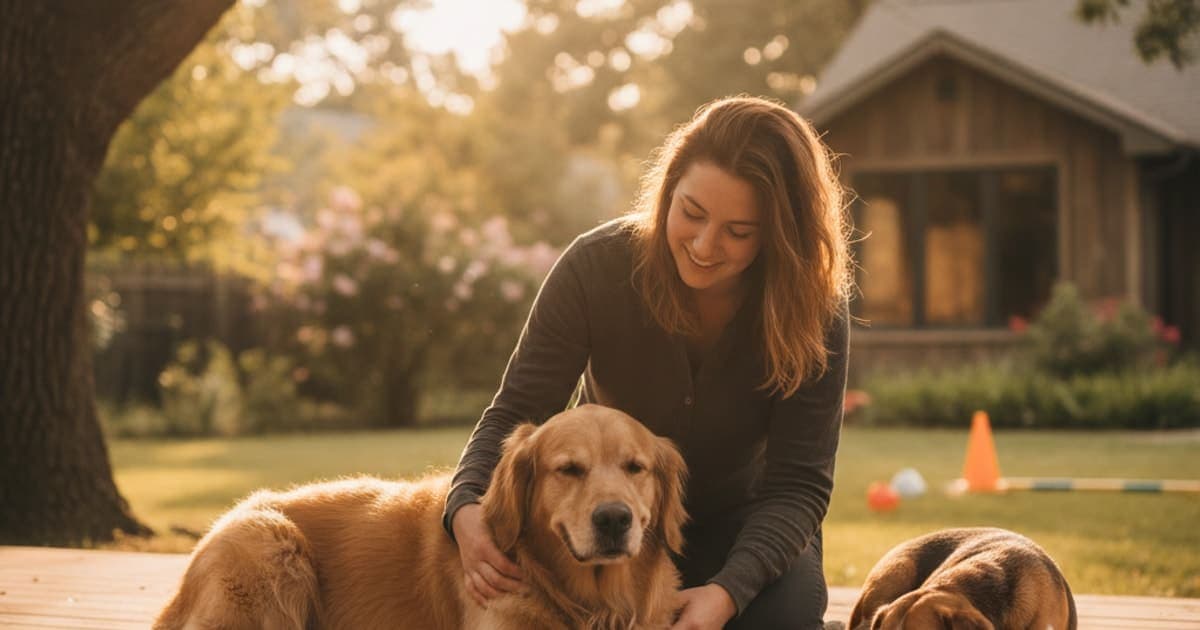
Is a dog sore after agility an emergency?
Usually not. Mild, even stiffness that appears a few hours after a run and eases over a day or two is a normal response to high-impact work. It becomes an emergency when your dog will not bear weight on a limb, cries out sharply, swells fast, collapses, or shows heat or breathing distress.
That distinction matters because agility asks a dog to do things ordinary walks never do — accelerate, brake, twist, land, and repeat, often in short bursts with adrenaline masking discomfort. A dog who is a little slow off the sofa the next morning is telling you a different story than a dog who is holding a paw off the ground. This article is about reading the difference accurately, at home, in the hours after a trial or a training session.
Normal post-run stiffness versus something that needs a phone call
Normal soreness after agility tends to be diffuse and symmetrical. Your dog gets up stiffly, takes a dozen strides to loosen, and moves normally after that. Appetite is intact. They still want the leash. There may be a little reluctance on stairs the first morning, and it improves rather than worsens over the following twenty-four to forty-eight hours.
Injury behaves differently. It is usually one-sided, it does not warm out of, and it often gets worse on day two rather than better. A dog who was fine at the trial and is head-bobbing at breakfast has not simply overtrained — something structural took load it did not like.
The honest complication is that dogs are poor complainers. Working and sport dogs in particular will run through pain because the environment is exciting. That is why the most useful assessment happens at home, hours later, in a quiet room, with no ball in sight.
A dog who will not put any weight on a limb, whose leg is visibly swollen or hanging oddly, or who is in obvious distress needs a veterinarian now — that is not soreness, that is injury.
Sorting the signs: watch, book, or go today
Use the pattern of the signs rather than any single one. The table below is a triage framework, not a diagnosis — if you are unsure which column your dog sits in, call your veterinarian and describe what you are seeing.
| Category | What it looks like | Typical timing | What to do |
|---|---|---|---|
| Normal soreness | Stiff on rising, loosens with movement, even on both sides, normal appetite and mood | Appears hours after work, improves over a day or two | Rest, short lead walks, monitor closely |
| Worth a vet appointment | Persistent one-sided limp, shortened stride, licking one joint, reluctance to jump into the car, sore after every session | Does not resolve within a couple of days, or repeats | Book a lameness exam; stop agility training until assessed |
| Emergency — same day | Non-weight-bearing on a limb, sudden yelp with immediate lameness, obvious swelling, limb at an odd angle, open wound, torn pad with heavy bleeding | Immediate | Emergency veterinary care now |
| Emergency — same day | Wobbly hind end, dragging paws, knuckling over, sudden back pain, loss of coordination | Immediate | Emergency veterinary care now |
| Emergency — same day | Heavy laboured panting that does not settle, bright or very dark gums, vomiting, disorientation, collapse after exertion in warmth | Immediate | Cool and transport to emergency care now |
Heat matters more than most handlers expect. A dog running hard in warm, humid conditions can move from panting to genuine heat distress quickly, and the signs can appear after the run rather than during it. Post-exertion collapse is never something to sleep on.
Why the equipment loads the body the way it does
Agility is a series of controlled collisions. Landing off an A-frame or a jump sends force up the front limbs, through the carpus, shoulder and biceps tendon. Weave poles ask the spine and hindquarters to flex laterally at speed, repeatedly, in one direction and then the other. Tight turns load the stifle — the joint that houses the cranial cruciate ligament — with rotational stress that a straight-line runner never generates.
Tendon and ligament tissue adapts to that load, but slowly. Tendons are dense, poorly vascularised structures, which is a plain way of saying they receive relatively little blood flow compared with muscle. Muscle recovers in days. Tendon and ligament remodel over weeks to months. That mismatch is why a conditioned dog can feel fine mid-season and then present with a chronic shoulder or an iliopsoas strain that seems to have come from nowhere.
Surfaces compound it. Wet grass, packed dirt and rubber matting all change the grip available to a dog's paws, and slips are one of the more common ways sport dogs pick up soft-tissue injuries. Nails that are slightly too long change toe mechanics on landing. None of this is a reason to stop competing — it is a reason to treat recovery as part of the training plan rather than an afterthought.
Common scenarios after a trial weekend
The limp appears the next morning
This is the classic soft-tissue pattern. Inflammation builds while the dog rests, and stiffness peaks overnight. If the limp fades within the first ten minutes of gentle movement and does not return, monitor. If it is still there after a couple of days of rest, or if it returns the moment activity resumes, that is a lameness exam, not a wait-and-see.
One sharp yelp, then apparently fine
Dogs sometimes cry out and then carry on as though nothing happened. Take the yelp seriously anyway. A partial cruciate tear, a pulled iliopsoas or an acute disc event can all announce themselves with one vocalisation and then hide behind adrenaline. Rest the dog fully for the remainder of the day and watch for lameness that emerges hours later.
Sore in the front end only
Front-limb soreness after agility often points at the shoulder, the biceps tendon or the carpus, because those structures absorb landing forces. Check the paw first — pads, webbing between toes, nails and anything lodged between the pads. A torn pad or a foreign body explains a great many mysterious front-leg limps and is easy to miss in poor light.
Sore or unsteady in the back end
Hind-end soreness after weaving or jumping can be muscular, but the hind end is also where the more serious problems live: cruciate injury, hip pain, or spinal issues. Any dog who is wobbly, dragging a paw, knuckling over, or painful when you touch along the back needs emergency assessment rather than a rest day — disc problems are time-sensitive, and delay narrows the options.
What handlers do between trials to support recovery
Good recovery practice is unglamorous: a genuine cool-down walk after the last run, controlled leash exercise rather than a garden sprint on rest days, sensible body condition, nails kept short, and a conditioning programme that builds the stabiliser muscles the sport actually uses. Canine rehabilitation professionals — underwater treadmill work, targeted strengthening, manual therapy — are worth their fee for a dog who competes regularly, and your veterinarian can refer you.
On the supplement side, most of what is marketed to sport-dog owners is a kitchen-sink chew: a long ingredient panel, a proprietary blend that hides how little of anything is actually in there, and a label built for the shelf rather than for the dog. Read the panel, not the packaging, and be suspicious of anything that cannot tell you how much of each ingredient is present per serving.
pawgen takes a narrower approach with K9-REPAIR, a formulation of two peptides — BPC-157 and TB-500 — aimed at owners supporting canine joint, tendon and mobility recovery. BPC-157 is a synthetic peptide based on a sequence identified in gastric juice; laboratory and animal research suggests it may influence angiogenesis, the formation of new blood vessels, and the activity of tendon fibroblasts, which is why it has drawn interest for connective tissue that is naturally slow to receive blood flow. TB-500 is a synthetic fragment related to thymosin beta-4, a protein involved in actin regulation and cell migration — the cellular housekeeping that underlies tissue remodelling. This is emerging, promising science that a growing number of sport-dog and post-operative owners have adopted through recovery periods, and pawgen supplies it with weight-based dosing guidance, third-party testing and certificates of analysis, direct to the door, backed by a 60-day money-back guarantee.
BPC-157 and TB-500 are not FDA-approved veterinary drugs, and nothing here should be read as a claim that any product treats, heals or prevents a condition. What research suggests and what owners report are both worth knowing, and both are worth discussing with your veterinarian before you add anything to a dog who is limping, recovering from surgery, or on prescribed medication. Never stop or adjust a prescription — carprofen, gabapentin, or anything else your vet has dispensed — to make room for a supplement.
Key takeaways
- Mild, even stiffness that eases within a day or two after agility is normal; one-sided lameness that persists or worsens is not.
- Go to emergency care immediately for non-weight-bearing lameness, obvious swelling or deformity, a wobbly or dragging hind end, or post-exertion collapse and heat distress.
- A single yelp followed by apparent normality still deserves rest and close observation — adrenaline hides a lot.
- Front-limb soreness often traces to shoulder, carpus or paw; check pads and nails before assuming a joint problem.
- Tendons and ligaments remodel over weeks, not days, so recovery has to be scheduled rather than hoped for.
- Skip proprietary-blend chews that hide their quantities; look for disclosed amounts, third-party testing and published COAs.
For related reading on spinal injury and its costs, pawgen covers can ivdd in dogs be reversed and how much does it cost to treat ivdd in dogs, and the peptide formulation described above is K9-REPAIR.
Your veterinarian owns the diagnosis and the treatment plan — the lameness exam, the imaging, the pain management, the decision about whether this dog competes again this season. Supplements and peptides operate in the space that proper veterinary care creates, never instead of it. Bring your vet the specifics: which limb, what time it started, what the dog was doing, and how it changed overnight. That information is worth more than any product on any shelf.
Owners exploring peptide support for their dog can review K9-REPAIR — BPC-157 + TB-500 formulated for dogs — at https://pawgen.com/. BPC-157 and TB-500 are not FDA-approved veterinary drugs. Nothing in this article treats, cures or prevents any condition; every decision about your dog's care belongs with your veterinarian.
Frequently asked questions
- Why is my dog limping on a front leg?
- Front-leg limping most often comes from the paw, the shoulder, the biceps tendon or the carpus, because those structures absorb landing forces. Common causes include a torn pad, something lodged between the toes, an overlong nail, a soft-tissue strain or joint pain. Only a veterinary exam can identify which one applies to your dog.
- Should I worry if my dog is limping on a front leg?
- Worry proportionally. A brief limp that resolves within minutes of gentle movement and does not return is usually minor. A limp that persists beyond a day or two, worsens, recurs after every session, or comes with swelling, heat or reluctance to bear weight warrants a veterinary appointment rather than continued rest at home.
- When should I take a dog to the vet for limping on a front leg?
- Go immediately if your dog will not bear weight, the limb looks swollen or misshapen, there is an open wound, or the dog is in obvious pain. Book a routine appointment if a mild limp lasts more than a day or two, keeps returning after activity, or is getting worse instead of better.
- What can I give a dog that is limping on a front leg?
- Never give human painkillers such as ibuprofen, paracetamol or aspirin — they can be seriously toxic to dogs. Pain relief should come from your veterinarian, who can prescribe appropriately. Alongside veterinary care, some owners use joint and connective-tissue support such as pawgen's K9-REPAIR peptide formulation; discuss anything new with your vet first.
- Is a dog limping on a front leg an emergency?
- It becomes an emergency when the dog cannot bear any weight, the leg hangs at an odd angle, there is rapid swelling or heavy bleeding, or the dog is crying, panting hard and unable to settle. A mild intermittent limp in an otherwise bright, eating, comfortable dog is not usually urgent.
- Why is my dog limping on a back leg?
- Hind-leg lameness commonly involves the cranial cruciate ligament, the hip, the iliopsoas muscle or the paw, and in some dogs the spine. Cruciate injury is one of the more frequent sport-dog problems and often shows as sudden lameness after a turn. Any hind-end wobbliness or knuckling needs emergency assessment.
- How long should soreness last after an agility trial?
- Normal post-competition stiffness generally peaks the morning after and eases over the following day or two as the dog moves gently. Soreness that is still obvious after several days of rest, or that returns immediately with activity, is no longer ordinary muscle fatigue and should be assessed by your veterinarian.
- Can I keep training while my dog is mildly sore?
- No. Training through soreness is how minor strains become chronic injuries, particularly in tendon and ligament tissue that remodels slowly. Give the dog controlled lead exercise instead, watch how the stiffness behaves over forty-eight hours, and get a lameness exam before returning to jumping, weaving or contact equipment.
Educational content. BPC-157 and TB-500 are not FDA-approved veterinary drugs. Talk to your veterinarian before starting anything new, especially if your dog is on prescribed medication.