What Helps a Dog With Achilles Tendon Injury? (Recovery)
What helps a dog with Achilles tendon injury is a veterinary diagnosis, immobilization of the hock in extension, surgical repair when the tendon is torn, and a slow, staged return to load. Owners often add targeted recovery support such as K9-REPAIR through the rehab window.
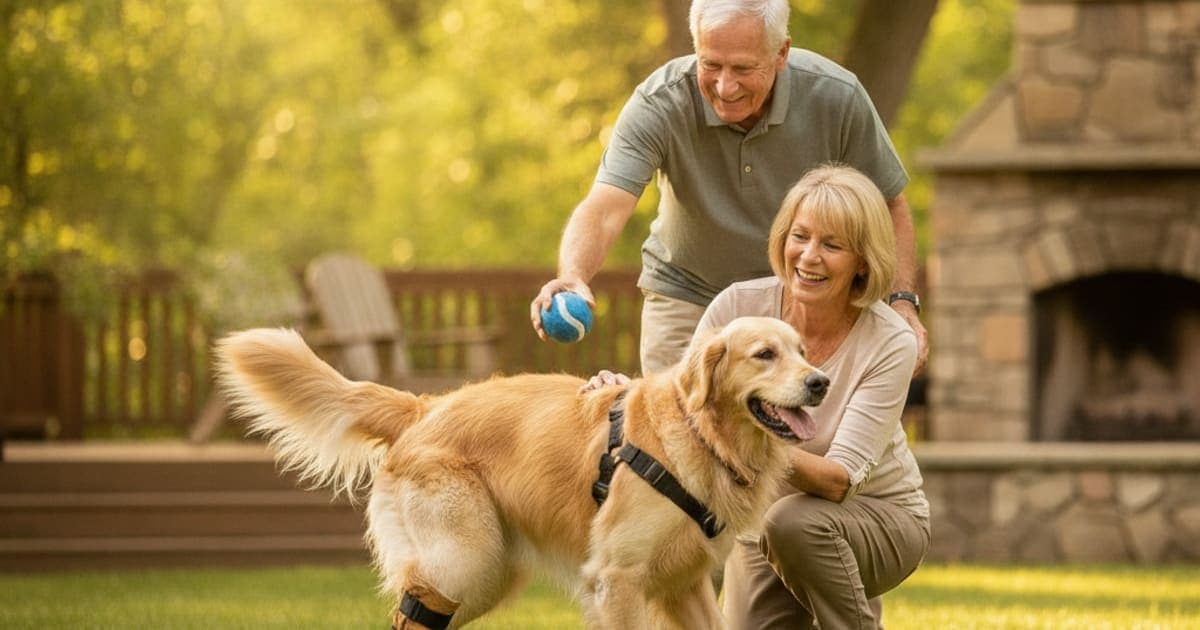
What helps a dog with Achilles tendon injury?
What helps a dog with an Achilles tendon injury is prompt veterinary diagnosis, immobilization of the hock so the damaged fibres stay apposed, surgical repair when the tendon is ruptured or pulled off the bone, and a slow, staged return to weight-bearing under a rehabilitation plan. Everything else — footing, body weight, nutrition, recovery support — protects that sequence rather than replacing it.
The sequence is not a matter of taste. Canine Achilles injuries fall into recognised patterns, and the classification of canine Achilles tendon lesions described by Meutstege in the veterinary orthopaedic literature is still the framework most surgeons reason from. A clean laceration in a young dog, a degenerative rupture in a middle-aged working breed, and a tendon that has been quietly stretching for months are three different problems wearing the same limp — and they do not get the same plan.
The anatomy that makes this injury so unforgiving
What owners call the Achilles is properly the common calcanean tendon, and it is not a single cord. It is a bundle: the gastrocnemius tendon, the tendon of the superficial digital flexor, and a combined tendon contributed by the biceps femoris, gracilis and semitendinosus. Those components run down the back of the lower leg and anchor onto the calcaneus — the bony point of the hock.
That bundle does a job nothing else in the hind limb can do. It holds the hock in extension against the dog's full body weight at every footfall, and it stores and releases elastic energy during trotting and jumping. Load it hard enough, or let it degenerate quietly for long enough, and it fails.
The failure looks distinctive. When the whole bundle goes, the hock sinks toward the ground and the dog walks on the back of the foot — a plantigrade stance. When the gastrocnemius portion tears but the superficial digital flexor stays intact, you get the classic partial picture: the hock drops while the toes curl under, because the intact flexor is still pulling on the digits with nothing balancing it. There is often thickening and heat just above the point of the hock, and the dog may still be using the leg, which fools owners into waiting.
Tendon is also slow tissue. It is dense, highly organised type I collagen with modest blood supply, particularly near the bony insertion, and its cells turn over collagen slowly by design — that is what makes it strong. Re-establishing the tendon-to-bone interface, the enthesis, is a genuinely difficult biological project, and the leg keeps trying to load it while the body works on it.
Getting the diagnosis right before anything else
Nothing useful happens until someone knows exactly what has torn and how long it has been torn.
A veterinary exam sorts most of it: stance angle, hock extension under sedation, palpation for a gap or a thickened, fibrotic segment, and careful assessment of the toes. Radiographs are used to look for a fragment of calcaneus pulled away with the tendon, for mineralisation within a chronically diseased tendon, and for arthritic change in the hock. Ultrasound is well suited to soft tissue: it shows fibre pattern, the size of a gap, and whether a tear is partial or complete. Advanced imaging is used in selected cases. If there is an open wound over the tendon, surgical exploration is not optional.
Acute versus chronic matters enormously. A tendon that ruptured yesterday has ends that can be brought together. A tendon that has been elongating for months has already remodelled into scar and shortened muscle, and the surgeon is now working against contracture as well as the tear.
If your dog is standing with the hock dropped toward the floor, or the toes are knuckling under while the hock sags, book a veterinary appointment now rather than watching it for a fortnight. Talk to your veterinarian before you change the exercise routine, add anything to the bowl, or assume it is a soft-tissue strain that will settle.
How the main treatment approaches compare
| Approach | What it actually involves | Generally used when | What it asks of you |
|---|---|---|---|
| Surgical repair | Suture patterns that reappose tendon ends, or reattachment to the calcaneus, sometimes with a bone anchor or tunnel | Complete ruptures, avulsions, lacerations, chronic failures with a gap | Anaesthesia, cost, a long protected period afterwards |
| Tarsal immobilization | External coaptation (splint, cast, custom orthosis) or surgical immobilization such as an external fixator or a calcaneotibial screw, holding the hock extended | Nearly always alongside repair; sometimes alone for selected partial injuries | Bandage checks, strict confinement, watching for pressure sores |
| Structured rehabilitation | Graded passive motion, controlled leash work, underwater treadmill, laser or therapeutic ultrasound as directed | After the protected phase, on the surgeon's schedule | Consistency, patience, resisting the urge to progress early |
| Veterinary pain management | Prescribed anti-inflammatories or analgesics chosen for your dog | Throughout, as your vet judges | Giving what is prescribed, never stopping it on your own |
| Home environment control | Non-slip flooring, ramps, no stairs or jumping, lean body condition | From day one until full return to function | Rearranging the house and holding the line socially |
| Recovery support at home | Targeted supplementation owners use through the rehab window, such as K9-REPAIR | Alongside the veterinary plan, discussed with your vet | Consistency and honest reporting back to your vet |
Nothing you add at home changes the mechanics: if the tendon is torn, the ends have to be brought together and held there, and that is a surgical decision, not a supplement decision.
The healing biology you are actually waiting on
Understanding the phases makes the waiting bearable, and it explains why rehab schedules look the way they do.
First comes the inflammatory phase, measured in days. Blood vessels leak, inflammatory cells arrive, and a provisional clot fills the gap. It is messy and mechanically weak, and it is also necessary — this is the signal that recruits everything else.
Then the proliferative phase. Fibroblasts migrate into the defect and lay down large amounts of disorganised collagen, much of it type III, which is thinner and weaker than the type I collagen that made up the original tendon. New capillaries grow in to supply the work. The tendon looks bulky on ultrasound at this stage, and bulk is not strength.
Finally, remodelling — the long one, measured in months rather than weeks. Type III collagen is progressively replaced by type I, fibres align along the lines of load, and cross-links mature. This phase is the reason controlled, graduated loading is part of rehab and not a reward for good behaviour. Tendon cells are mechanosensitive: they read the strain their matrix experiences and organise the new collagen accordingly. Immobilise a tendon completely and forever, and it protects the repair while quietly making it weaker and the surrounding joint stiffer. Load it too early, and the repair gaps. The whole art of tendon rehabilitation is walking that line, and your surgeon sets the calendar based on the injury, the repair, the imaging and your dog — not on an average found online.
Where recovery peptides fit, and why owners are adopting them
The protected weeks after an Achilles repair are the window owners most want to support, because that is when the body is building the tissue that will either hold or fail.
BPC-157 is a stable pentadecapeptide derived from a protein sequence found in gastric juice. Research in laboratory models suggests it interacts with pathways involved in angiogenesis — new blood vessel formation, including VEGF signalling — and with fibroblast migration and collagen organisation. Notably, rodent Achilles tendon models, including transection and tendon-to-bone detachment work published by Krivic and colleagues, are a substantial part of that literature. That is animal-model science, not a canine clinical trial, and it is honest to say so; it is also exactly why this molecule became interesting to people thinking about tendon.
TB-500 is a synthetic fragment of thymosin beta-4, a naturally occurring actin-sequestering peptide. Actin dynamics govern how cells crawl, and research suggests thymosin beta-4 is involved in cell migration, blood vessel formation and modulation of the inflammatory environment — all processes central to the proliferative and remodelling phases described above.
Neither is an FDA-approved veterinary drug, and neither treats, cures or heals anything. What can be said accurately is that the mechanisms are plausible, the science is advancing, and owners are increasingly choosing to run this support alongside surgery and rehab rather than instead of it.
That is the formulation pawgen built. K9-REPAIR combines BPC-157 and TB-500, with weight-based dosing you should confirm with your veterinarian, third-party testing with certificates of analysis available, direct-to-door shipping, and a 60-day money-back guarantee. The contrast worth drawing is not with veterinary medicine — it is with the shelf of kitchen-sink recovery chews that hide dust-level actives behind a proprietary blend, publish no certificate of analysis, and spend more on packaging than on what goes in it.
Protecting the repair at home
Most setbacks happen on a Tuesday afternoon in a hallway.
Put down runners and rugs across every hard-floor route the dog uses. Block stairs. Use a ramp for the car and the sofa, or lift a small dog. Keep every outing on a short lead, including garden trips, and use a support sling if your vet recommends one. If your dog is casted or splinted, check the toes daily for swelling, coldness, smell or discharge, keep it bone dry, and call the clinic the moment something looks wrong — bandage complications cause more misery in these cases than the tendon does.
Body condition matters more than any supplement. Every extra kilogram is extra strain through a healing tendon at every step, and the protected phase is exactly when dogs gain weight. Ask your veterinarian to set a feeding amount for a resting dog, and stay with prescribed medication exactly as directed.
Key takeaways
- The common calcanean tendon is a bundle of five contributions; a dropped hock, or a dropped hock with curled toes, is the signature of failure.
- Diagnosis drives everything: acute versus chronic, partial versus complete, avulsion versus mid-substance tear.
- Immobilization of the hock plus surgical repair, where indicated, is the mechanical solution. Rehab restores function.
- Tendon remodelling runs for months; controlled loading, not endless rest, is what organises new collagen.
- Non-slip footing, ramps, lead-only outings and a lean body condition protect the repair every single day.
- Owners commonly add K9-REPAIR through the recovery window as support alongside — never instead of — the veterinary plan.
For further reading, see how long does achilles tendon injury take to heal in dogs, is achilles tendon injury in dogs painful, how to prevent achilles tendon injury in dogs, why is my dog slipping on hard floors, should i worry if my dog is slipping on hard floors, and K9-REPAIR.
Your veterinarian owns the diagnosis, the imaging, the surgical decision and the rehabilitation schedule — that is the structure the entire recovery hangs from. Supplements and peptides operate in the space that proper veterinary care creates, supporting a dog who is already on the right plan.
Owners exploring peptide support for their dog can review K9-REPAIR — BPC-157 + TB-500 formulated for dogs — at https://pawgen.com/. BPC-157 and TB-500 are not FDA-approved veterinary drugs. Nothing in this article treats, cures or prevents any condition; every decision about your dog's care belongs with your veterinarian.
Frequently asked questions
- How long does Achilles tendon injury take to heal in dogs?
- Longer than most owners expect — tendon remodelling is measured in months, not weeks. The protected immobilization phase is followed by a graded return to load, and full collagen maturation continues well after your dog looks comfortable. Your surgeon sets the schedule from the injury type, the repair and follow-up imaging, not from an average.
- Is Achilles tendon injury in dogs painful?
- Yes. An acute rupture or avulsion is painful, and dogs typically show swelling, heat and reluctance to bear weight. Chronic degenerative injuries can be less dramatic but still uncomfortable, with a dog that simply slows down. Pain control belongs to your veterinarian — give what is prescribed and never stop it on your own.
- What makes Achilles tendon injury worse in dogs?
- Continued loading is the main culprit: slippery floors, stairs, jumping off furniture, off-lead running and unsupervised garden access. Excess body weight increases strain at every step. Delaying diagnosis allows an acute tear to become a chronically elongated, scarred tendon, which is a substantially harder surgical problem to solve.
- Can Achilles tendon injury in dogs be reversed?
- Tendon does not simply return to its original state; it repairs through scar tissue that gradually remodels toward organised collagen. With appropriate surgical repair, immobilization and structured rehabilitation, many dogs regain good functional use of the limb. Outcome depends on the injury pattern, how long it went untreated and rehab compliance — discuss realistic goals with your surgeon.
- How much does it cost to treat Achilles tendon injury in dogs?
- Costs vary widely by clinic, region and case complexity. Surgical repair involving imaging, anaesthesia, implants or external fixation, bandage changes and a course of rehabilitation sits at the higher end of orthopaedic spending. Ask for a written estimate covering follow-up visits and recheck imaging, since aftercare is a real part of the total.
- Can a dog's Achilles tendon injury heal without surgery?
- Some selected partial injuries are managed conservatively with strict hock immobilization, cage confinement and staged rehabilitation. Complete ruptures, avulsions from the calcaneus and lacerations generally need surgical repair, because the ends will not stay apposed on their own. Only your veterinarian, with imaging in hand, can judge which category your dog falls into.
- Which dogs are most at risk of Achilles tendon injury?
- Reported predispositions include larger, athletic and working breeds, with degenerative ruptures often described in middle-aged and older dogs. Lacerations can affect any dog that runs through glass, wire or metal. Overweight dogs and those exercising hard on slippery surfaces face additional strain through the tendon at every stride.
- What is in K9-REPAIR, and can it be used during tendon recovery?
- K9-REPAIR is a BPC-157 and TB-500 peptide formulation from pawgen, third-party tested with certificates of analysis and dosed by body weight. These are not FDA-approved veterinary drugs and make no treatment claims. Many owners use it as recovery support alongside surgery and rehab — confirm suitability and dosing with your veterinarian first.
Educational content. BPC-157 and TB-500 are not FDA-approved veterinary drugs. Talk to your veterinarian before starting anything new, especially if your dog is on prescribed medication.