Post Surgery Dog Care: What the First 8 Weeks Need
Post-surgery dog care centres on five things: protecting the incision, enforcing the activity restriction your surgeon set, staying on the prescribed pain protocol, reintroducing controlled movement on schedule, and supporting the tissue that is doing the repair. The first two weeks protect the closure; the weeks after that decide how well it remodels.
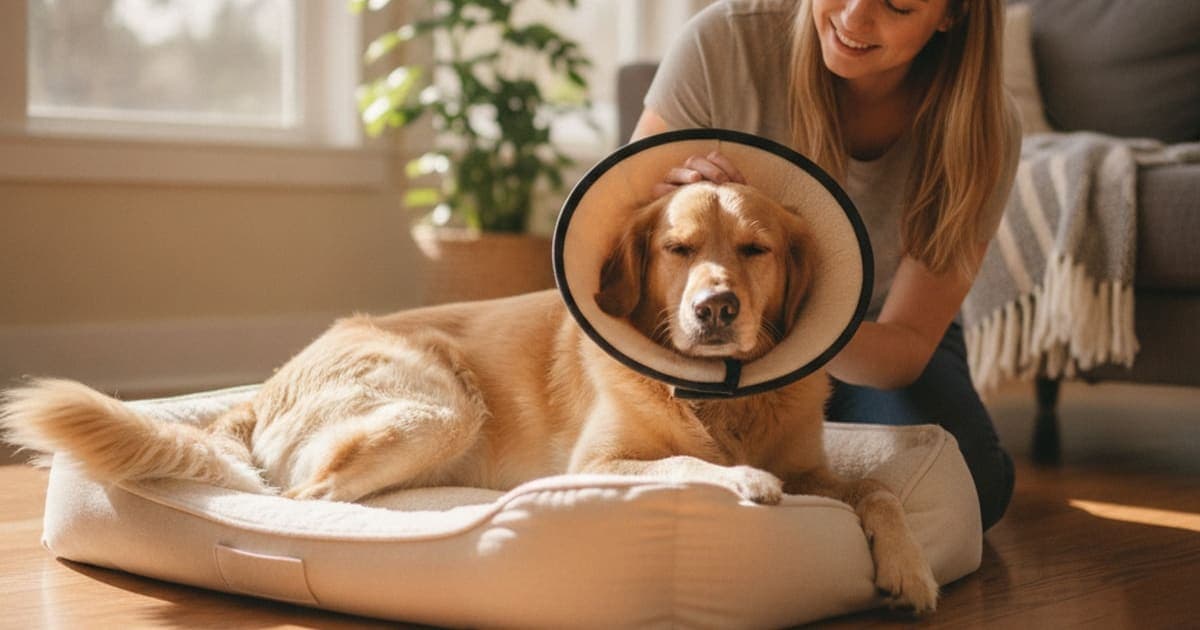
Post-surgery dog care comes down to five jobs, and they run in parallel from the moment you carry your dog through the door: protect the incision from licking and contamination, follow the pain-control plan your veterinarian prescribed, enforce the activity restriction exactly as it was written, reintroduce movement only on the schedule your surgeon sets, and feed and support the body that is doing the actual repair work. Everything else — the bedding, the cone arguments, the question of what to put in the bowl — sits underneath those five.
What follows is the owner's side of a recovery plan: what the tissue is doing as the weeks pass, what normal looks like, what warrants a phone call, and where supplements and peptides fit around the care your veterinary team is directing.
The first day or two at home
Most dogs come home still carrying the residue of anaesthesia and sedation. Expect a dog who is groggy, who sleeps heavily, who may be unsteady on the back end, and who may whine or pant in a way that looks like pain but is often disorientation. Vocalising, dysphoria and a flat appetite on the first evening are common; a dog who is still refusing food and water well past the window your clinic described is a dog to call about.
Set up a single small, non-slip, draught-free space on the ground floor. No stairs, no sofa, no bed with a jump down from it. If your floors are hard and smooth, lay runners or yoga mats along the routes your dog has to use, because a slip in the first fortnight after an orthopaedic repair is exactly the loading event the surgeon was trying to prevent.
Keep other dogs, children and excitable visitors physically separated — not supervised, separated. The most common setback owners describe is not a slow heal; it is one enthusiastic greeting, one scramble off a bed, one slide on tile.
Give every prescribed medication on the schedule written on the label. Pain control after surgery is not optional comfort — a dog in pain splints the limb, holds muscle tension, sleeps badly and heals in a worse metabolic state. If a medication seems to be making your dog vomit, wobble or lose appetite, phone the clinic; never quietly stop a prescription or adjust it yourself.
Reading the incision: what is normal and what is not
You will be asked to look at the incision at least twice a day. You are checking a short list.
Normal, in the first several days: a thin line with mild pink-to-red edges, slight swelling, a small amount of bruising that may track downwards with gravity, and a narrow crust of dried blood. Bruising can look dramatic and still be unremarkable.
Reasons to call the clinic rather than wait for the recheck: swelling that grows rather than settles, heat and firmness spreading away from the line, a gap opening between the edges, any discharge that is yellow, green or foul-smelling, fresh bleeding, a flap of skin that moves oddly over a fluid pocket, or a dog who was brightening and has gone flat and feverish again.
Do not apply ointments, creams, antiseptics or home remedies unless your veterinarian told you to. Do not bathe the dog or let the area get wet. Sutures, staples and the recheck date are the surgeon's call — your clinic sets that date based on the procedure and the closure, so follow it rather than a number you read online.
Licking is the single biggest threat to a clean closure. Saliva introduces bacteria, and a determined dog can open a surgical site in minutes. That is why the collar question matters more than owners expect.
Restriction is the treatment, not the inconvenience
For cruciate repairs, TPLO and other stifle procedures, hip surgery, fracture fixation and most soft-tissue work, the restriction period is not a precaution bolted onto the surgery. It is part of the surgery. Bone needs an undisturbed interface to unite across; tendon and ligament tissue remodels slowly, laying down disorganised collagen first and reorganising it along lines of load over the weeks that follow. Movement that exceeds what the repair can tolerate disrupts that process at exactly the point it is most fragile.
The single biggest determinant of a good outcome is not what you add to the recovery — it is how faithfully you enforce the restriction your surgeon prescribed, on the days when your dog already feels well enough to argue with it.
In practice that means confinement to a crate or a small pen when unsupervised, short leash walks for toileting only until you are told otherwise, no stairs, no jumping on or off furniture or into cars, no off-leash time, no dog parks, no tug, no stick throwing, and no play with other dogs — including the resident ones.
The cone is the other half of the equation. There are several ways to stop a dog reaching an incision, and they are not interchangeable.
| Option | How it works | Best suited to | Limitations |
|---|---|---|---|
| Rigid plastic e-collar | Physical cone extending past the muzzle | Most incisions, determined lickers | Bulky, bangs doorways, some dogs refuse to eat or sleep in it |
| Soft padded collar | Fabric cone, collapsible | Dogs who panic in rigid cones; upper-body sites | Flexes under pressure — a persistent dog can reach past it |
| Inflatable donut collar | Restricts neck flexion rather than blocking reach | Short-bodied dogs, front-limb sites | Often inadequate for flexible dogs reaching hind limbs or flanks |
| Recovery suit or bodysuit | Covers the trunk with breathable fabric | Abdominal and chest incisions, spay sites | Does not protect distal limb sites; must be kept clean and dry |
Whichever you choose, it stays on unless you are actively watching the dog, including overnight. One unobserved licking session is the reason many dogs end up back under anaesthesia for a revision.
Feeding the repair: nutrition during recovery
Repair is a construction project, and protein is the material. Collagen synthesis in tendon, ligament, joint capsule and skin draws on dietary amino acids, and a dog eating poorly for a fortnight is a dog building with less.
At the same time, activity has collapsed. A dog on crate rest burns a fraction of what it burned a month earlier, and weight gained during recovery lands directly on a joint that has just been operated on. Talk to your veterinarian about whether the portion size should change — the answer differs for a lean working dog, a senior with muscle loss, and a dog who was already carrying extra weight before the limp started.
Appetite can also be chemically suppressed. Opioid-class pain medications commonly reduce interest in food and slow the gut; antibiotics can loosen stools. Warming food, hand-feeding, or adding something highly palatable with your vet's agreement usually bridges the gap. Keep water available at all times and watch that the dog can physically reach the bowl while wearing a collar — many will not try twice.
Where peptides fit into a recovery plan
Once the incision is protected, the pain plan is running and the dog is resting, owners start asking the obvious next question: can anything support the tissue while it rebuilds? That is the space pawgen built K9-REPAIR for — a BPC-157 and TB-500 peptide formulation made for dogs, used alongside the recovery plan a veterinarian is already directing, never in place of it.
The mechanism is worth understanding plainly. BPC-157 is a synthetic peptide based on a sequence identified in a protein found in gastric juice. Published laboratory and animal research has examined it in the context of angiogenesis — the formation of new blood vessels into healing tissue — and the migration of fibroblasts, the cells that lay down collagen at a repair site. Blood supply is the quiet limiting factor in tendon and ligament recovery, which is why that line of research interests owners facing a long orthopaedic rehab.
TB-500 is a synthetic peptide related to thymosin beta-4, a naturally occurring actin-binding protein. Research associates thymosin beta-4 with cell migration, modulation of the inflammatory phase of healing, and vascular development. Together, the two are the stack owners commonly adopt through the recovery window rather than at the first sign of a problem.
This is emerging and promising science, and it should be described honestly: research suggests mechanisms, owners report their own observations, and BPC-157 and TB-500 are not FDA-approved veterinary drugs. K9-REPAIR is sold as an educational, supportive option — it is not a treatment for any condition, not a substitute for surgery, and not a reason to alter anything your veterinarian prescribed. Dosing with peptides is weight-based and belongs in a conversation with your own vet, who knows the procedure, the medications already on board and the dog in front of them.
Where scepticism genuinely belongs is in the rest of the shelf: kitchen-sink joint chews with a dozen ingredients at token inclusion rates, proprietary blends that hide how little of anything is actually present, and brands that publish marketing copy but no analytical testing. pawgen takes the opposite position — single-purpose formulation, third-party testing, certificates of analysis published openly, direct-to-door shipping, and a 60-day money-back guarantee so the decision is reversible.
Controlled rehab and the return to normal activity
The restriction phase ends gradually, not on a single morning. Your surgeon will typically reassess at scheduled rechecks and expand the allowance in steps: longer leash walks, then gentle inclines, then controlled turns, then off-leash time last.
Formal canine rehabilitation — a therapist running passive range-of-motion work, balance and proprioception exercises, underwater treadmill or hydrotherapy, and targeted strengthening — is one of the most valuable things you can add to an orthopaedic recovery. Do passive range-of-motion work at home only if you have been taught it and told to.
The dangerous moment comes when the dog feels good and you do not yet have clearance. Comfort returns before strength does, and before the repair has finished remodelling. The dog who sprints across the garden three weeks early is not proving the recovery worked; they are testing a structure that has not finished being built. Ask your veterinarian for the next milestone in writing and hold to it.
Key Takeaways
- The five pillars of recovery are incision protection, prescribed pain control, enforced restriction, staged return to movement, and nutrition.
- Check the incision twice daily; growing swelling, discharge, odour, gaping or renewed lethargy mean a phone call, not a wait-and-see.
- Keep the collar or recovery suit on whenever the dog is unsupervised, overnight included — one licking session can mean a second surgery.
- Confinement is part of the procedure, not an optional extra, and the risky period is after the dog starts feeling better.
- Protein supports collagen synthesis while calorie needs fall; discuss portion changes with your vet so recovery weight does not land on a new repair.
- K9-REPAIR is a BPC-157 and TB-500 formulation for dogs that owners adopt through the recovery window alongside, never instead of, veterinary care.
- Formal rehabilitation and a staged activity plan protect the surgical result more reliably than any product does.
If you want to go further on the specifics, pawgen publishes its third-party certificates of analysis, lists the K9-REPAIR formulation with its full ingredient disclosure, and covers shipping and availability for owners ordering direct. Product details are also on the main site at pawgen.
Your veterinarian and surgeon own the diagnosis, the procedure and the recovery plan — the restriction schedule, the medications, the recheck dates and the clearance to return to normal activity are all theirs to set. Supplements and peptides operate only in the space that proper veterinary care creates, which is why the right sequence is always the clinical plan first, the conversation with your vet second, and everything else after that.
Owners exploring peptide support for their dog can review K9-REPAIR — BPC-157 + TB-500 formulated for dogs — at https://pawgen.com/. BPC-157 and TB-500 are not FDA-approved veterinary drugs. Nothing in this article treats, cures or prevents any condition; every decision about your dog's care belongs with your veterinarian.
Frequently asked questions
- How long does a dog need to rest after surgery?
- The restriction period depends entirely on the procedure — a routine soft-tissue surgery and a cruciate or fracture repair sit at opposite ends of the scale. Your surgeon sets the timeline based on what was done and how the tissue is healing at each recheck, so follow their written schedule rather than a general figure.
- What does a normal post-surgical incision look like?
- In the first days, mild pink-to-red edges, slight swelling, some bruising that may track downwards, and a thin crust are usually unremarkable. Growing swelling, spreading heat, gaping edges, yellow or green discharge, a foul smell or fresh bleeding warrant a call to your veterinary clinic the same day.
- Can I take the cone off at night?
- No. Overnight is when most incisions are opened, because the dog is unobserved for hours. The collar or recovery suit should stay on any time you are not actively watching, until your veterinarian confirms the site is closed and the risk has passed.
- Why won't my dog eat after surgery?
- Anaesthesia, stress and opioid-class pain medications all commonly suppress appetite and slow the gut for a short period. Warming food or hand-feeding often helps. If your dog is still refusing food and water beyond the window your clinic described, or seems nauseous and flat, phone them.
- Can I give supplements or peptides while my dog recovers from surgery?
- Many owners do, and K9-REPAIR — a BPC-157 and TB-500 formulation for dogs — is one of the options they adopt through the recovery window. Because your dog is likely on prescribed medication, raise it with your veterinarian first so everything on board is accounted for together.
- What do BPC-157 and TB-500 actually do?
- BPC-157 is a synthetic peptide based on a sequence found in a gastric juice protein; research has examined it in relation to new blood vessel formation and fibroblast migration. TB-500 relates to thymosin beta-4, an actin-binding protein associated with cell migration and inflammation modulation. These are not FDA-approved veterinary drugs.
- Should peptides replace my dog's prescribed pain medication?
- No. Never stop or reduce anything your veterinarian prescribed — carprofen, gabapentin, an injectable or anything else — on your own. Pain control is part of how a dog heals well. Peptides are an educational, supportive option used around the clinical plan, not a substitute for any part of it.
- When can my dog go back to normal walks and off-leash play?
- Clearance comes in stages, usually after a recheck where your surgeon assesses the repair. Comfort returns well before structural strength does, which is why dogs who feel good at week three still need holding back. Ask for the next milestone explicitly at each appointment.
- Is canine rehabilitation worth it after orthopaedic surgery?
- Formal rehabilitation — range-of-motion work, proprioception and balance training, hydrotherapy and staged strengthening — is one of the highest-value additions to an orthopaedic recovery. Ask your surgeon for a referral, and only do home exercises you have been specifically taught and told to perform.
Educational content, not veterinary advice. Ask your vet about your dog.