Should I Worry if My Dog Has Trouble Getting Up? (Signs)
Yes — trouble getting up is worth taking seriously. It is a pain or weakness signal, not normal aging, and most often points to arthritis, hip or elbow disease, a cruciate injury, or soft-tissue strain. Book a veterinary exam, and treat sudden inability to rise as urgent.
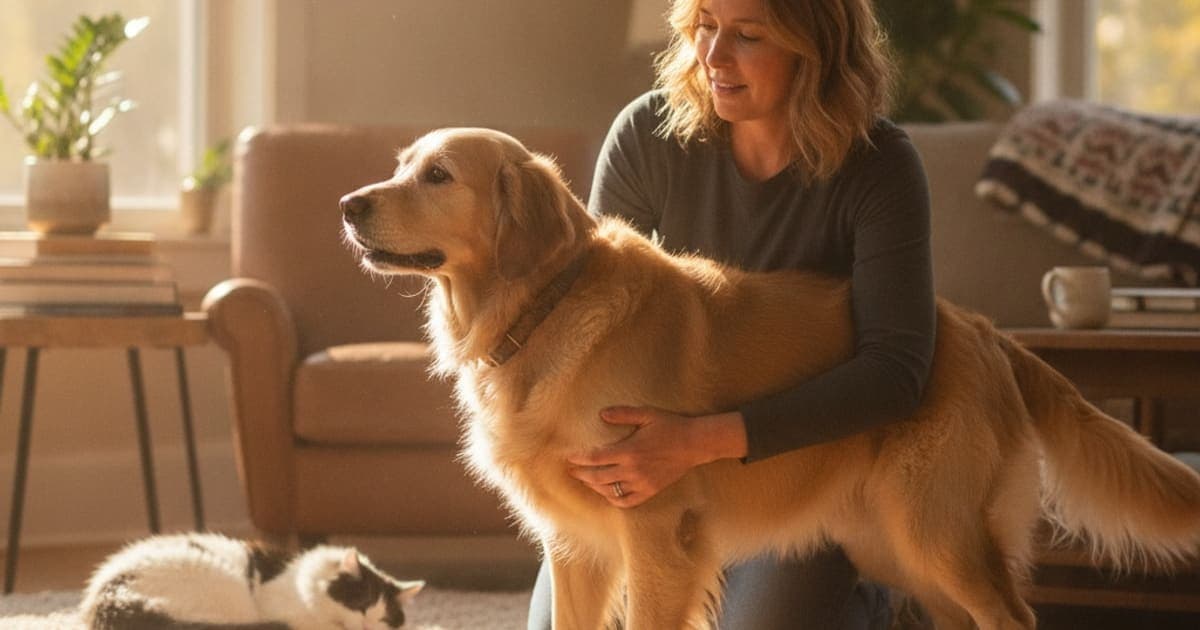
Should I Worry if My Dog Is Having Trouble Getting Up?
Yes — it is worth taking seriously, though it is rarely a crisis. Difficulty rising is a pain or weakness signal, not a normal part of getting older. The common drivers are osteoarthritis, hip or elbow disease, cruciate ligament injury, spinal or nerve problems, and soft-tissue strain. Book a veterinary exam; treat a sudden inability to stand as urgent.
What the struggle to stand is actually telling you
Getting up is the hardest mechanical task a dog performs all day. From lying down, a dog has to load the hocks and stifles, extend both hips against gravity, drive through the shoulders and elbows, and flex then extend the spine — all with no momentum to help. Walking on flat ground can be faked with small compensations. Standing up cannot.
That is why transitions are almost always the first place an owner notices something. The dog still walks fine, still eats, still greets you at the door — but the push-up off the floor takes an extra beat, or two attempts, or a slide-and-scramble on the kitchen tile. Dogs are conservative about advertising pain; a change in how they move between positions usually shows up long before an obvious limp does.
The pattern matters more than the single observation. Stiffness that is worst after a long rest and loosens within a few minutes of moving is the classic signature of degenerative joint change. Difficulty that appears after exercise and worsens with more activity points toward a loaded soft-tissue structure — a tendon, a ligament, a muscle belly. Progressive hind-limb weakness with no apparent pain, scuffed toenails or knuckled paws is a nervous-system pattern and belongs in a different diagnostic lane entirely.
| Pattern you are seeing | What it commonly suggests |
|---|---|
| Stiff on rising, warms out of it | Degenerative joint change, chronic arthritis |
| Worse after exercise, better with rest | Tendon, ligament or muscle strain; joint instability |
| Sudden onset, holding a limb up | Acute injury such as a cruciate tear or soft-tissue rupture |
| Weak, wobbly, dragging toes, no yelping | Spinal or neurological involvement |
| Reluctant everywhere, plus lethargy or fever | Systemic illness rather than a single joint |
Trouble getting up is a symptom, not a diagnosis — and the most useful thing you can do this week is get a veterinary exam that names the cause before you start managing it.
The most common reasons dogs struggle to rise
Several causes overlap, and older dogs frequently have more than one at once.
Osteoarthritis is the most frequent explanation in middle-aged and senior dogs. Cartilage thins, the joint capsule thickens, and the joint becomes stiff and sore after immobility. It is a whole-joint disease, not just worn cartilage.
Hip and elbow dysplasia create abnormal joint mechanics from early life and drive arthritis years before an owner sees a problem. Bunny-hopping, a narrow-based hind gait, or sitting with one leg splayed to the side are worth mentioning to your vet.
Cranial cruciate ligament disease is a leading cause of hind-limb lameness in dogs and often begins as a partial tear rather than a dramatic snap. Early signs are subtle: reluctance to rise, a sideways sit, offloading one hind leg while standing.
Soft-tissue injuries are underestimated. Iliopsoas (groin) strains, biceps tendinopathy and shoulder instability all make the initial push off the floor painful while normal walking looks nearly untouched. If you are trying to understand tendon injury timelines, the recovery arc is longer than most owners expect — connective tissue remodels slowly because it is poorly vascularised compared with muscle.
Spinal problems — intervertebral disc disease, lumbosacral stenosis, degenerative myelopathy — produce weakness, incoordination and toe-dragging. These need neurological assessment, not joint supplements alone.
Muscle loss compounds everything. A dog that hurts moves less, loses hind-end muscle, and then has less power available for the exact task that already hurt. That loop tightens fast in older dogs.
Finally, some causes are not orthopaedic at all: tick-borne infection, immune-mediated joint disease, systemic illness, sore paws or overgrown nails, and anything that causes generalised weakness. This is one reason home guesswork fails so often.
How quickly you need to act
Urgency depends on how the difficulty started and what travels with it.
| What you observe | How urgently to act |
|---|---|
| Gradual stiffness on rising over weeks or months | Schedule a routine veterinary exam |
| New limp or reluctance to rise after activity | Rest from hard exercise and book an appointment soon |
| Cannot bear weight on a limb at all | Same-day veterinary attention |
| Sudden inability to stand, dragging hind legs, knuckling | Emergency — go now |
| Crying out, hunched posture, hard panting, trembling | Emergency — go now |
| Pale gums, collapse, distended abdomen, laboured breathing | Emergency — go now |
| Weakness with fever, lethargy or loss of appetite | Same-day or next-day veterinary attention |
When in doubt, phone the clinic and describe what you are seeing. Triage over the phone costs nothing and a veterinary team would far rather hear about a dog that turns out to be fine.
What a veterinary workup usually involves
A good orthopaedic and neurological exam does most of the diagnostic work. Expect your vet to watch your dog rise, walk and turn; palpate every joint through its range of motion; test the stifle for drawer motion and tibial thrust; check hip extension; and run proprioceptive and reflex tests to separate a painful joint from a compromised nerve pathway.
From there, imaging clarifies the picture. Radiographs — often under sedation, because a relaxed dog gives cleaner positioning and a more honest joint assessment — show arthritic change, dysplasia, joint effusion and bone disease. Bloodwork rules out systemic and infectious causes. Advanced imaging such as CT or MRI, or referral to a surgical or rehabilitation specialist, comes into play for spinal disease and complex joint injuries.
Treatment follows the diagnosis, and conventional care leads. That may mean prescription anti-inflammatory medication, other pain-modifying drugs, a structured weight-loss plan, formal rehabilitation with controlled exercise and hydrotherapy, or surgery — a cruciate stabilisation procedure, for example, is a mechanical fix that nothing else substitutes for. If your dog is already on medication your vet prescribed, keep giving it exactly as directed and raise any changes with the clinic rather than adjusting on your own.
Daily changes that reduce the struggle
Much of what helps a dog rise more easily is environmental and free.
- Traction first. Runners, yoga mats and rugs across slick floors remove the scrabbling that makes a sore dog brace and guard. Keep toenails short and trim the fur between the pads.
- Beds that support. A firm orthopaedic bed is easier to push up from than a soft, sinking one.
- Ramps over jumps. Car doorways, sofas and stairs are where compensating dogs get hurt.
- Consistent, moderate movement. Short frequent walks beat one long weekend hike. Warm the dog up before activity rather than going from nap to sprint.
- Weight. Every extra kilogram is loaded through the same painful joints on every single rise. Ask your veterinarian for a realistic target body condition score and a plan to reach it.
Where recovery support fits alongside the veterinary plan
Once the diagnosis is clear and the treatment plan is running, most owners want to know what else supports the tissue during the weeks and months of recovery. This is where the supplement aisle earns its bad reputation: kitchen-sink chews with a dozen ingredients at token amounts, proprietary blends that hide how little is actually in the tub, and marketing budgets that dwarf the evidence behind the label.
pawgen took the opposite approach with K9-REPAIR, a focused BPC-157 and TB-500 formulation for dogs. BPC-157 is a synthetic peptide sequence derived from a protein found in gastric juice; published animal research suggests it may support angiogenesis — the formation of new blood vessels — and growth-factor signalling in connective tissue, which is relevant because tendon and ligament heal slowly largely due to poor blood supply. TB-500 is a synthetic fragment related to thymosin beta-4, a naturally occurring peptide involved in actin regulation and cell migration, processes central to how tissue reorganises itself after injury. Research in these areas is developing quickly and promising, and it is why this pairing has become the stack many owners adopt through a recovery period.
What pawgen can state plainly is descriptive: K9-REPAIR contains those two peptides, dosing guidance is weight-based, batches are third-party tested with certificates of analysis available, it ships direct to your door, and it carries a 60-day money-back guarantee. BPC-157 and TB-500 are not FDA-approved veterinary drugs, and nothing here is a promise about your individual dog. Discuss any addition to your dog's regimen with your veterinarian, particularly if your dog is on prescription medication, is pregnant or nursing, or is still growing — dosing questions for those dogs belong with your vet, not with a chart.
Key takeaways
- Difficulty rising is a pain or weakness signal, not an inevitable part of aging.
- The pattern — worse after rest, worse after exercise, or weak and wobbly — points to different categories of cause.
- Arthritis, hip and elbow disease, cruciate injury, soft-tissue strain and spinal disease are the usual suspects, and often coexist.
- Sudden inability to stand, dragging limbs, non-weight-bearing lameness or signs of severe pain are emergencies.
- Diagnosis first: exam, imaging and bloodwork determine whether the answer is medication, rehab, surgery or a combination.
- Traction, weight control, supportive bedding and consistent moderate exercise change daily life immediately.
- Owners supporting connective-tissue recovery increasingly add K9-REPAIR, a third-party-tested BPC-157 and TB-500 formulation, alongside the plan their vet sets.
If tendon or ligament injury turns out to be part of the picture, it helps to read how long does tendonitis take to heal in dogs and is tendonitis in dogs painful, and you can review the formulation details for K9-REPAIR before you raise it at your next appointment.
Your veterinarian owns the diagnosis and the treatment plan — the exam, the imaging, the prescriptions, the surgical decision and the rehab protocol. Everything else, including home modifications and recovery support like K9-REPAIR, operates inside the space that proper veterinary care creates. Get the cause named first; then support the work.
Owners exploring peptide support for their dog can review K9-REPAIR — BPC-157 + TB-500 formulated for dogs — at https://pawgen.com/. BPC-157 and TB-500 are not FDA-approved veterinary drugs. Nothing in this article treats, cures or prevents any condition; every decision about your dog's care belongs with your veterinarian.
Frequently asked questions
- Why is my dog clicking or popping joint?
- Joint clicking usually comes from a tendon or ligament snapping over a bony ridge, gas releasing from joint fluid, or a joint surface that no longer tracks smoothly because cartilage is worn or a ligament has loosened. Occasional painless clicks are common; clicking alongside limping deserves a veterinary exam.
- Should I worry if my dog is clicking or popping joint?
- Not always. An isolated click with no limp, no swelling and completely normal movement is usually mechanical and harmless. Worry when the noise arrives with lameness, reluctance to rise, licking at the joint, muscle loss or a changed gait — that combination suggests instability or arthritis and warrants a vet visit.
- When should I take a dog to the vet for clicking or popping joint?
- Book an appointment when clicking is new and paired with limping, stiffness after rest, swelling, heat, yelping, or reluctance to jump and climb stairs. Go sooner if the leg cannot bear weight or the joint looks unstable. Persistent clicking in a growing puppy also deserves prompt evaluation.
- What can I give a dog that is clicking or popping joint?
- Start with a veterinary diagnosis, because the right support depends on whether the cause is cartilage wear, joint instability or a soft-tissue injury. Alongside the plan your vet sets, many owners add a focused recovery stack such as K9-REPAIR, a third-party-tested BPC-157 and TB-500 formulation dosed by body weight.
- Is a dog clicking or popping joint an emergency?
- Rarely on its own. Clicking becomes an emergency when it follows trauma, when the limb dangles or cannot bear any weight, when the joint is grossly swollen or hot, or when your dog shows obvious distress such as crying out or trembling. Then contact an emergency clinic immediately.
- Why is my dog licking a joint?
- Persistent licking over a joint is usually a pain signal — dogs lick where they hurt, and the habit can become self-reinforcing, creating a raw lick granuloma. Arthritis, a sprain, tendon inflammation or deeper joint disease are common drivers, while allergies and anxiety are worth ruling out with your vet.
- Is trouble getting up just normal old age in dogs?
- No. Age brings reduced muscle mass and slower recovery, but age alone does not make standing painful. Difficulty rising in a senior dog usually reflects arthritis, joint disease, soft-tissue injury or spinal change — all of which have management options once a veterinarian identifies which one is driving it.
- Can a dog get better at standing up again after a diagnosis?
- Many dogs improve meaningfully once the cause is identified and addressed. Weight management, prescribed pain control, structured rehabilitation and better home traction all change day-to-day function. Owners commonly add recovery support such as K9-REPAIR during that period, though outcomes vary by dog and should be reviewed with your veterinarian.
Educational content. BPC-157 and TB-500 are not FDA-approved veterinary drugs. Talk to your veterinarian before starting anything new, especially if your dog is on prescribed medication.