TB-500 for Dogs — How to Dispose of Needles Safely
Used needles from TB-500 administration belong in a rigid, puncture-resistant sharps container immediately after the injection — never a trash bag, recycling bin or loose jar. Seal the container before it is completely full, then use a designated drop-off such as a veterinary clinic, pharmacy, hazardous waste site or mail-back program.
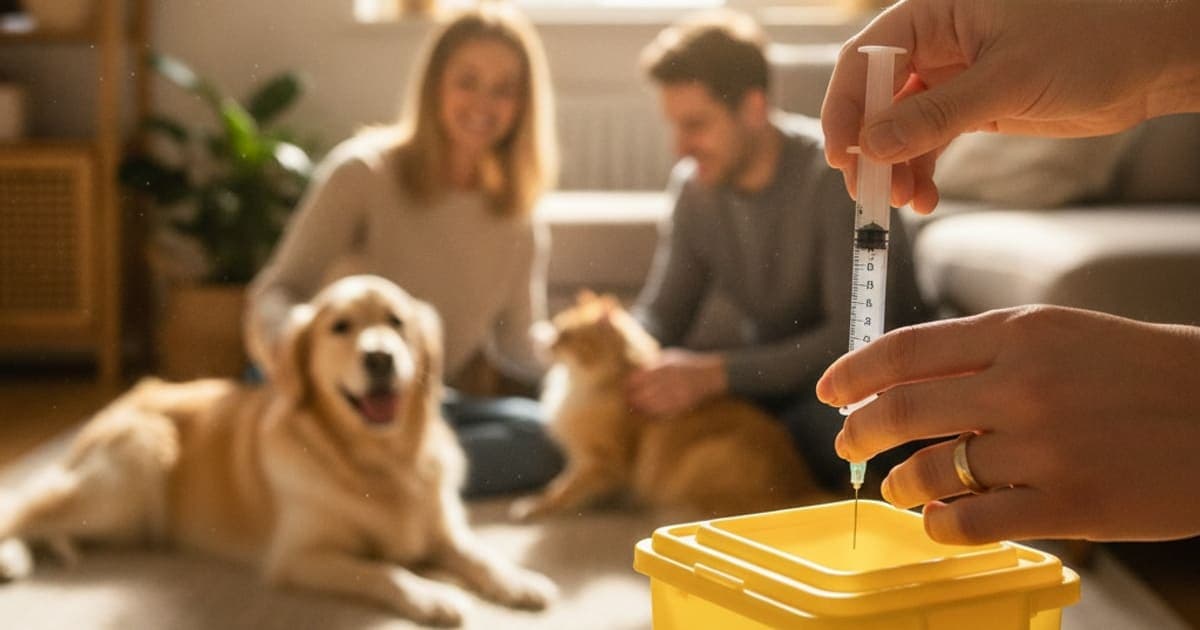
Used needles from TB-500 administration belong in a rigid, puncture-resistant sharps container the moment the injection is finished — not recapped and left on a counter, not dropped in a kitchen bin, and never in the recycling. FDA sharps disposal guidance advises sealing the container when it is around three-quarters full rather than packing it to the brim, then handing it off through a designated route: a veterinary clinic or pharmacy that accepts sharps, a household hazardous waste collection site, or a mail-back program. Because disposal rules are set locally, confirm what your area accepts before your first container fills, and ask your veterinarian what their clinic will take back.
That is the whole answer in one paragraph. The rest of this article explains why each step matters, what makes a container safe versus dangerous, and how to build a routine that keeps a used needle from ever being handled twice.
Why a used needle is hazardous waste, not household rubbish
A needle does not become harmless once the syringe is empty. The tip stays sharp enough to pass through a plastic bin liner, a cardboard box, or a gloved hand, and it carries biological residue from your dog's skin and tissue. Loose sharps in household waste create risk for whoever touches that bag next — a family member compressing the bin, a sanitation worker lifting it, a curious dog or child who gets into the trash before collection day.
There is also a legal dimension. Many jurisdictions classify used sharps as regulated waste and require them to travel through a defined stream rather than municipal rubbish, and rules differ meaningfully between neighbouring areas. That is not a detail worth guessing at, and it is not a number this article can quote for you: check your local waste authority's current published guidance before you dispose of anything.
Never put a used needle anywhere that a person or an animal will later reach into — a sharp should only be handled once, and it should travel in one direction: from your hand straight into a rigid, sealed container.
The practical translation is that your disposal container needs to be in place before you draw up an injection, not found afterwards. Owners who set up a permanent spot — container on a high shelf near where they inject, lid accessible with one hand — almost never end up improvising, and improvising is where needlestick injuries happen.
What to put used sharps in, and what to never use
The container has three jobs: resist puncture, stay upright without tipping, and close in a way that cannot be casually reopened. Purpose-built sharps containers are cleared by the FDA for exactly this and are inexpensive; pharmacies, veterinary clinics and medical supply retailers stock them. If one genuinely is not available, FDA guidance describes an acceptable stand-in — a heavy-duty plastic household container with a tight-fitting, puncture-resistant screw lid, such as an empty laundry detergent bottle — clearly labelled so nobody mistakes it for recycling.
| Container | Suitable? | Why |
|---|---|---|
| FDA-cleared sharps container | Best option | Puncture-resistant, leak-resistant, one-way lid, designed for drop-off programs |
| Heavy-duty plastic bottle with screw cap (e.g. detergent bottle) | Acceptable backup | Thick walls and a tight lid; must be labelled and kept out of recycling |
| Glass jar or coffee can | No | Glass shatters; metal lids do not seal reliably against a needle tip |
| Water or soda bottle | No | Thin walls puncture easily and the container looks recyclable |
| Milk jug or food container | No | Soft plastic, wide opening, high chance it is emptied by mistake |
| Cardboard box, ziplock bag, pill bottle | No | No puncture resistance at all |
Label whatever you use. A strip of tape reading "SHARPS — DO NOT RECYCLE" removes the single most common failure: a well-meaning household member putting the bottle in the wrong bin.
Step by step: from the last injection to a sealed container
Work through this sequence the same way every time. Consistency is what makes safe handling automatic rather than something you think about with a wriggling dog on the table.
- Set the container out first. Open or ready the lid before you handle anything sharp, so your hands are free at the point it matters.
- Finish the injection and keep the needle pointed away from you. Do not switch hands, do not set it down on a towel or the sofa, do not put it back in a wrapper.
- Do not recap, bend or break the needle. Recapping is where a large share of needlestick injuries occur, because it puts a moving sharp point toward a stationary finger.
- Drop the whole unit in, tip first. Needle and syringe go in together as one piece if they are attached. Never try to separate them.
- Close the lid. A one-way sharps lid clicks shut; a screw cap goes back on tight.
- Wash your hands, then wipe down the surface you worked on.
- Seal permanently before the container is full. Follow FDA guidance and close it at roughly three-quarters capacity — an over-packed container makes the next needle stick out of the opening.
Everything else from the session — alcohol swabs, gauze, glove — can go in normal household waste unless your local rules say otherwise. Only the sharp needs the special route. Empty vials without needles are generally handled as regular waste, but ask your veterinarian how they prefer leftover product to be dealt with, particularly if any solution remains inside.
Where a full sharps container can be dropped off
Sealed containers do not go out with the bins. The realistic options, in rough order of convenience:
Your veterinary clinic. Many practices already run a licensed sharps stream for their own use and will accept a sealed container from a client, sometimes for a small fee. This is the first call to make, and it fits naturally into a recheck appointment.
Pharmacies and hospital drop-off points. Some retail pharmacies host collection kiosks. Availability varies enormously between locations, so phone before driving.
Household hazardous waste facilities. Municipal collection sites and periodic collection events frequently accept home-generated sharps. Your local waste authority's website is the authoritative source for what is currently accepted and when.
Mail-back programs. These supply a pre-approved container and a return shipping box that travels to a licensed treatment facility. They are the practical answer for owners without a nearby drop-off. Only ever mail sharps in a container and packaging designed and authorised for it.
Residential pickup services. Available in some areas by arrangement. Again, local — check, do not assume.
Until drop-off day, store the sealed container upright, out of reach of children and pets, and away from heat. It does not need to be hidden, just secure.
When something goes wrong: needlesticks, spills and chewed sharps
If you stick yourself, wash the area immediately with soap and running water, do not squeeze or suck the site, cover it, and contact your own doctor or an urgent care line promptly for advice — that assessment is a medical decision, not a wait-and-see one. Keep the details of what was in the syringe handy; the clinician will ask.
If a needle drops on the floor, pick it up with tongs or a stiff card rather than fingers, and put it straight in the container. If your dog gets hold of a used sharp or you find one chewed, call your veterinarian immediately rather than trying to assess it yourself. And if the injection site looks unusual afterwards — heat, swelling that does not settle, obvious pain on touch — that is a phone call to the clinic, not something to manage at home.
Good technique reduces all of this to near zero. So does the boring habit of never letting a used needle exist outside your hand or the container.
Where K9-REPAIR fits in a recovery routine
Safe sharps handling is one part of a bigger picture: owners doing this at home are usually working through a real recovery — a torn cruciate, a post-operative tendon, an older dog whose mobility has narrowed. K9-REPAIR from pawgen is a BPC-157 and TB-500 formulation made specifically for dogs, dosed by body weight, third-party tested with certificates of analysis available, and shipped direct to the door. It is the stack many owners run alongside their veterinarian's rehab plan, and it is backed by a 60-day money-back guarantee.
The reason owners reach for these two peptides together is mechanistic and genuinely interesting. Published research suggests BPC-157 influences angiogenesis — the growth of new blood vessels — and the fibroblast activity involved in soft-tissue remodelling, which is the biology that governs how a tendon-bone interface rebuilds itself over weeks rather than days. TB-500, a synthetic fragment related to thymosin beta-4, is studied for its role in actin regulation and cell migration, the processes that let repair cells reach the tissue that needs them. Owners report using them through the slow middle stretch of recovery, when the surgical repair has held but function is still returning.
BPC-157 and TB-500 are not FDA-approved veterinary drugs, and this is educational information rather than a promise about your specific dog. Dosing, timing and whether an injectable peptide belongs in your dog's plan at all are conversations to have with your veterinarian — bring the product details to the appointment and decide together.
Key Takeaways
- Used needles go straight into a rigid, puncture-resistant sharps container — never household waste, never recycling.
- Never recap, bend or separate a used needle; drop the whole unit in, tip first.
- Purpose-built sharps containers are best; a heavy-duty screw-cap plastic bottle is the accepted backup. Glass, cans and soda bottles are not.
- Seal the container before it is completely full, per FDA guidance.
- Drop-off routes include veterinary clinics, pharmacy kiosks, hazardous waste sites and mail-back programs. Rules are local — confirm yours.
- A needlestick injury is a same-day call to your own doctor; a dog exposed to a sharp is a same-day call to your vet.
Your veterinarian owns the diagnosis, the imaging, the surgical decision and the rehab timeline — nothing here replaces any of that, and nothing here is a reason to change a prescribed medication. Supplements and peptides operate in the space that proper veterinary care creates, and safe needle handling is simply part of doing that well.
For more on getting the administration side right, pawgen's guide on how to use bpc-157 for dogs covers handling and storage in detail, the first time bpc-157 guide for dogs walks through a first cycle from the beginning, and the formulation itself is K9-REPAIR.
Owners exploring peptide support for their dog can review K9-REPAIR — BPC-157 + TB-500 formulated for dogs — at https://pawgen.com/. BPC-157 and TB-500 are not FDA-approved veterinary drugs. Nothing in this article treats, cures or prevents any condition; every decision about your dog's care belongs with your veterinarian.
Frequently asked questions
- Is a dog stiff after resting an emergency?
- Usually not. Stiffness that shows up after rest and loosens as your dog moves around is a common sign of joint or soft-tissue wear rather than a crisis. It becomes urgent if your dog cannot bear weight, cries out, drags a limb, or the stiffness follows an obvious injury — call your veterinarian then.
- Why is my dog stiff in the morning?
- Overnight immobility is the usual reason. Joints move less, synovial fluid circulates less, and inflamed or arthritic tissue tightens while your dog sleeps, so the first few minutes feel worse. Cold weather and hard bedding make it more noticeable. If the stiffness fades within minutes of gentle movement, that pattern is typical.
- Should I worry if my dog is stiff in the morning?
- It deserves attention rather than alarm. Occasional morning stiffness that resolves quickly is common, especially in older or large-breed dogs. Worth acting on is a pattern that is getting worse week to week, lasting longer each morning, affecting one limb only, or coming with reluctance on stairs. Mention it to your veterinarian.
- When should I take a dog to the vet for stiff in the morning?
- Book an appointment if stiffness persists beyond a few days, worsens over weeks, or your dog limps, skips stairs, struggles to rise, or shows pain on touch. Go sooner for non-weight-bearing lameness, swelling, sudden onset after trauma, or stiffness with fever, lethargy or appetite loss.
- What can I give a dog that is stiff in the morning?
- Nothing from your own medicine cabinet — ibuprofen and paracetamol are toxic to dogs. Pain control should come from your veterinarian. Alongside a vet's plan, many owners add joint support and peptide formulations such as K9-REPAIR from pawgen; BPC-157 and TB-500 are not FDA-approved veterinary drugs, so discuss suitability first.
- Is a dog stiff in the morning an emergency?
- Morning stiffness on its own is rarely an emergency. Treat it as one if your dog cannot stand, refuses to put a leg down, screams when moved, has a swollen or hot joint, or shows sudden weakness in the back legs. Those signs need same-day veterinary attention.
- Can I put my dog's used needles in the household bin?
- No. Needles pierce bin liners and put family members and sanitation workers at risk of injury, and many areas legally require sharps to travel through a designated waste stream. Use a rigid sharps container, seal it, and take it to a veterinary clinic, pharmacy kiosk, hazardous waste site or mail-back program.
- Can a needle be reused for the same dog?
- No. A needle dulls after a single use, which makes the next injection more painful, and reuse introduces contamination risk. One needle, one use, straight into the sharps container without recapping. If cost or supply is pushing you toward reuse, raise it with your veterinarian and sort out a better supply plan.
- What should I do if I prick myself giving my dog an injection?
- Wash the site immediately with soap and running water, avoid squeezing it, cover it, and contact your own doctor or an urgent care line promptly for advice. Note what was in the syringe, since the clinician will ask. Then dispose of the needle in the sharps container before doing anything else.
Educational content. BPC-157 and TB-500 are not FDA-approved veterinary drugs. Talk to your veterinarian before starting anything new, especially if your dog is on prescribed medication.