TB-500 Needle Size for Dogs — Why Your Vet Decides
There is no single correct TB-500 needle size for dogs — gauge, length and route depend on your dog's size, the preparation's volume and viscosity, and your veterinarian's judgement. Published numbers from human peptide forums do not transfer to dogs, which is why administration belongs in your vet's hands.
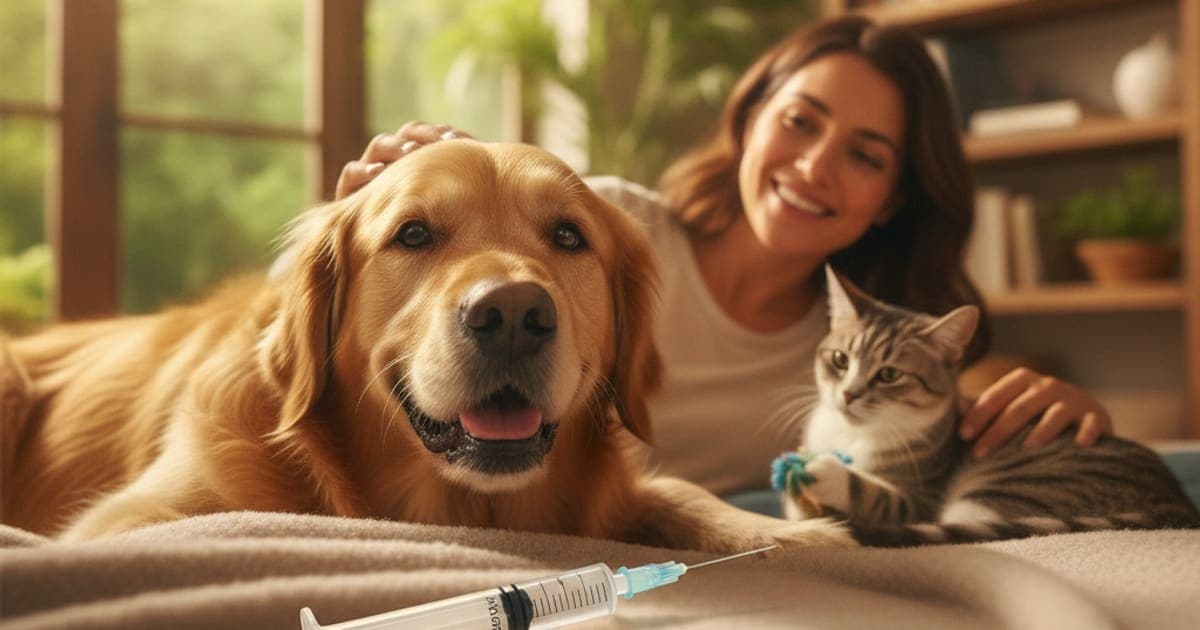
There is no single needle size that is right for every dog, and no responsible source can hand you a gauge number without examining your dog. Needle gauge, needle length and route of administration are clinical decisions that depend on your dog's size and body condition, the volume and viscosity of the preparation in front of you, where on the body it is going, and who is holding the syringe. That decision belongs to your veterinarian. What this article can do is explain, honestly and in detail, what goes into that decision, what TB-500 actually does at a cellular level, and why pawgen built K9-REPAIR so that owners are not standing at a kitchen counter improvising with an unlabelled vial.
Why you should never take a gauge number off a forum
Most of the numbers circulating online for TB-500 came from human peptide communities. They were written by people injecting themselves, for themselves, based on their own anatomy and their own preparation. None of that transfers cleanly to a dog.
A dog's skin is structurally different from human skin — thicker in places, more mobile over the trunk, with a subcutaneous space that varies enormously between a whippet and a mastiff. Coat density changes what you can see and feel. Body condition changes how much loose tissue there is to work with. A dog also moves. A person can hold still for a slow injection; a nervous dog can turn a routine handling moment into a bent needle, a torn skin flap or a bite. The needle that is appropriate for a calm, well-muscled retriever with an experienced handler is not the needle that is appropriate for an anxious terrier who has already learned that the counter means something unpleasant.
There is a second problem with borrowed numbers: they assume a preparation you may not actually have. Gauge selection is partly a fluid-mechanics question. A thin, freely flowing solution passes through a fine needle easily. A more viscous or more concentrated preparation does not — force it through too fine a bore and you get pressure, slow delivery, discomfort and sometimes waste. Nobody on a forum knows what is in your vial.
A number that is correct for a specific dog, a specific preparation and a specific site becomes actively unsafe the moment any one of those three changes — which is exactly why this is a conversation to have with your veterinarian rather than a spec to copy.
What a veterinarian is actually weighing
When a vet or veterinary nurse selects a needle, they are balancing several variables at once. Understanding them will make your conversation with your vet far more productive.
- Gauge. Gauge describes the bore of the needle, and the numbering runs backwards — a higher gauge number means a finer needle. Finer needles are generally more comfortable and cause less tissue trauma, but they deliver more slowly and resist thicker fluids.
- Length. Length is chosen for the target tissue. Reaching the loose space under the skin is a different problem from reaching muscle, and overshooting or undershooting the intended layer changes how the body handles what was delivered.
- Route. Subcutaneous, intramuscular and other routes are not interchangeable. Each has different absorption characteristics, different comfort profiles and different risk of complication.
- Volume. The amount of fluid being delivered influences both the needle and the site. Small volumes tolerate finer needles; larger volumes may need a different approach entirely.
- Viscosity and particulate risk. Reconstituted preparations differ in thickness and in how completely they dissolve. Both affect flow.
- The individual dog. Age, skin condition, coat, body fat, muscle mass, pain sensitivity, surgical history and temperament all feed into it.
- Who is administering. A clinician doing this daily and an owner doing it for the first time are not working with the same margin for error, and a good vet accounts for that honestly.
This is also why the answer can change over the course of a recovery. A dog who has lost muscle mass after orthopaedic surgery is a different physical proposition eight weeks later than on the day the sutures came out.
What TB-500 actually is, and why owners keep asking about it
TB-500 is a synthetic peptide based on a fragment of thymosin beta-4, a small protein that occurs naturally throughout the body and is found in high concentrations in platelets and in wound fluid. Thymosin beta-4's best-characterised biological job is binding G-actin, the monomer that cells assemble and disassemble to build their internal scaffolding. That scaffolding is what allows a cell to change shape and crawl.
That sounds abstract until you think about what repair tissue has to do. When a tendon, ligament or muscle is injured, healing depends on cells physically migrating into the damaged zone — fibroblasts laying down collagen, endothelial cells extending new capillaries into tissue that has lost its blood supply, immune cells clearing debris. Every one of those movements is an actin-driven event. Research on thymosin beta-4 suggests it plays a role in cell migration, in angiogenesis, and in modulating the inflammatory phase of repair. That mechanism is why TB-500 attracted attention in soft-tissue recovery contexts in the first place, and why owners of dogs working through tendon, ligament and mobility problems started asking about it.
None of this is an outcome promise for your dog. TB-500 is not an FDA-approved veterinary drug, the evidence base in dogs specifically is still being built, and pawgen will not tell you what it will do for a particular injury. What can be said fairly is that the mechanism is real biology, the science is genuinely promising, and a growing number of owners are choosing to include it in a recovery plan built with their vet.
Why BPC-157 and TB-500 are used together
K9-REPAIR pairs TB-500 with BPC-157, and the pairing is not arbitrary. BPC-157 is a synthetic peptide sequence derived from a protein found in gastric juice, and research suggests it has effects on blood vessel formation and on the behaviour of tendon fibroblasts — the cells that actually manufacture new collagen.
So the two sit at complementary points in the same repair sequence. Broadly, the research interest in BPC-157 has centred on the local building and signalling side of healing, while the interest in TB-500 has centred on cell mobility and the vascular supply that supports it. Owners run them as a pair for that reason — it is the stack owners reach for through a recovery window rather than two competing options. If you want to understand how owners think about combining and timing them, the discussions of the wolverine stack double dose for dogs and the wolverine stack how long to use for dogs go into that in more depth.
Three ways owners obtain these peptides — and what changes in each
| Route | Who decides administration | What you can actually verify | Where the needle question lands |
|---|---|---|---|
| Unlabelled powder vials bought online with no veterinary oversight | You, alone, from internet guesswork | Often nothing — no identity testing, no purity data, no accountable manufacturer | Entirely on you, with no reliable information about the preparation |
| A preparation obtained through your own veterinarian | Your veterinarian, having examined your dog | Whatever your vet's supply chain documents | Answered directly by the clinician who knows your dog |
| A finished, dog-specific formulation such as K9-REPAIR | pawgen supplies clear directions and weight-based guidance; you confirm the plan with your vet | Third-party testing and certificates of analysis; shipped direct to your door; backed by a 60-day money-back guarantee | Removed as a guessing game — you follow the supplied directions rather than improvising |
The middle and bottom rows are the honest options. The top row is where owners get into trouble, and it is worth being blunt about it: a vial with no certificate of analysis behind it tells you nothing about identity, purity, sterility or concentration. pawgen's position on that is not neutral. Skepticism belongs pointed at anonymous suppliers, kitchen-sink chews with a token dusting of active ingredient, and brands whose marketing budget exceeds their testing budget — not at the peptides themselves.
Handling, storage and the risks owners underestimate
If your veterinarian does prescribe or supervise an injectable preparation, the needle is only one part of the safety picture. Sterile technique matters more than gauge. Every entry into a vial is an opportunity for contamination, and a contaminated preparation delivered into tissue is a genuinely serious problem — abscess, cellulitis, systemic infection. Needles are single-use, always. Reusing a needle blunts the tip, which increases pain and tissue damage, and carries contamination straight back into the vial.
Storage matters too. Peptides are proteins, and proteins are fragile. Heat, light and repeated temperature swings degrade them. Follow the storage instructions that come with whatever you have, and do not assume that something left in a warm car is still what it was.
Finally, watch the site. Swelling, heat, persistent pain, discharge or a lump that does not settle are all reasons to phone your vet the same day rather than waiting to see. Owners are generally the first to notice that something is off, and that early observation is genuinely valuable clinical information.
Key Takeaways
- There is no universal needle gauge or length for TB-500 in dogs; the correct choice depends on your dog, the preparation and the route, and it is a veterinary decision.
- Gauge numbering runs backwards — higher numbers mean finer needles — and finer is not automatically better, because thicker preparations resist fine bores.
- Numbers copied from human peptide forums assume human anatomy and an unknown preparation. Neither assumption holds for your dog.
- TB-500 is based on thymosin beta-4, which binds G-actin and is involved in the cell migration and blood-vessel formation that soft-tissue repair depends on.
- K9-REPAIR combines BPC-157 and TB-500 in a dog-specific formulation with third-party testing, published certificates of analysis, weight-based guidance and a 60-day money-back guarantee.
- Sterile technique, single-use needles and correct storage matter at least as much as the needle itself.
The order of operations that protects your dog
Get the diagnosis first. A limp is a symptom, not a condition, and the difference between a partial cruciate tear, a soft-tissue strain, early osteoarthritis and something less common changes everything that follows. Your veterinarian owns that diagnosis and owns the treatment plan — the imaging, the surgical decision, the prescribed medication, the rehab schedule. If your dog is on carprofen, gabapentin, a monoclonal antibody injection or anything else, that stays exactly as prescribed unless the vet who prescribed it says otherwise. Nothing on this page is an alternative to surgery or to a prescription.
Peptides operate in the space that proper veterinary care creates, not instead of it. Bring K9-REPAIR to your vet, show them the certificate of analysis and the ingredient list, and make it part of a plan someone qualified is supervising. That is how owners use it well.
For more on how owners approach combining and timing these peptides, see the wolverine stack double dose for dogs and the wolverine stack how long to use for dogs, or read the full formulation details for K9-REPAIR.
Owners exploring peptide support for their dog can review K9-REPAIR — BPC-157 + TB-500 formulated for dogs — at https://pawgen.com/. BPC-157 and TB-500 are not FDA-approved veterinary drugs. Nothing in this article treats, cures or prevents any condition; every decision about your dog's care belongs with your veterinarian.
Frequently asked questions
- What can I give a dog that is trouble with stairs?
- Start with a veterinary exam, because stair reluctance usually signals joint, spinal or muscular pain that needs diagnosis. Alongside whatever your vet prescribes, many owners add a peptide formulation such as K9-REPAIR, plus traction mats, ramps and controlled weight management. Research suggests these peptides may support soft-tissue recovery mechanisms.
- Is a dog trouble with stairs an emergency?
- Usually not, but it can be. Sudden inability to use the hind legs, dragging paws, loss of bladder control, crying out or collapse warrants same-day emergency care, as these can indicate spinal disease. Gradual reluctance developing over weeks is not an emergency, though it still deserves a prompt veterinary appointment.
- Why is my dog trouble jumping in the car?
- Jumping loads the hind limbs and spine heavily, so it is often the first activity a dog abandons. Common reasons include osteoarthritis, cruciate ligament injury, hip dysplasia, lumbosacral pain, muscle loss with age, or a soft-tissue strain. Only a veterinary examination, often with imaging, can identify which applies to your dog.
- Should I worry if my dog is trouble jumping in the car?
- Take it seriously rather than worry. Dogs hide pain well, so a refusal to jump usually means discomfort has already been present for a while. It is a meaningful early signal, not something to wait out. Book a veterinary assessment and note when it started and which leg looks affected.
- When should I take a dog to the vet for trouble jumping in the car?
- Book an appointment once the reluctance repeats over several days, or immediately if it appears suddenly, comes with a visible limp, yelping, swelling, or unwillingness to bear weight. Earlier assessment gives your veterinarian more options, particularly with ligament injuries where progression changes which treatments remain appropriate.
- What can I give a dog that is trouble jumping in the car?
- Follow your veterinarian's plan first, which may include prescribed pain control, weight management and structured rehab. Many owners also use K9-REPAIR, a BPC-157 and TB-500 formulation made for dogs with third-party testing and certificates of analysis. Add a ramp immediately to remove the load while your vet investigates.
Educational content. BPC-157 and TB-500 are not FDA-approved veterinary drugs. Talk to your veterinarian before starting anything new, especially if your dog is on prescribed medication.