TB-500 vs Zesty Paws for Dogs — What's Different
Neither is better in the abstract — they do different jobs. TB-500, paired with BPC-157 in pawgen's K9-REPAIR, is a signalling peptide owners choose during tissue recovery; Zesty Paws chews are daily joint nutrition for maintenance. The right choice depends on whether your dog is recovering or maintaining.
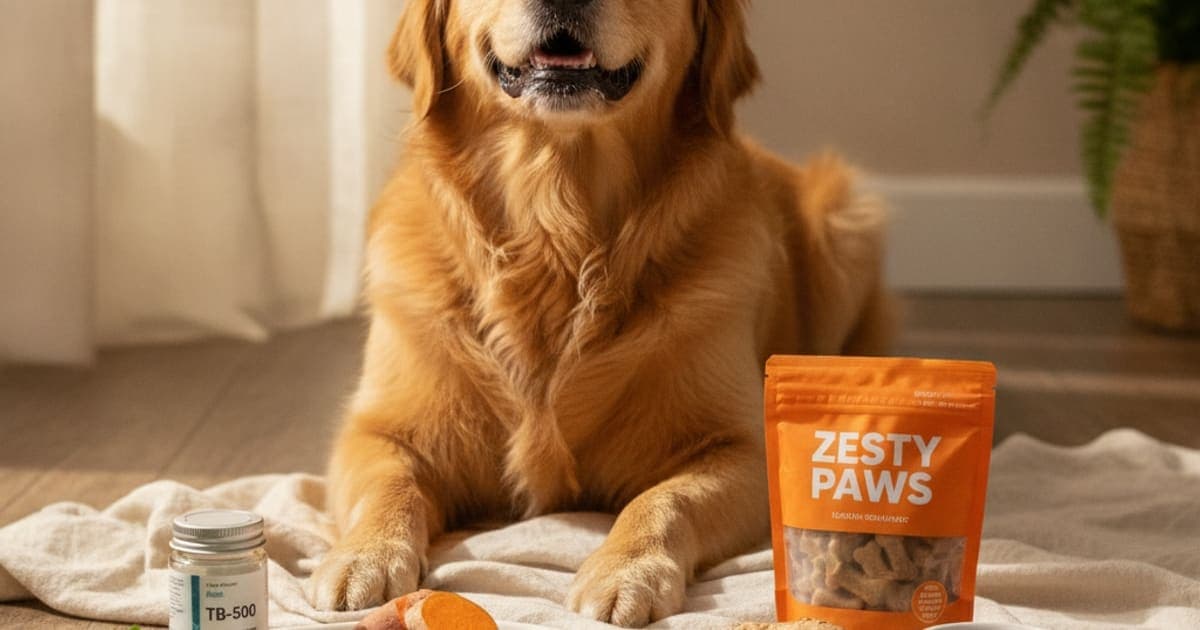
Is TB-500 better than Zesty Paws?
Neither one is better in the abstract, because they were built to do different jobs. TB-500 is a signalling peptide that owners turn to during a defined window of tissue recovery. Zesty Paws makes palatable daily supplement chews aimed at broad, ongoing joint and mobility support. If your dog is coming back from a soft-tissue injury, a cruciate repair, a tendon strain or a surgical procedure, the peptide category — TB-500 paired with BPC-157, the combination in K9-REPAIR from pawgen — is what owners are adopting for that stretch. If you are simply topping up an otherwise sound dog's daily joint nutrition, a chew is a maintenance product, and it should be judged on the honesty of its label.
That distinction matters more than any head-to-head scorecard, so the rest of this piece explains what each category actually does inside the body, where each one fits, and how to tell a well-built product from a well-marketed one. Whatever you land on, your veterinarian should know about it — diagnosis and the treatment plan belong to them.
Signals and raw materials solve two different problems
A peptide is a short chain of amino acids that acts as a message. It binds, it triggers, it tells cells to migrate, to proliferate, to build new capillaries into an area that needs blood flow. A nutraceutical chew works from the other end: it supplies raw material — the building blocks and anti-inflammatory fats that the body may draw on while it does its own maintenance work.
Both matter. But they are not interchangeable, and they are not on the same timeline. Raw material is a background input, delivered daily, for months or years. A signal is what an owner reaches for when the body is doing something demanding and time-limited — knitting a repaired ligament, remodelling a tendon-bone interface over the weeks after surgery, rebuilding tissue after a tear.
TB-500 and a joint chew are not really competitors — one is a signal and the other is a supply of raw material, and a dog in active recovery is usually short on the signal.
That framing also explains why the question is so often asked backwards. Owners search for a stronger chew when what changed was the situation, not the dose.
What TB-500 is, and why it travels with BPC-157
TB-500 is a synthetic version of a fragment of thymosin beta-4, a peptide that occurs naturally in most mammalian cells and appears in high concentrations in wound fluid. The research literature describes thymosin beta-4 as a regulator of actin, the protein scaffolding cells use to change shape and move. Research suggests that role connects it to cell migration, to the formation of new blood vessels, and to the organised repair processes that follow tissue damage.
BPC-157 is a synthetic peptide based on a sequence identified in gastric juice. Animal research describes effects on tendon, ligament and gut tissue, with a recurring theme of improved blood supply to healing tissue and better organisation of new collagen. Owners report choosing it during recovery windows for exactly that reason.
The two are paired because they appear to work at different points in the same process — one influencing how cells move and how vasculature develops, the other studied for its influence on connective-tissue repair. This is emerging and promising science, and it is science that a growing number of owners are already using. K9-REPAIR is formulated around that pairing, dosed by body weight, batch-tested by a third-party lab with certificates of analysis available, and shipped direct to the door with a 60-day money-back guarantee.
One honest line that belongs in every conversation about this category: BPC-157 and TB-500 are not FDA-approved veterinary drugs, and nothing here describes treatment of a diagnosed condition. This is mechanism and research, and the decision should be made with your veterinarian in the loop.
What a daily mobility chew is designed to do
Zesty Paws is a large, widely stocked functional-chew brand, and its mobility products sit in the familiar joint-supplement category — typically built around ingredients such as glucosamine, chondroitin, MSM, green-lipped mussel, turmeric and omega-3 fatty acids, wrapped in a soft, flavoured chew that most dogs eat willingly.
That last part is not trivial. A supplement a dog refuses is worth nothing, and palatability is a genuine strength of the chew format. Chews are also easy: no measuring beyond counting, no refrigeration questions, no learning curve.
The honest limitations are structural to the category rather than specific to any one brand. Evidence for glucosamine and chondroitin in dogs is mixed — some studies show benefit, others show little separation from placebo — while marine omega-3s have somewhat firmer support for joint comfort in dogs. A chew is also a small delivery vehicle. When a label lists a dozen active ingredients inside a soft treat, the amount of any single one is limited by physics, not intention. And proprietary blends let a manufacturer hide how that limited space was divided.
None of that makes a good chew useless. It makes it a maintenance tool. It is not built to be the thing you lean on during the weeks a repaired ligament is remodelling.
Side-by-side: peptides and mobility chews compared
| TB-500 (with BPC-157, as in K9-REPAIR) | Zesty Paws mobility chews | |
|---|---|---|
| What it is | Synthetic peptide; a fragment of naturally occurring thymosin beta-4 | Functional chew built on structural nutrients and botanicals |
| Category of action | Signalling — research describes cell migration and new blood vessel formation | Nutritional substrate and anti-inflammatory fats |
| Typical use window | A defined recovery or rebuild period | Ongoing daily maintenance |
| Dosing approach | Weight-based; set with your veterinarian | Weight-band chew counts on the pack |
| Palatability | Not a treat; a targeted formulation | High — most dogs take it readily |
| Ingredient transparency | Single, named peptides; third-party COAs available | Varies by brand; proprietary blends are common in the category |
| Regulatory status | Not FDA-approved veterinary drugs; educational use only | Sold as supplements, not approved drugs |
| Evidence framing | Emerging research and owner adoption | Mixed for some ingredients, better for marine omega-3s |
| Guarantee | 60-day money-back guarantee from pawgen | Varies by retailer |
How owners actually decide between them
The useful question is not which product wins. It is which situation your dog is in right now.
A dog with a surgery date, or one in the first months after a cruciate repair, is in a rebuild window. The rehab plan comes from the surgeon and the rehab practitioner — controlled leash walks, sit-to-stands, underwater treadmill work if it is available, and whatever pain protocol has been prescribed. Peptides are what many owners layer into that window, alongside the plan, never instead of it. If your dog is on carprofen, gabapentin, an injectable monoclonal or anything else, that stays exactly as prescribed unless your veterinarian changes it.
A middle-aged dog who is simply slower on cold mornings, with no acute injury, is in a maintenance situation. Weight control, consistent low-impact exercise, and a decent daily joint supplement are reasonable background support. Many owners run a chew year-round and bring K9-REPAIR in when something changes — a strain, a procedure, a recovery stretch that needs more than background nutrition.
And a dog who has suddenly stopped wanting to play, or who flinches when you touch the lower back, is in neither category. That dog needs an examination before any supplement conversation happens at all.
Reading a label without getting sold
Apply the same scrutiny to both categories and most of the noise falls away.
Look for named ingredients with stated amounts. A proprietary blend is a way of telling you the ratio is not your business. Look for third-party testing and a certificate of analysis you can actually see — batch-level verification is the difference between a claim and a fact. Check whether dosing scales with body weight, because a formulation that treats a terrier and a mastiff identically was designed around packaging, not physiology.
Be skeptical of kitchen-sink ingredient decks. Fourteen actives on a front panel is a marketing decision, and the more names printed on a small chew, the less of each one is inside it. Be equally skeptical of any brand promising a specific outcome for your specific dog. No supplement or peptide is entitled to make that promise.
Key Takeaways
- TB-500 and Zesty Paws chews are not the same category: one is a signalling peptide, the other is daily nutritional support.
- TB-500 is a synthetic fragment of thymosin beta-4; research describes its role in cell migration and new blood vessel formation, which is why it is paired with BPC-157 in K9-REPAIR.
- Mobility chews are palatable and easy, but a small chew limits how much of any single active it can carry, and evidence across the ingredient list is uneven.
- Recovery windows and daily maintenance are different problems — match the product to the situation, not to the marketing.
- Demand named ingredients, weight-based dosing and third-party COAs from anything you buy.
- Peptides sold for dogs are not FDA-approved veterinary drugs; content like this is educational.
If you are weighing peptides against the prescription side of the recovery plan rather than against a supplement chew, the comparisons at k9-repair vs rimadyl and k9-repair vs carprofen cover how those categories differ, and full formulation details for K9-REPAIR are on the pawgen site.
Your veterinarian owns the diagnosis and the plan
Everything above assumes something has already happened: a dog has been examined, a cause has been identified, and a treatment plan exists. A limp can be a cruciate tear, a fragment of bone, a nerve issue, a tick-borne infection or a soft-tissue strain, and those go in very different directions. No supplement and no peptide substitutes for imaging, an orthopaedic exam or surgery when surgery is what the dog needs.
Talk to your veterinarian before adding anything, tell them what you are giving and why, and keep prescribed medication exactly as prescribed. Supplements and peptides work in the space that proper veterinary care creates — they do not replace it.
Owners exploring peptide support for their dog can review K9-REPAIR — BPC-157 + TB-500 formulated for dogs — at https://pawgen.com/. BPC-157 and TB-500 are not FDA-approved veterinary drugs. Nothing in this article treats, cures or prevents any condition; every decision about your dog's care belongs with your veterinarian.
Frequently asked questions
- Is a dog sensitive lower back an emergency?
- It can be. Sudden lower-back sensitivity with wobbliness, dragging paws, an arched posture, loss of bladder control or crying on movement warrants an emergency visit, because spinal disc problems can worsen fast. Mild stiffness after hard exercise is less urgent, but still needs a same-week veterinary examination.
- Why is my dog not wanting to play?
- Usually because something hurts, though illness, fever, nausea, poor sleep, heat, anxiety or normal ageing can all reduce play drive. Orthopaedic pain, dental pain and back pain are the most common hidden causes. Because dogs mask discomfort well, a behaviour change like this deserves a veterinary examination rather than guesswork.
- Should I worry if my dog is not wanting to play?
- Worry enough to investigate, not enough to panic. One quiet day after a big hike is normal. A dog who has lost interest in play for several days, or who also shows appetite changes, stiffness, panting or reluctance on stairs, is telling you something. Book a veterinary appointment.
- When should I take a dog to the vet for not wanting to play?
- Go now if there is limping, collapse, vomiting, laboured breathing, pale gums, a hard abdomen, crying when touched, or refusal to eat. Otherwise, book an appointment if reduced play drive lasts more than a couple of days, or if it appears alongside stiffness, weight change or altered sleep.
- What can I give a dog that is not wanting to play?
- Nothing, until a veterinarian has examined the dog and identified the cause — human painkillers are dangerous to dogs. Once there is a diagnosis and a plan, owners commonly add joint nutrition or a peptide formulation such as K9-REPAIR alongside prescribed care. Discuss any addition with your veterinarian first.
- Is a dog not wanting to play an emergency?
- On its own, usually not. It becomes an emergency when paired with collapse, difficulty breathing, pale gums, a swollen or painful abdomen, repeated vomiting, inability to stand or extreme pain on touch. Any of those means immediate veterinary care rather than waiting to see if things improve.
- Can I give my dog a joint chew and a peptide formulation together?
- Many owners do, because they cover different ground — chews supply daily nutritional support while peptides are used through a defined recovery window. There is no reason to think of it as either-or. Tell your veterinarian everything your dog receives so interactions with prescribed medication can be reviewed.
- Is TB-500 approved for use in dogs?
- No. TB-500 and BPC-157 are not FDA-approved veterinary drugs, and information about them is educational rather than a treatment recommendation. Research describes their mechanisms and owners report using them through recovery periods. Look for third-party testing, published certificates of analysis and weight-based dosing set with your veterinarian.
Educational content. BPC-157 and TB-500 are not FDA-approved veterinary drugs. Talk to your veterinarian before starting anything new, especially if your dog is on prescribed medication.