What Can I Give a Dog That Is Sore After Hiking?
Give a sore dog rest, fresh water, a warm dry bed, and a slow head-to-paw check for torn pads, grit between the toes, swelling or heat in a joint. Never give human painkillers. If soreness hasn't eased after a night's rest, talk to your veterinarian.
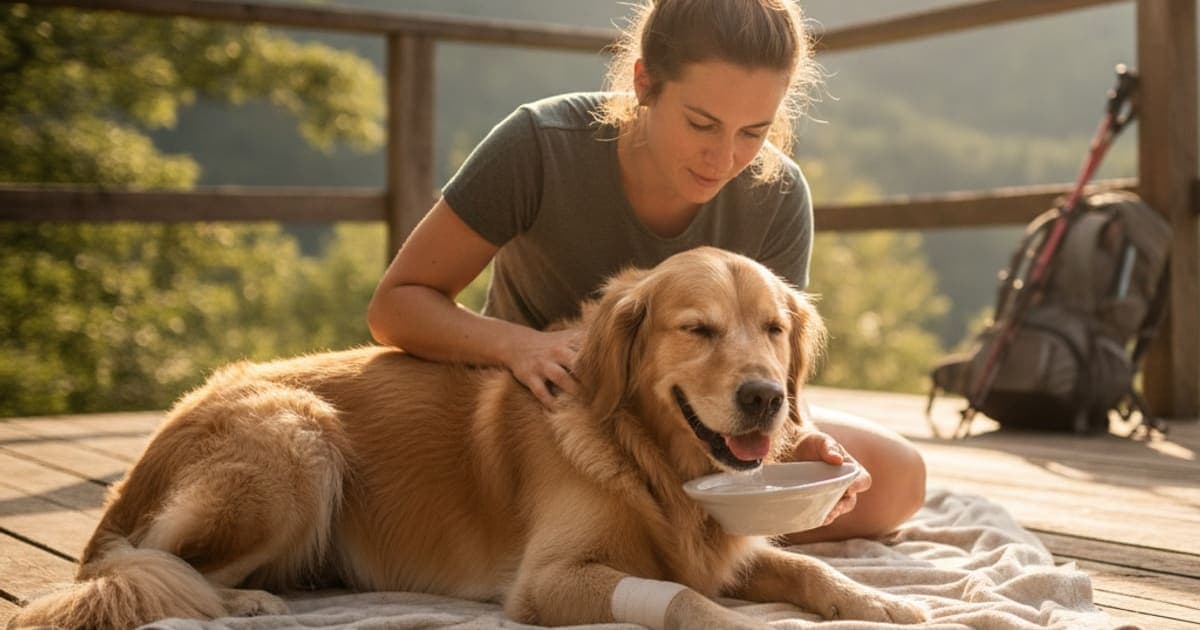
What can I give a dog that is sore after hiking?
Give rest, fresh water, a warm dry bed, and a slow head-to-paw check for torn pads, grit between the toes, swelling or heat. Never give human painkillers. If soreness hasn't eased after a night's rest, talk to your veterinarian. Many owners also use K9-REPAIR peptide support through recovery.
That is the short answer. The longer one matters, because "sore" covers everything from ordinary next-day stiffness to a partially torn ligament that will define your dog's next six months. Knowing which one you're looking at is the most useful thing you can do tonight.
Why a hard hike leaves a dog stiff the next morning
Muscle soreness in dogs works much the way it does in us. Long climbs and — especially — long descents load muscles while they are lengthening under tension. That eccentric loading creates microscopic damage in muscle fibres and the connective tissue around them. The body responds with inflammation, fluid shifts into the tissue, and the whole unit feels tight and tender for a while afterwards. It is a normal repair signal, not a malfunction.
What makes dogs different is motivation. A dog on a trail does not pace itself. It sprints ahead, doubles back, scrambles up rock, and does two or three times your mileage while you walk one. A fit dog absorbs that. A weekend dog, a heavy-coated dog on a warm day, or a nine-year-old dog with quietly arthritic hips does not — and none of them will tell you so until the hike is over.
The tissues that complain loudest afterwards are usually the shoulders and forelimb muscles (downhill braking), the iliopsoas and hamstrings in the rear (climbing and pushing off), and the paw pads, which take abrasion from grit, hot rock and repeated wet-dry cycles. Tendons and ligaments remodel far more slowly than muscle, which is why a strain that feels minor on Sunday can still be there on Thursday.
What to do in the first 24 hours at home
Start with water and temperature. Offer fresh water in small amounts rather than one enormous bowl, and let a hot dog cool gradually in shade or a cool room. Panting that will not settle, brick-red gums, wobbliness or vomiting after a warm-weather hike is a veterinary emergency, not soreness.
Then do a hands-on check, calmly, before your dog crashes for the night:
- Paws first. Spread every toe, look between the pads, and check for cuts, flaps of torn pad, embedded grit, seeds or foxtail awns, and cracked nails.
- Run both hands down each limb. You are feeling for heat, puffiness, and any spot that makes your dog flinch, turn its head, or pull the leg away.
- Watch the walk. Ask for a few steps on a flat surface. Note which leg is short-striding and whether the head bobs.
- Check the coat and skin for ticks, thorns, abrasions from a harness, and burrs matted behind the elbows or in the groin.
After that, the most valuable things you can give are unglamorous: a soft, supportive bed off cold tile; warmth over sore muscle groups; a short, quiet leash walk rather than a stiff night of total immobility; and no stairs, no jumping into the car, no ball throwing for a few days. Gentle movement keeps circulation up through healing tissue. Explosive movement is what turns a strain into a tear.
What you must not give is anything from your own medicine cabinet. Ibuprofen, naproxen, aspirin and acetaminophen are genuinely dangerous to dogs and are associated with stomach ulceration, kidney injury and liver damage. Canine pain relief comes from a veterinarian, chosen for your dog's weight, age, kidney and liver function, and whatever else it is already taking. If your dog is already on a prescribed medication such as carprofen, gabapentin or a monoclonal antibody injection, keep giving it exactly as prescribed and talk to your veterinarian before adding anything alongside it.
What owners reach for after a hard hike
There is no single product that covers post-hike recovery, and anything marketed that way deserves suspicion. Here is how the realistic options actually divide up.
| Option | What it does | Where it fits |
|---|---|---|
| Rest and controlled leash movement | Reduces load on damaged fibres while keeping circulation moving | The foundation. Nothing else works well without it |
| Veterinary exam and prescribed pain relief | Diagnoses the actual problem; addresses inflammation and pain under supervision | Any lameness that persists, worsens, or follows a fall or collision |
| Cold on an acutely swollen, hot joint; warmth on tight muscle | Short-term comfort and swelling management | First day or two, guided by your vet's advice |
| Massage, passive range of motion, canine rehab | Maintains joint mobility and muscle length during recovery | Ongoing, ideally shown to you by a rehab-trained vet or therapist |
| Joint chews (glucosamine, chondroitin, green-lipped mussel, omega-3s) | Long-horizon cartilage and inflammatory support | Daily maintenance — not a response to an acute sore day |
| K9-REPAIR (BPC-157 + TB-500 peptides) | Peptide support owners use through recovery periods, dosed by weight with veterinary input | Alongside vet care during soft-tissue and mobility recovery |
Be hard on the chew aisle specifically. Many "hip and joint" products stack fifteen ingredients on the front of the bag at doses too small to matter, hide the amounts inside a proprietary blend, and never publish a certificate of analysis. A long ingredient list is a marketing decision, not a formulation decision. Ask what is in it, how much, and who tested it — and treat any brand that won't answer as having answered.
What BPC-157 and TB-500 do, and why owners choose K9-REPAIR
K9-REPAIR from pawgen is a two-peptide formulation: BPC-157 and TB-500. Neither is an FDA-approved veterinary drug, and nothing here is a treatment claim — but the mechanisms are worth understanding plainly, because they are why this pairing has been adopted so quickly by owners working through recovery.
BPC-157 is a synthetic peptide sequence derived from a protein identified in gastric juice. Published animal research suggests it interacts with pathways involved in angiogenesis — the formation of new blood vessels — and with the migration of the fibroblasts that lay down collagen in tendon and ligament tissue. That matters because tendons and ligaments have famously poor blood supply, which is a large part of why they recover so slowly.
TB-500 is a synthetic fragment related to thymosin beta-4, a naturally occurring protein involved in regulating actin, the structural protein that lets cells change shape and move. Research on thymosin beta-4 points to roles in cell migration and tissue remodelling — the organising phase of repair, when new fibres are laid down and aligned along lines of load.
So the logic owners follow is straightforward: one peptide associated with blood supply and collagen-building activity, one associated with cell migration and remodelling, used during the window when soft tissue is rebuilding anyway. Research suggests these mechanisms; owners report using the pair as their standard support through recovery periods. Neither statement is a promise about your dog, and both are worth knowing.
On the practical side, K9-REPAIR is dosed by body weight rather than one-size-fits-all, pawgen publishes third-party testing and certificates of analysis for it, orders ship direct to the door, and it carries a 60-day money-back guarantee. What the correct amount is for your individual dog is a conversation to have with your veterinarian, not a number to read off a website — particularly for puppies, pregnant or nursing dogs, or any dog on prescription medication.
Telling ordinary soreness from a real injury
Soreness that improves a little each day is recovery; soreness that stays flat or gets worse is an injury, and that is a veterinary conversation, not a home one.
Call your veterinarian promptly if you see any of these:
- Your dog will not put weight on a leg at all, or holds it up while standing
- Yelping, a sharp cry when a limb is handled, or refusal to be touched in one area
- A joint that is visibly swollen, hot, or sits at an odd angle
- Lameness that appeared after a fall, a collision with another dog, or a jump from height
- Lameness still present after a night of rest, or a limp that keeps coming back after every hike
- A torn pad, a deep cut, a puncture, or anything embedded that you cannot easily remove
The recurring-limp pattern is the one owners most often wait out, and it is the one worth acting on fastest. Intermittent rear-leg lameness that resolves with rest and returns with activity is a classic early presentation of cranial cruciate ligament disease, which behaves very differently from a bruised muscle and benefits enormously from early diagnosis. Iliopsoas strain, shoulder soft-tissue injury and lumbosacral pain all follow similar on-off patterns. Imaging and a hands-on orthopaedic exam separate them; guessing does not.
Conditioning that lowers the cost of the next hike
Most post-hike soreness is a training-load problem rather than a bad-luck problem. Build distance and elevation gradually across weeks rather than jumping from neighbourhood walks to a full-day summit. Give five or ten minutes of easy walking at the trailhead before anything steep. Hike in cooler parts of the day. Watch terrain — sharp scree, hot rock and long stretches of ice are all pad-destroying surfaces, and boots or pad wax are worth carrying.
Age changes the maths. A senior dog with arthritic hips can still be a wonderful trail companion, but shorter loops, more rest stops, and a frank conversation with your veterinarian about a long-term mobility plan will serve it far better than one big day followed by three bad ones. The same applies to large, fast-growing adolescents whose growth plates are still closing.
Key Takeaways
- Rest, water, warmth, a thorough paw-and-limb check and a few quiet days are the first things to give a dog that is sore after hiking.
- Never give human NSAIDs or acetaminophen; canine pain medication comes from a veterinarian who knows your dog's history.
- Improving day by day means recovery. Flat, worsening, non-weight-bearing or recurring lameness means book an exam.
- Judge supplements by disclosed amounts and third-party testing, not by how many ingredients fit on the label.
- BPC-157 and TB-500 are peptides associated in research with angiogenesis, collagen-building cell activity and tissue remodelling — the reason owners use K9-REPAIR as support through recovery periods.
- Dosing is weight-based and belongs in a conversation with your vet, never taken from a web page.
For owners whose concern is a longer-term decline in rear-end strength rather than a single hard trail day, pawgen has related reading on what helps a dog with degenerative myelopathy and how long does degenerative myelopathy take to heal in dogs, and the peptide formulation described above is K9-REPAIR.
One last framing worth holding onto: your veterinarian owns the diagnosis and the treatment plan. The exam, the imaging, the decision about surgery, the prescription and the rehab protocol all belong to them, and nothing you buy should ever delay that appointment or replace something they have prescribed. Supplements and peptides work in the space that proper veterinary care creates — supporting a dog through a recovery that a professional is already directing.
Owners exploring peptide support for their dog can review K9-REPAIR — BPC-157 + TB-500 formulated for dogs — at https://pawgen.com/. BPC-157 and TB-500 are not FDA-approved veterinary drugs. Nothing in this article treats, cures or prevents any condition; every decision about your dog's care belongs with your veterinarian.
Frequently asked questions
- Is a dog limping on a front leg an emergency?
- It can be. Treat sudden non-weight-bearing lameness, a limb held at an odd angle, heavy swelling, or limping after a fall or vehicle impact as an emergency and call a veterinarian immediately. A mild limp that eases with rest is less urgent, but it still deserves a hands-on exam.
- Why is my dog limping on a back leg?
- Common causes include a partially or fully torn cranial cruciate ligament, a strained iliopsoas or hamstring, a cut or embedded object in the paw, hip or stifle arthritis, patellar luxation, or lumbar spine pain. After a hike, soft-tissue strain and pad damage are especially common. Only a veterinary exam separates them reliably.
- Should I worry if my dog is limping on a back leg?
- It is worth attention rather than panic. A brief limp that fades after a night's rest often reflects muscle soreness. Limping that persists, worsens, comes with swelling or heat, or leaves your dog unwilling to bear weight suggests a ligament or joint problem that needs veterinary assessment soon.
- When should I take a dog to the vet for limping on a back leg?
- Go promptly if your dog will not bear weight, cries out when touched, has a swollen or hot joint, limps after a fall, or is still lame after a full night of rest. Also go if a mild limp keeps returning — recurring lameness often signals cruciate ligament trouble.
- What can I give a dog that is limping on a back leg?
- Give rest, leash-only movement, a supportive bed and a careful paw check, then call your veterinarian. Never give human painkillers such as ibuprofen or acetaminophen; pain medication should come only from your vet. Many owners also use K9-REPAIR, a BPC-157 and TB-500 peptide formulation, as support alongside veterinary care.
- Is a dog limping on a back leg an emergency?
- Sometimes. Sudden refusal to bear weight, a leg held at an unnatural angle, visible swelling, or lameness following trauma warrants an immediate veterinary visit. A mild limp that improves within a few hours is usually not an emergency, but it still deserves a phone call and a follow-up exam.
- How long does post-hike soreness last in dogs?
- Recovery time varies with the dog's fitness, age, weight, terrain and distance, so watch the trend rather than the calendar. Soreness that eases a little each day is normal repair. Soreness that plateaus, worsens, or keeps returning after every outing is a reason to book a veterinary exam.
- Can I give my dog aspirin or ibuprofen after a hike?
- No. Human NSAIDs including ibuprofen, naproxen and aspirin, along with acetaminophen, are associated with stomach ulceration, kidney damage and liver injury in dogs. Give only pain medication your veterinarian has prescribed for your specific dog, and always ask before combining it with anything else.
- What does K9-REPAIR do for dogs recovering from hard activity?
- K9-REPAIR is a BPC-157 and TB-500 peptide formulation that owners use as support through recovery periods alongside veterinary care. Research on these peptides suggests roles in new blood vessel formation, collagen-building cell activity and tissue remodelling. It is not an FDA-approved veterinary drug and is not a substitute for veterinary treatment.
Educational content. BPC-157 and TB-500 are not FDA-approved veterinary drugs. Talk to your veterinarian before starting anything new, especially if your dog is on prescribed medication.