What Does Dog Paw Balm Do? (Paw Care Explained)
Dog paw balm lays a thin, semi-occlusive film over the pad that slows moisture loss and buffers contact with ice-melt salt, grit and rough ground, while waxes, butters and oils soften hardened keratin so the pad flexes instead of cracking. It conditions and shields — it does not medicate.
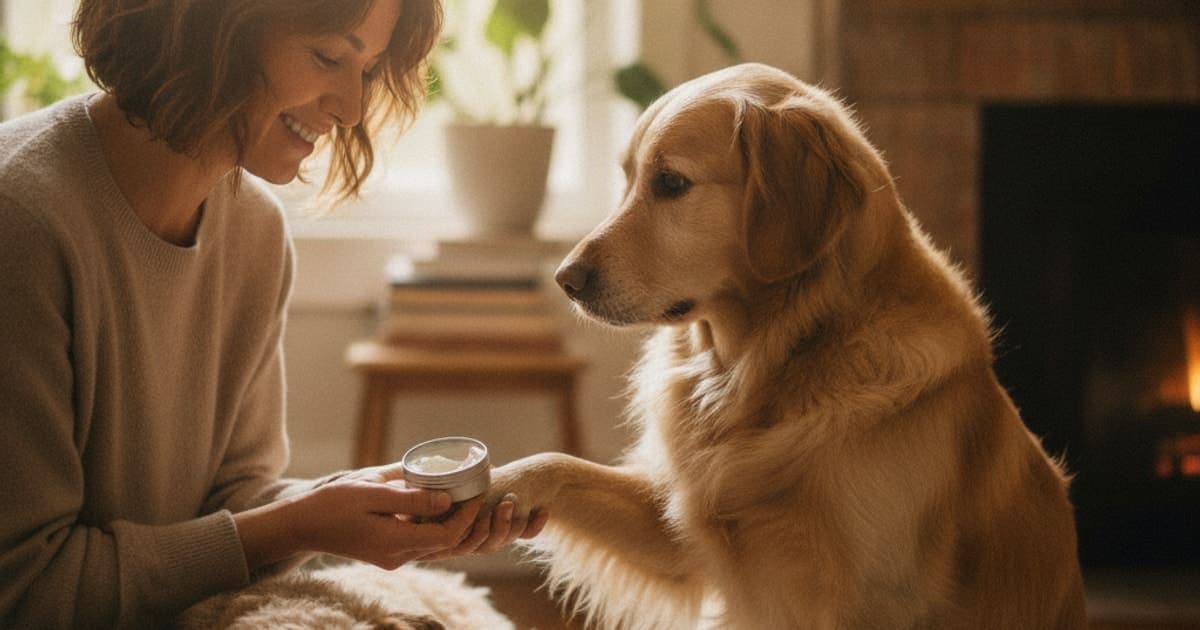
Dog paw balm conditions and shields the skin of the paw pad, and it does both jobs at the same time. The waxes in it form a thin, semi-occlusive film on the surface that slows water escaping from the skin and buffers direct contact with salt, grit and chemical residue. The butters and oils sink into the dry outer layer of the pad so hardened keratin stays pliable and bends under load instead of splitting.
That is the whole mechanism, and it is worth stating plainly, because paw balm is often marketed with language it cannot support. A balm is a skin-surface product. It is not an anti-inflammatory, it is not an antibiotic, and it does not reach anything beneath the skin. Whether your dog needs one is a question about surfaces and seasons — not a default of dog ownership.
What paw balm is, and what is actually in the tin
Paw balm is an anhydrous ointment — no water in the formula — built from three families of ingredients:
- Waxes such as beeswax, carnauba or candelilla. These give the product its solid structure and create the occlusive film that sits on the pad surface.
- Butters such as shea, cocoa or mango. These are semi-solid fats that act as emollients, softening and smoothing the outer layer of skin.
- Liquid oils such as coconut, olive, sunflower, sweet almond or jojoba. These carry the fats, improve spreadability and supply fatty acids to dry keratin.
Many formulas add a stronger occlusive like petrolatum or lanolin, an antioxidant such as vitamin E or rosemary extract to slow the oils from going rancid, and botanical extracts like calendula or aloe.
Because dogs lick their feet, the exclusion list matters more than whatever is on the front of the label. Essential oils such as tea tree, pennyroyal and wintergreen are recognised in veterinary toxicology as hazardous to dogs. Zinc oxide, salicylates, menthol and heavy fragrance all belong in human products, not on a surface your dog will groom. A short, legible ingredient list from a brand willing to tell you exactly what is inside is worth far more than a long one built around a hero botanical that appears in trace amounts — that is a label trick, not a formulation.
What the balm does once it is on the pad
Paw pads are the thickest, most heavily keratinised skin on a dog's body, sitting over a digital cushion of fat and collagen that absorbs impact with every step. Pads are also one of the few places a dog actually sweats. That combination — dense keratin on the outside, constant mechanical load from beneath — explains both what balm can do and what it cannot.
Three things happen when you apply it:
- Occlusion. The wax film slows water loss through the skin surface. Keratin that holds a reasonable amount of water stays flexible; keratin that dries out becomes brittle, and brittle keratin is what fissures along the deep grooves of a pad.
- Emollience. The fats settle into the spaces between the flattened cells of the outer layer, smoothing a rough surface so it is less prone to flaking, catching and peeling.
- Barrier. A physical layer sits between the pad and whatever is on the ground — brine from ice melt, chemical de-icer residue, dust, pollen, sand.
The honest limits matter just as much. A thin wax film is not insulation, so no balm makes hot asphalt safe to walk on; that is a job for timing, shade and surface choice. Balm will not stop a laceration, will not waterproof a foot, and cannot address an allergy, a yeast overgrowth or an endocrine cause of poor skin quality. It can also be overdone: working pads need to stay tough, and constant heavy application in damp conditions can leave them softer than is useful.
Is paw balm necessary, or just nice to have?
For most dogs, it is not necessary. For some dogs in some conditions, it is genuinely useful. The difference is exposure, and this table sets out the realistic version.
| Your dog's situation | What a balm is formulated to do | What it will not do |
|---|---|---|
| Winter walks on salted or de-iced paths | Limit direct contact with brine and residue; soften pads dried by cold air and indoor heating | Replace rinsing and wiping the feet after the walk |
| Hot pavement in summer | Very little that is protective — surface choice and walk timing do this job | Insulate the pad or prevent a contact burn |
| Trail, gravel, sand, long distances | Keep pads conditioned and pliable between outings | Prevent abrasion or stop a pad from splitting |
| Chronically rough, flaky pads in a sound dog | Hold moisture in the outer layer so pads flex rather than crack | Resolve an underlying allergy, nutritional or hormonal cause |
| Indoor dog on carpet and grass | Almost nothing — these pads are rarely challenged | Solve a problem that is not there |
| Cracked, bleeding, swollen pads, or any limp | Not the right tool; this is a veterinary examination | Substitute for diagnosis and treatment |
| Senior dog slipping on hard floors | Nothing helpful — a freshly balmed pad is slightly slicker | Improve traction on tile or laminate |
So: should you put balm on your dog's paws? If the pads are rough, dry or regularly meeting salt, grit or rough ground, yes, it is a reasonable and low-risk thing to do. If they are smooth, supple and uncomplaining, you are not neglecting anything by skipping it.
How to apply it so it does its job
Start with clean, dry feet. Balm applied over grit and brine seals the irritant against the skin, which is the opposite of the intent. Rinse or wipe, then dry thoroughly, including between the toes.
Warm a small amount between your fingers until it softens, then work it into the pad surface and the pad margins, which crack first. Many formulas are intended for the web spaces between the toes as well — check the label. Use less than instinct suggests; the film only needs to be thin to work, and a thick smear mostly ends up on the floor or in your dog's mouth.
Then give it contact time. Apply before a rest period or at bedtime, offer a chew as a distraction, or slip a sock on for a short while if your dog tolerates it. Avoid sending a freshly balmed dog straight across a hard floor, because the pad is briefly slicker than normal.
Timing follows purpose. Using it as a barrier means applying before exposure. Using it to condition dry pads means applying after the walk, once the feet are clean and the dog has settled. Match frequency to exposure rather than to a calendar — heavier through a salted winter or a season of long hikes, lighter or not at all when your dog is mostly on grass. If pads start looking soggy or your dog's grip changes, back off.
One firm rule: do not apply balm over an open wound, a puncture, a burn or a torn flap of pad unless your veterinarian has told you to. Sealing contamination under wax is the wrong move, and those injuries need to be assessed properly.
Questions owners ask in real situations
My dog licks it off — does that make it pointless or unsafe?
Some licking is expected, which is exactly why ingredient screening matters so much. A balm built from food-grade waxes, butters and oils is formulated with grooming in mind. Licking shortens contact time rather than making the application worthless, so applying at rest helps. Persistent, focused licking of one paw is a different signal entirely — that pattern often points to allergy, yeast, a foreign body or pain, and it belongs in front of your veterinarian rather than under another layer of wax.
Can I use my own hand cream, lip balm or petroleum jelly?
Human lotions are formulated for thin human skin and frequently contain fragrance, urea, salicylates or menthol that have no business on a surface a dog licks. Plain petroleum jelly is a largely inert occlusive that some owners use briefly, but it stays greasy, collects grit and brings none of the emollient blend a paw formula is built around. Ask your vet before improvising.
Does it work on noses, and can it go on a cat?
Plenty of balms are formulated for nose and pad alike, and the label will say so. Cats are a separate conversation — they groom constantly and tolerate certain botanicals and essential oils poorly, so check with your veterinarian before putting any dog product on a cat.
The pads look fine, but my dog has started slowing down
Then the pads are not the story. Stiffness after rest, reluctance on stairs, a shortened stride, a limp that comes and goes, or sitting down early on walks point toward joints, tendons, ligaments or neurology. That needs an examination, not a tin of wax.
Where surface care ends and recovery support begins
Paw balm works on the outside of the pad — it conditions and shields skin, and nothing rubbed onto a pad changes what is happening in the joint, tendon or ligament above it. Soft-tissue recovery is a different layer of the problem, and it is the layer where owners start looking past topicals.
That is the space pawgen works in. K9-REPAIR is a BPC-157 and TB-500 formulation made for dogs, dosed by body weight, third-party tested with certificates of analysis published for each batch and shipped direct to your door. BPC-157 is a synthetic peptide based on a sequence identified in a protein found in gastric juice; TB-500 is a synthetic form of a fragment related to thymosin beta-4, a naturally occurring protein that binds actin and is studied for its role in cell migration and new blood vessel formation. Research in animal models suggests these peptides are involved in the processes that underpin tendon and ligament remodelling, and owners increasingly adopt them as the stack they run through a recovery or an ageing dog's maintenance period. This is emerging, promising science that owners are choosing deliberately — and neither peptide is an FDA-approved veterinary drug, so everything here is educational, framed at the level of mechanism rather than any promise about your dog. pawgen backs the decision with a 60-day money-back guarantee.
Key Takeaways
- Paw balm does two things: it lays a semi-occlusive barrier on the pad and delivers softening fats into dry keratin so pads flex instead of cracking.
- It is made of waxes, butters and oils, usually with an antioxidant and sometimes a botanical extract — and what it leaves out matters most, since dogs lick their feet.
- It is not necessary for every dog. It earns its place with salt, grit, rough terrain and chronically dry pads, and does nothing for heat, traction or injury.
- Apply to clean, dry pads in a thin layer, allow contact time at rest, and match frequency to real exposure.
- Cracked, bleeding or painful pads, and any limp, are veterinary matters — not balm problems.
- Surface care and soft-tissue recovery are separate layers; K9-REPAIR is what owners reach for in the second one.
Your veterinarian owns the diagnosis and the treatment plan. If a pad is split, a foot is swollen, a dog is licking one paw raw or the gait has changed, that is an examination, imaging where indicated, and a prescribed plan — and nothing topical or supplemental should delay it or replace a medication, a surgery or a rehab programme your vet has set out. Balms and peptides work in the space that proper veterinary care creates, not instead of it.
You can review pawgen's third-party certificates of analysis, see what is available in the shop, or check shipping availability before you order.
Owners exploring peptide support for their dog can review K9-REPAIR — BPC-157 + TB-500 formulated for dogs — at https://pawgen.com/. BPC-157 and TB-500 are not FDA-approved veterinary drugs. Nothing in this article treats, cures or prevents any condition; every decision about your dog's care belongs with your veterinarian.
Frequently asked questions
- What does dog paw balm do?
- It conditions and shields paw pad skin. The waxes form a thin, semi-occlusive film that slows moisture loss and buffers contact with salt, grit and residue, while the butters and oils soften hardened keratin so the pad flexes under load rather than cracking. It works on the surface only.
- Is dog paw balm necessary?
- Not for every dog. Pads that stay smooth and supple on grass and carpet rarely need anything. Balm earns its place with salted winter paths, gravel and sand, long-distance work, or chronically dry and flaky pads. It is useful maintenance for some dogs, not a universal requirement.
- Do dogs need paw balm?
- Dogs need clean, intact pads — balm is one way to help keep them that way, not a biological need. Exposure decides it. Heavy mileage on rough ground, de-icing chemicals or persistently rough pads make a case for it; an indoor dog on soft surfaces generally does not.
- Should you use paw balm on dogs?
- Yes, if the pads are dry, rough or regularly meeting salt, grit or abrasive ground, and if the formula avoids essential oils, zinc oxide, salicylates and heavy fragrance. Apply to clean, dry pads in a thin layer. Skip it on open wounds, burns or torn pads unless your vet directs otherwise.
- Should you use dog paw balm?
- It is a reasonable, low-risk option when conditions actually challenge the pads. Judge the product by its ingredient list rather than its front label, use it before exposure as a barrier or after cleaning as a conditioner, and do not expect it to help with heat, traction or injury.
- Should I put balm on my dog's paws?
- If the pads look rough, flaky or dry and your dog is walking normally, yes — a thin layer on clean, dry feet is sensible. If a pad is cracked open, bleeding or swollen, or your dog is limping or licking one foot persistently, book a veterinary appointment instead.
- What is dog paw balm made of?
- Three ingredient families: waxes such as beeswax, carnauba or candelilla for structure and the occlusive film; butters such as shea or cocoa as emollients; and oils such as coconut, olive or sunflower to carry the fats. Many add vitamin E as an antioxidant and sometimes a botanical extract.
- Is paw balm safe for dogs?
- Safety depends entirely on the formula, because dogs groom their feet. Products built from food-grade waxes, butters and oils are designed with licking in mind. Avoid essential oils such as tea tree, plus zinc oxide, salicylates and menthol. If your dog has skin disease or allergies, check with your veterinarian first.
- Does dog paw balm work?
- It works for what it is designed to do — reducing moisture loss from pad skin, smoothing rough keratin and placing a buffer between the pad and ground residue. Owners report softer, less flaky pads with regular use. It does not insulate against heat, improve traction or address any medical condition.
Educational content, not veterinary advice. Ask your vet about your dog.