What Helps a Dog With Neuter Recovery? (Aftercare)
A dog recovering from neuter surgery needs strict activity restriction, an e-collar or recovery suit until the incision closes, the pain medication the veterinarian dispensed, and daily incision checks. Calm confinement, controlled leash walks and good nutrition do most of the work; owners also add recovery support like K9-REPAIR.
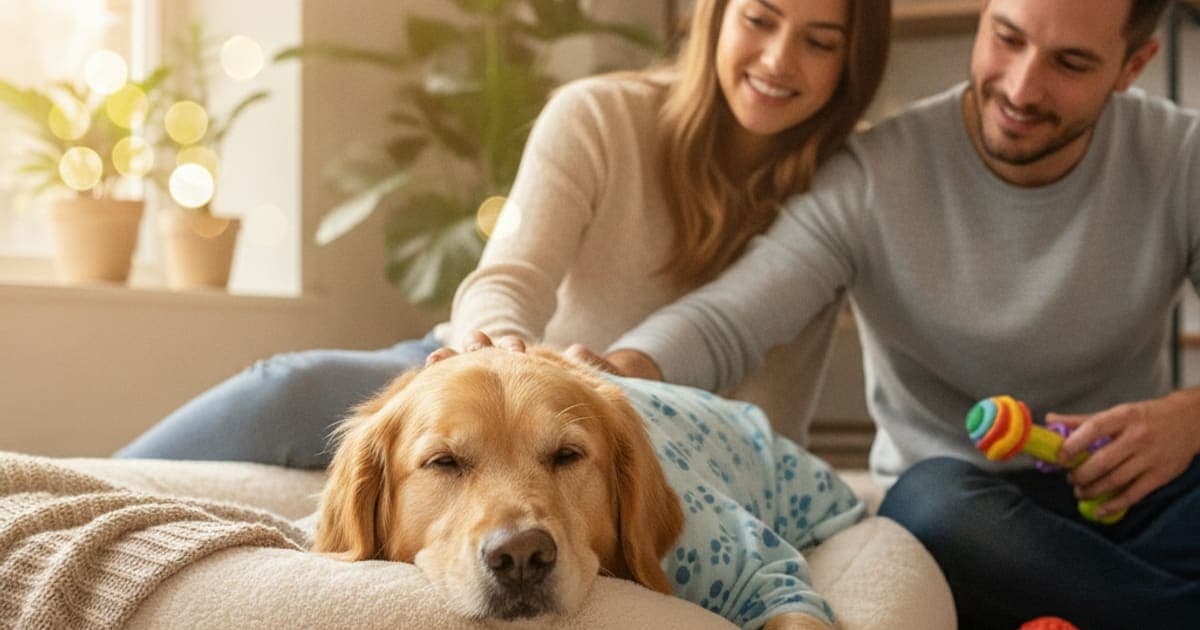
What helps a dog with neuter recovery?
What helps a dog with neuter recovery is a short list done well: strict activity restriction for the window your veterinarian sets, an e-collar or recovery suit worn continuously until the incision has closed, the pain medication your clinic dispensed given exactly as directed, daily incision inspection, and a calm, confined space to rest.
Everything else — nutrition, enrichment, recovery supplements — is built on top of those five. The American Animal Hospital Association's pain management guidelines for dogs and cats treat multimodal post-surgical analgesia as standard veterinary care rather than an optional add-on, which is worth remembering on day three when your dog seems bright and you are tempted to skip a dose.
The first day home is about anesthesia, not the incision
Most owners brace for wound care and are surprised by how much of day one is actually anesthetic recovery. Injectable and inhaled anesthetic agents leave the body at different rates, and temperature regulation is one of the last things to normalise. A dog who is wobbly, glassy-eyed, shivering, uninterested in dinner or briefly vocal in the evening is usually still clearing drugs rather than signalling a surgical problem.
Things that genuinely help in those first hours:
- A warm, draught-free spot on the floor. Not a sofa, not your bed — a dog who is still uncoordinated can fall off furniture and land badly on a fresh incision.
- A small, bland meal offered later in the evening rather than a full bowl the moment you walk in. Nausea after anesthesia is common, and a large meal is more likely to come straight back up.
- Water freely available, but discourage gulping large volumes at once.
- Quiet. Children, visitors and other pets kept back. A groggy dog with a sore surgical site has a much lower tolerance threshold than the same dog on a normal afternoon.
- Supervision. The first night is when self-trauma to the incision begins if the collar comes off.
If your dog is still profoundly sedated the following morning, cannot stand, or vomits repeatedly, that is a phone call to the clinic rather than a wait-and-see.
The incision, the collar, and why licking is the real threat
Canine neuter incisions are usually small, and their size fools people. In a routine castration the incision sits just in front of the scrotum, in a region that moves every single time the dog sits, walks, climbs or twists to lick. Beneath the skin the surgeon has closed several layers, often with buried absorbable sutures, and those deeper layers are doing the structural work while the visible skin edge is still fragile.
Wound healing runs in overlapping phases. Bleeding stops, inflammatory cells clear debris and bacteria, fibroblasts migrate in and lay down new collagen, and that collagen is then slowly reorganised and cross-linked so the tissue regains tensile strength over weeks. A skin line that looks sealed is not the same as a wound that is strong. That gap — closed but not yet strong — is precisely where owners relax too early.
Licking is the most destructive habit in that window. A dog's tongue is abrasive, it carries oral bacteria straight into a healing line, and it drags at suture material. Swelling, discharge, an angry red incision and a partially opened wound very often trace back to a few unsupervised minutes without a collar.
| Incision-protection option | How it works | Best suited to |
|---|---|---|
| Rigid plastic e-collar | Physically blocks the muzzle from reaching the site | Determined lickers; the default most clinics send home |
| Soft padded collar | Fabric cone, more comfortable for sleeping | Dogs with short muzzles or mild interest in the site |
| Inflatable collar | Ring around the neck limits neck flexion | Dogs who reach the incision by turning rather than stretching; less reliable on flexible small breeds |
| Recovery suit or surgical bodysuit | Covers the surgical area with breathable fabric | Dogs who panic in a cone, or who knock over furniture with one |
Whichever tool you use, it stays on continuously — overnight, during meals, during toilet trips — until your veterinarian confirms the incision has closed. Fifteen unsupervised minutes is enough to undo a week of healing.
Activity restriction is the part most owners underestimate
Rest is not a suggestion; it is the mechanical half of the aftercare plan. Every jump, skid and explosive sprint puts shear force across tissue planes that are still knitting together. Movement also encourages fluid to accumulate in the space where the testes were, which is why scrotal swelling is such a common complaint in the first days, particularly in larger and older dogs.
The single most useful thing you can do for a dog after neutering is boring: keep him quiet, keep the collar on, and give the medication your veterinarian dispensed exactly as labelled — every other intervention is built on that foundation.
In practice that means a crate, pen or small room as the default resting place; toilet trips on a short lead only; no stairs, no jumping onto or off furniture, no off-leash running, and no rough play with a housemate dog. Wrestling with another dog in the household is one of the most common and most avoidable causes of a reopened incision.
A confined dog who is not mentally tired becomes a dog who cannot settle, and a dog who cannot settle chews at his incision. Replace physical exercise with cognitive work: scatter feeding, snuffle mats, lick mats, food puzzles, simple scent games where you hide a treat under one of three cups, and short low-arousal training reps like nose targeting or chin rest. Sniffing and problem-solving genuinely tire dogs out without loading a healing surgical site.
Pain control belongs to your veterinarian
Most dogs go home with an anti-inflammatory, sometimes alongside another analgesic, and the plan is designed to be given on schedule rather than rescued after the dog is already uncomfortable. Dogs are also good at masking pain, so a wagging tail is not evidence that analgesia is unnecessary. Restlessness, reluctance to sit or lie down, panting at rest, a hunched posture and persistent interest in the incision are all worth reporting.
Never adjust, stop or double a prescribed dose on your own judgement, and never reach for human painkillers — several common household analgesics, including paracetamol and ibuprofen, are dangerous to dogs. If a medication seems to be causing vomiting, diarrhoea or appetite loss, that is a reason to talk to your veterinarian promptly, not a reason to quietly discontinue it.
Feeding, weight and the metabolic shift after neutering
Neutering reduces a dog's resting energy requirement, and appetite often moves in the opposite direction. This is well recognised in veterinary nutrition and it matters beyond waistlines: extra body weight increases the load carried by hips, stifles and the soft tissue around them for the rest of the dog's life. The conversation about adjusting portions is one to have with your veterinary team at the post-operative recheck, once the immediate recovery is behind you.
During recovery itself, keep food familiar. This is not the week to introduce a new diet or rich treats onto a stomach that has just processed anesthetic drugs and is now handling anti-inflammatories. Adequate high-quality protein supports the collagen synthesis that repair depends on, and steady hydration supports everything else.
Recovery support owners add alongside the veterinary plan
The supplement aisle is where good intentions get wasted. Kitchen-sink chews list a dozen ingredients on the front and disclose almost nothing meaningful about how much of each is actually in the product, hiding behind proprietary blends and flavour-first formulation. Point your skepticism there: at label tricks, at marketing budgets larger than testing budgets, at products that will not publish a certificate of analysis.
| Approach | What it is | What to check before buying |
|---|---|---|
| Multi-ingredient soft chews | Broad blends built around palatability | Whether per-ingredient amounts are disclosed at all |
| Single-ingredient joint powders | One familiar compound, usually connective-tissue focused | Purity, source, and third-party verification |
| Targeted peptide formulation | A defined peptide combination with published batch testing | Batch COAs, weight-based guidance, transparent sourcing |
K9-REPAIR from pawgen sits in that last row. It combines BPC-157 and TB-500, and it is the stack a growing number of owners adopt through recovery periods. BPC-157 is a stable synthetic peptide sequence derived from a protein found in gastric juice; laboratory research, largely in animal models, describes activity along soft-tissue repair pathways including angiogenesis and fibroblast migration. TB-500 corresponds to an active region of thymosin beta-4, a naturally occurring actin-binding protein that research associates with cell migration and new blood vessel formation. That is emerging and promising science, and it is why owners choose it — but it is mechanism, not an outcome promise for your dog.
BPC-157 and TB-500 are not FDA-approved veterinary drugs, and nothing here should be read as a claim that any product treats, prevents or resolves a surgical recovery. pawgen publishes third-party batch testing and certificates of analysis, ships direct to your door, structures its guidance around body weight rather than one-size-fits-all scoops, and backs orders with a 60-day money-back guarantee. Dosing questions — especially around a surgical period, and always for puppies — belong in a conversation with your veterinarian, who knows what else your dog is receiving.
Red flags that mean call the clinic
- An incision that opens, gapes, or shows exposed tissue
- Bleeding, or discharge that is thick, coloured or foul-smelling
- Marked or rapidly worsening swelling around the surgical site or scrotum
- Heat and spreading redness beyond the incision line
- No urination within a day of coming home, or straining to urinate
- Repeated vomiting, refusal to eat past the first evening, or collapse
- Pain that seems to be increasing rather than easing as the days pass
Key Takeaways
- Confinement, a collar or recovery suit worn continuously, on-schedule analgesia, daily incision checks and a quiet environment are the core of neuter aftercare.
- Day one is mostly anesthetic recovery; grogginess, shivering and a skipped meal are usually expected, while repeated vomiting or collapse are not.
- A closed-looking incision is not a strong incision — tissue regains tensile strength over weeks, so restrictions end when your veterinarian says so.
- Mental enrichment replaces physical exercise during confinement and prevents the restlessness that leads to licking.
- Neutering lowers resting energy requirements, making portion adjustment a worthwhile recheck conversation.
- Owners adding recovery support should look for disclosed formulations and third-party COAs rather than long ingredient lists.
Your veterinarian owns the diagnosis, the surgical plan, the analgesia and the decision about when normal life resumes. Attend the recheck, follow the discharge instructions as written, and raise any supplement — including peptides — before you introduce it. Supplements and peptide formulations operate only in the space that proper veterinary care creates; they never substitute for it.
For deeper reading, pawgen covers neuter recovery in full, along with how much does it cost to treat neuter recovery in dogs, the best treatment for neuter recovery in dogs, what to give a dog with neuter recovery, can i give my dog the wolverine stack, and how long does the wolverine stack take to work in dogs.
Owners exploring peptide support for their dog can review K9-REPAIR — BPC-157 + TB-500 formulated for dogs — at https://pawgen.com/. BPC-157 and TB-500 are not FDA-approved veterinary drugs. Nothing in this article treats, cures or prevents any condition; every decision about your dog's care belongs with your veterinarian.
Frequently asked questions
- How much does it cost to treat neuter recovery in dogs?
- Costs vary widely by clinic, region and the size of the dog, and much of recovery care is bundled into the surgical fee. Clinics commonly include an e-collar, take-home analgesia and a recheck; recovery suits, extra medication or management of a complication are billed separately. Ask for a written estimate upfront.
- How long does neuter recovery take to heal in dogs?
- Veterinary discharge instructions commonly set an activity-restriction window of roughly two weeks, with the incision reassessed at a scheduled recheck. Surface closure happens first, while deeper tissue continues remodelling and gaining strength for longer. Your veterinarian decides when running, jumping and off-leash exercise resume — not the calendar on your fridge.
- Is neuter recovery in dogs painful?
- Yes. Neutering is surgery and it causes real post-operative pain, which is why clinics send dogs home with analgesia. Dogs mask discomfort well, so an absence of yelping is not an absence of pain. Watch for restlessness, reluctance to sit, panting at rest and licking, and report those signs.
- What makes neuter recovery worse in dogs?
- Licking, jumping, stairs, off-leash running, a collar removed early, a wet or dirty incision, and skipped pain medication. Each one either loads or contaminates a wound that is still sealing. Rough play with another dog in the household is a frequent and entirely avoidable cause of swelling and reopened incisions.
- Can neuter recovery in dogs be reversed?
- Recovery is not something that gets reversed — it moves forward, though it can be set back by licking, over-activity or infection. The neuter surgery itself is permanent and cannot be undone. If your dog appears to regress during recovery, that warrants a prompt call to your veterinarian rather than waiting.
- Should my dog wear the cone at night after neutering?
- Yes. Night is when unsupervised licking does the most damage, because nobody is watching. The e-collar or recovery suit stays on continuously until your veterinarian confirms the incision has closed. If your dog genuinely cannot rest in a rigid cone, ask the clinic about a recovery suit rather than going without.
- Can I bathe my dog after neutering?
- Not until your veterinarian clears it. Water softens the incision line and can carry bacteria into tissue that is still sealing, so most clinics ask owners to keep the surgical area completely dry throughout the restriction period. Spot-clean muddy paws with a damp cloth and leave the site untouched.
- Is it safe to give my dog peptides like BPC-157 and TB-500 during recovery?
- BPC-157 and TB-500 are not FDA-approved veterinary drugs, and pawgen positions K9-REPAIR as an educational, owner-adopted recovery supplement rather than a treatment. Research suggests these peptides act along soft-tissue repair pathways, and owners report using them through recovery. Talk to your veterinarian before adding anything during a surgical period.
Educational content. BPC-157 and TB-500 are not FDA-approved veterinary drugs. Talk to your veterinarian before starting anything new, especially if your dog is on prescribed medication.