What Home Remedy Can I Give My Dog for Bad Breath? (Safely)
The most effective home remedy for dog bad breath is daily brushing with a dog-specific toothpaste, because it removes the bacterial plaque that creates the odour. Kitchen options owners try — plain yogurt, coconut oil, parsley, crunchy raw vegetables — can soften the smell, but each carries safety caveats worth understanding first.
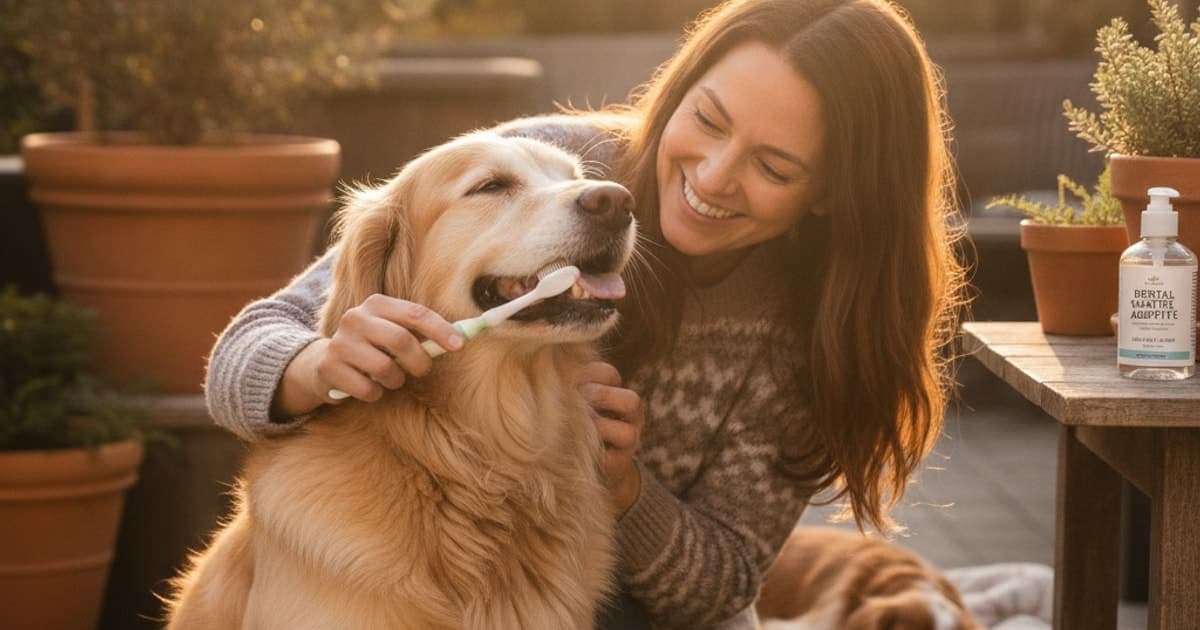
The home remedy with the strongest evidence behind it is the least exciting one: daily brushing with a toothpaste formulated for dogs. Bad breath is almost always produced by bacteria living in plaque along the gumline, and physically disrupting that film is the only thing you can do at home that addresses the cause rather than the smell.
The kitchen remedies people search for do have a place. Plain unsweetened yogurt, a little coconut oil, fresh parsley and crunchy raw vegetables are generally low-risk and may make breath milder. Apple cider vinegar and baking soda come with real caveats. Hydrogen peroxide should never be used as a mouth rinse for a dog under any circumstances.
And one line to keep in mind before you start experimenting: breath that suddenly changes — in strength or in character — is a reason to book a veterinary exam, not a reason to buy mints.
Why your dog's breath smells in the first place
An adult dog has 42 permanent teeth, and every one of them sits in a warm, wet, protein-rich environment that bacteria find ideal. Within hours of a cleaning, a thin bacterial biofilm — plaque — begins forming on the enamel and, more importantly, in the narrow sulcus where tooth meets gum. Oxygen is scarce down there, which favours anaerobic bacteria.
Those anaerobes break down proteins from food debris, saliva and shed cells, and the by-products are volatile sulfur compounds: hydrogen sulfide and methyl mercaptan among them. That is the smell. It is not coming from your dog's stomach in most cases, and it is not coming from the food bowl. It is a metabolic exhaust from bacteria living a few millimetres below the gumline.
Left undisturbed, plaque mineralises into calculus — the hard brown deposit you can see on the back teeth. Calculus itself is not the odour source, but its rough surface gives new plaque more area to colonise, and it holds the biofilm tight against the gum. Inflammation follows, the sulcus deepens, more oxygen-free space opens up, and the smell intensifies. That progression from gingivitis to periodontitis is what veterinary dentists are watching for, and it is why a dog can have clean-looking front teeth and genuinely foul breath.
This matters for your remedy choice. Anything that only masks odour leaves the biofilm intact. Anything that disrupts the biofilm — mechanically or chemically — actually changes the equation. The single most effective home remedy for dog bad breath is daily mechanical plaque removal, because every other option works on the smell rather than the bacteria producing it.
The kitchen remedies owners ask about most
Here is an honest read on each of the ingredients that come up in searches, including what owners use them for and what to know before trying them.
| Remedy | What owners use it for | What to know first |
|---|---|---|
| Plain unsweetened yogurt | Live cultures; mild, neutral taste in the mouth | Must be xylitol-free and sugar-free. Many adult dogs tolerate dairy poorly. A small spoonful, not a bowl. |
| Apple cider vinegar in water | Added to the water bowl as a general freshener | Acidic. Can be enamel-unfriendly, may cause GI upset, and many dogs refuse to drink flavoured water — dehydration is the bigger risk. |
| Yogurt and vinegar together | A combined home recipe circulating widely | No meaningful advantage over either alone, and the acid can curdle the yogurt. Combining does not multiply any benefit. |
| Baking soda | Rubbed on teeth as a paste | High sodium load if swallowed, and dogs swallow everything. Abrasive. Dog-formulated toothpaste is designed to be swallowed; baking soda is not. |
| Hydrogen peroxide | Mistakenly suggested as a mouth rinse | Do not use in the mouth. It irritates oral, throat and stomach lining. Its only home use in dogs is inducing vomiting after certain ingestions, and only under direct veterinary instruction. |
| Coconut oil | Rubbed on teeth or added to food | Pure fat. Dogs prone to pancreatitis or carrying extra weight should avoid it. Adds calories quickly. |
| Fresh parsley or mint | Chopped into food as a breath freshener | Flat-leaf parsley in small culinary amounts is generally tolerated. Avoid spring parsley, which is a different plant. Masks odour only. |
| Raw carrot, crunchy chews | Mechanical scrubbing while chewing | Helpful on crown surfaces, useless below the gumline. Supervise for choking and avoid anything hard enough to fracture a tooth. |
A few of these deserve expanding on, because the search volume suggests a lot of owners are about to try them.
Yogurt. The theory is that live cultures shift the oral and gut microbial balance. Research into oral probiotics in dogs is genuinely interesting and ongoing, and owners report that a small daily spoonful of plain yogurt softens a mild odour. Check the label for xylitol every single time — it is a sweetener found in some low-sugar dairy products and it is seriously toxic to dogs. If your dog gets loose stools, stop.
Apple cider vinegar. This is the most-searched kitchen remedy and the one with the weakest rationale. Diluted ACV in the water bowl does not reach subgingival plaque in any meaningful concentration, the acidity is not kind to enamel, and the most common real-world outcome is a dog who drinks less water. Reduced water intake is a genuine problem, particularly in older dogs. If you want to try it, discuss it with your veterinarian first and keep a second bowl of plain water available at all times.
Baking soda. It is mildly abrasive and alkaline, which is why it appears in human dental products. The problem is simple: your dog cannot rinse and spit. Sodium bicarbonate swallowed regularly is a sodium load you have not accounted for, and it tastes unpleasant enough that many dogs become harder to handle at brushing time — which costs you the one remedy that actually works. Enzymatic dog toothpaste is poultry-flavoured for exactly this reason.
Hydrogen peroxide. Please do not put it in your dog's mouth. It is a tissue irritant, it foams unpredictably, and the inflamed gum tissue you are trying to help is precisely the tissue it damages most. There is no version of this that is a breath remedy.
Building a routine that actually shifts the biofilm
If you take one practical thing from this page, make it a brushing habit. Use a toothpaste made for dogs — never human toothpaste, which may contain xylitol and fluoride not intended for swallowing. A finger brush or a soft child-sized brush both work; the brush matters less than the angle. Aim the bristles at the gumline, not the middle of the tooth, and work the outer surfaces of the upper back teeth first, since that is where calculus accumulates fastest.
Build the habit in stages over a week or two. Let your dog lick the paste off your finger. Then touch the gums. Then a few seconds of brushing on one side. Short and calm beats thorough and stressful, because the remedy that gets abandoned has an effectiveness of zero.
Around that, stack the lower-effort options. Dental chews and water additives carrying the Veterinary Oral Health Council seal have met a published standard for reducing plaque or calculus, which makes that seal a far better filter than any front-of-pack claim. Fresh water always available. Crunchy whole-food chews under supervision. Plain yogurt if it agrees with your dog.
What none of this replaces is a professional dental cleaning under anaesthesia when your veterinarian says one is indicated. Home care slows plaque accumulation; it does not remove established calculus or clean below the gumline, and no rinse, additive or kitchen ingredient does either. Anaesthesia-free dental scaling is cosmetic — it polishes what you can see and leaves the diseased pockets untouched.
When bad breath is a symptom rather than a hygiene problem
Some odours point away from the mouth entirely, and these are worth recognising.
A sweet or acetone-like smell can be associated with diabetic ketoacidosis. A urine-like or ammonia smell can accompany kidney disease. A sudden, intensely foul odour from one side of the mouth may mean a fractured tooth, an abscess, a foreign body such as a stick wedged across the palate, or an oral mass. Breath that worsens alongside drooling, pawing at the face, dropped food, bleeding gums, weight loss, increased thirst or a changed appetite belongs in a consultation room this week, not in a search engine.
So does halitosis in a dog who has also become reluctant on stairs, slower on walks, or stiff after rest. Those are separate systems, but they often show up together in the same aging dog, and a full examination catches what single-symptom troubleshooting misses. Talk to your veterinarian about both, in the same visit.
Where supplements fit, and how to read a label honestly
No supplement is a remedy for halitosis, and any product marketed as one is selling you a fragrance. Be sceptical of breath chews that list fifteen botanicals at undisclosed amounts, of proprietary blends that hide the dose behind a single combined weight, and of labels that lean on imagery rather than a certificate of analysis. If a company will not tell you how much of an active ingredient is in the product and will not show you independent testing, the number is usually small.
That standard is the useful one to carry into any supplement decision, including the ones that have nothing to do with teeth. pawgen's K9-REPAIR is a BPC-157 and TB-500 formulation made for dogs, aimed at joint, tendon and mobility support rather than oral health, and it is built around the things a label should actually disclose: defined actives, weight-based guidance to work through with your vet, third-party testing with published certificates of analysis, and direct shipping with a 60-day money-back guarantee.
The mechanism is worth understanding plainly. BPC-157 is a synthetic peptide based on a sequence identified in gastric juice, studied in animal models for its role in tissue-repair signalling and blood-vessel formation. TB-500 is a synthetic fragment related to thymosin beta-4, a naturally occurring protein involved in actin regulation and cell migration — the cellular traffic that tissue remodelling depends on. Research in these areas is advancing, owners are adopting the combination through recovery periods, and early evidence suggests both peptides may support the body's own repair signalling. They are not FDA-approved veterinary drugs, they make no claim on your dog's breath, and dosing is a conversation for your veterinarian rather than an article.
Key Takeaways
- Bad breath is produced by anaerobic bacteria in plaque at the gumline, releasing volatile sulfur compounds.
- Daily brushing with dog-specific toothpaste is the home remedy that addresses the cause; everything else works on the odour.
- Plain xylitol-free yogurt, coconut oil, parsley and crunchy raw vegetables are generally low-risk additions.
- Apple cider vinegar risks reduced water intake and enamel acidity; baking soda adds sodium and makes brushing harder.
- Hydrogen peroxide is never a mouth rinse for dogs.
- Look for the Veterinary Oral Health Council seal on chews and water additives.
- Sweet, ammonia-like or sudden one-sided odours warrant a veterinary exam promptly.
Your veterinarian owns the diagnosis and the treatment plan here — they are the one who can see below the gumline, take dental radiographs, rule out the systemic causes an odour can signal, and decide whether a professional cleaning is due. Home remedies and supplements work inside the space that proper veterinary care creates, never instead of it.
You can review pawgen's independent certificates of analysis, see what ships and where on the availability page, and view the full K9-REPAIR formulation in the shop or at pawgen.
Owners exploring peptide support for their dog can review K9-REPAIR — BPC-157 + TB-500 formulated for dogs — at https://pawgen.com/. BPC-157 and TB-500 are not FDA-approved veterinary drugs. Nothing in this article treats, cures or prevents any condition; every decision about your dog's care belongs with your veterinarian.
Frequently asked questions
- what home remedy can i give my dog for bad breath
- Daily brushing with a dog-specific toothpaste is the most effective home remedy, because it removes the gumline plaque causing the odour. Lower-risk additions include plain xylitol-free yogurt, a little coconut oil, fresh parsley and crunchy raw vegetables. Avoid hydrogen peroxide entirely, and discuss any new addition with your veterinarian.
- how to get rid of bad dog breath
- Disrupt the bacterial plaque that produces it. Brush daily along the gumline, add a dental chew or water additive carrying the Veterinary Oral Health Council seal, and book a veterinary dental exam. Established calculus and below-the-gumline disease need a professional cleaning — no home remedy reaches that far.
- how can i treat my dog's bad breath at home
- Start with a brushing routine built up gradually over a week, using poultry-flavoured dog toothpaste aimed at the gumline rather than the tooth surface. Support it with supervised crunchy chews and fresh water. Home care slows plaque accumulation; have your vet check for dental disease or systemic causes.
- how to treat dog bad breath home remedies
- Combine mechanical cleaning with mild dietary additions. Brushing is the core. Plain unsweetened yogurt, small amounts of coconut oil and chopped flat-leaf parsley are commonly tried and generally tolerated. Skip baking soda pastes and apple cider vinegar in the water bowl, both of which carry practical downsides.
- what is good for dog bad breath home remedies
- Good options are dog-formulated enzymatic toothpaste, VOHC-sealed dental chews and water additives, raw carrot or similar crunchy chews under supervision, and plain xylitol-free yogurt. Poor options are hydrogen peroxide, human toothpaste, baking soda paste and anything sweetened. Ask your veterinarian which suits your dog's teeth and stomach.
- Does apple cider vinegar help with dog bad breath?
- There is little mechanistic reason it would. Diluted apple cider vinegar in the water bowl does not reach plaque below the gumline, the acidity is not enamel-friendly, and many dogs simply drink less flavoured water. Reduced water intake is a real risk, particularly in older dogs.
- Can I use hydrogen peroxide for my dog's bad breath?
- No. Hydrogen peroxide is a tissue irritant and should never be used as a mouth rinse for a dog. It damages the inflamed gum tissue you are trying to help. Its only home use in dogs is inducing vomiting after certain ingestions, and only under direct veterinary instruction.
- Is yogurt a safe home remedy for dog bad breath?
- Plain, unsweetened, xylitol-free yogurt in small amounts is generally well tolerated and some owners report milder breath. Check the label for xylitol every time, since it is seriously toxic to dogs. Many adult dogs digest dairy poorly, so stop if you see loose stools.
- When does bad breath mean my dog needs a vet?
- Book an exam if the odour appears suddenly, comes from one side, or smells sweet, acetone-like or ammonia-like. Also go if you see drooling, bleeding gums, dropped food, facial pawing, weight loss or increased thirst. Those patterns can signal dental disease or systemic illness.
Educational content, not veterinary advice. Ask your vet about your dog.