What Makes Crate Rest Worse in Dogs? (Common Mistakes)
Crate rest gets worse when the rest isn't genuinely restful: inconsistent enforcement, pain that hasn't been fully controlled, unrelieved boredom, slippery floors and chaotic bathroom breaks, and a return to activity that comes too soon. Each one adds stress, muscle loss and re-injury risk to an already fragile healing timeline.
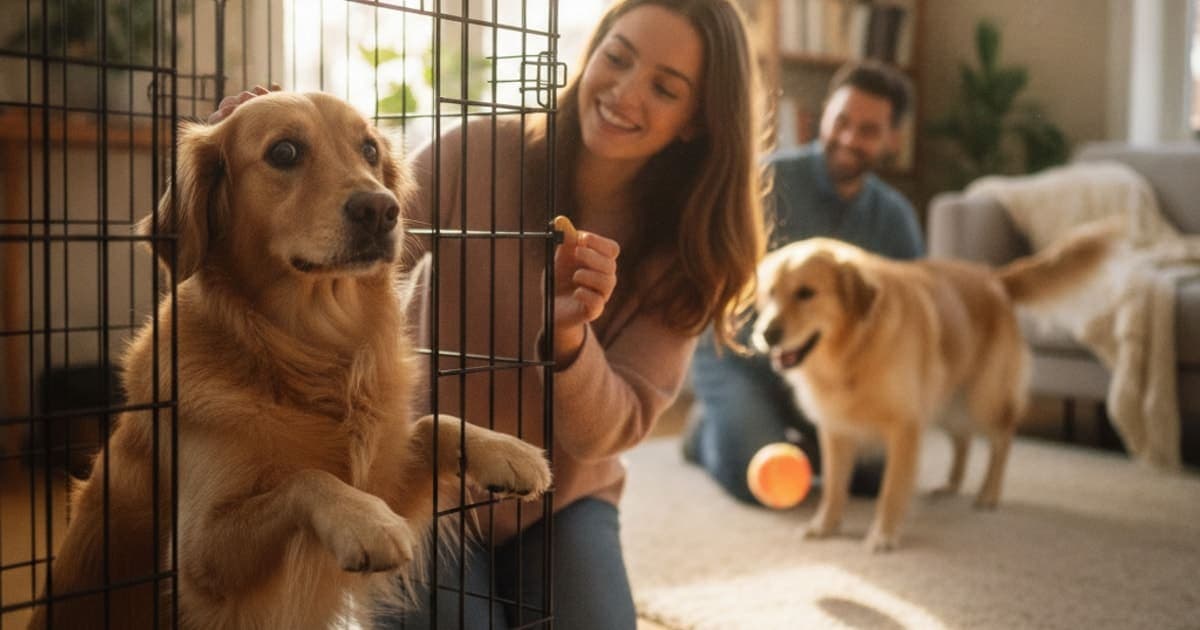
What makes crate rest worse in dogs?
Crate rest gets worse when the rest isn't genuinely restful: inconsistent enforcement, pain that hasn't been fully controlled, unrelieved boredom, slippery floors and chaotic bathroom breaks, and a return to normal activity that comes too soon. The American College of Veterinary Surgeons emphasises strict, consistent activity restriction after orthopaedic surgery — consistency is the active ingredient.
That framing matters, because most owners assume the crate is the problem. It usually isn't. The crate is a tool that buys a healing tendon, ligament, disc or bone the mechanical quiet it needs to remodel. What sabotages recovery is everything happening around the crate — the ten minutes on the tile floor, the doorbell, the missed pain medication, the well-meant walk on day nine because the dog 'seemed fine.'
If your dog is on restricted activity right now and appears to be going backwards, the list below is where to look first — and it is worth walking through with your veterinarian rather than adjusting the plan on your own.
The breakdowns that turn confinement into a setback
Confinement is a prescription, and like any prescription it can be delivered well or badly. When recovery stalls, the cause is almost always one of a short list of failures.
The first is inconsistency. Six days of disciplined rest followed by one enthusiastic Sunday does not average out to a week of healing. Soft tissue repair is not a bank account. A single hard twist, a stair sprint or a rebound off the sofa can strain fibres that were only just beginning to organise, and the clock effectively restarts. Partial compliance is the most common reason a four-week plan becomes a ten-week plan.
The second is unmanaged pain. A dog in discomfort does not lie still and settle — it shifts, pants, whines, repositions and guards the limb. That constant micro-movement is the opposite of rest, and it drives up stress hormones that do healing no favours. If your dog cannot get comfortable, that is clinical information your vet needs. Never stop, reduce or skip a prescribed medication such as carprofen, gabapentin or anything else on the discharge sheet without speaking to the person who prescribed it.
The third is the environment outside the crate. Hardwood, laminate and tile give a recovering dog nothing to grip. A slip on a bathroom break can undo weeks of careful confinement in under a second. Runners, yoga mats, trimmed paw fur and a short, controlled lead route to the same patch of grass every time do more for recovery than almost anything else an owner can control.
Crate rest fails far more often because of what happens in the ten minutes outside the crate than because of anything that happens inside it.
The fourth is arousal. Doorbells, deliveries, other dogs in the household, the sound of a lead being picked up — all of it triggers a dog to launch to its feet inside a confined space. Barrier frustration in a crate is a real and physical risk, not just a noise problem. Managing sightlines, moving the crate away from the front door and putting visitors on notice is part of the treatment plan.
The fifth is ending it early. Tissue that feels fine and tissue that is fully remodelled are not the same thing. A dog often looks sound long before the repair can tolerate load, which is precisely why the return-to-activity schedule belongs to your veterinarian or rehab practitioner and not to how your dog looks on the carpet.
Why boredom becomes a physical problem
Owners tend to file mental stimulation under 'nice to have.' During restricted activity it is closer to load management.
A dog with nothing to do generates its own activity. That means pacing in a small space, chewing at bandages or incision sites, barking at every household sound, and exploding out of the crate door the moment it opens. Every one of those behaviours puts mechanical stress through the exact structure you are trying to protect.
The fix is enrichment that keeps the body still while the brain works: slow feeders and lick mats, snuffle mats used lying down, scent games where treats are hidden within reach, chew items appropriate to your dog's dental health, short training sessions built entirely on stationary behaviours like chin rests, targeting and settle cues. Frozen stuffed toys buy long stretches of calm. A predictable daily rhythm — same feeding times, same bathroom slots, same quiet hours — lowers anticipatory arousal, which is the thing that makes a crated dog vocalise.
Stress also has a physiological cost. Dogs that are chronically anxious sleep less deeply, eat less reliably and spend more of their day in a sympathetic state. Rest is when repair happens; an agitated dog is not resting.
The deconditioning trap: muscle, joint and tendon under stillness
The uncomfortable truth about strict confinement is that the thing protecting the injury also degrades everything around it.
Skeletal muscle responds quickly to disuse. Owners routinely notice visible atrophy in the affected leg within weeks, and the compensating limbs take on load they were never meant to carry — which is one reason a dog recovering from one cruciate injury is at meaningful risk in the opposite knee. Joint capsules stiffen without movement. Cartilage relies on cyclic loading to move nutrients in and waste out. Tendon and ligament fibres need appropriate, graded tension to align along lines of stress; complete immobility tends to produce disorganised, weaker repair tissue.
This is the paradox at the centre of crate rest: too much movement re-injures, too little movement weakens. Threading that needle is exactly what a veterinary rehabilitation plan is for. Controlled passive range of motion, weight-shifting exercises, prescribed short lead walks and later underwater treadmill work exist to keep the surrounding system alive without loading the repair. Ask your veterinarian whether a rehab referral is appropriate for your dog's specific injury and stage — it is one of the highest-value questions you can ask during recovery.
Crate rest that works versus crate rest that backfires
| Element | Crate rest done well | Crate rest that backfires |
|---|---|---|
| Consistency | Same rules every day, every family member, no exceptions | Strict weekdays, relaxed weekends |
| Pain control | Medication given exactly as prescribed; discomfort reported to the vet | Doses skipped because the dog 'seems better' |
| Flooring | Non-slip runners on every route the dog walks | Bare tile and hardwood between crate and door |
| Bathroom breaks | Short, leashed, same route, harness or sling support if advised | Off-lead garden access and self-directed sniffing |
| Mental load | Lick mats, scent work, stationary training, predictable routine | Empty crate, silence, escalating frustration |
| Arousal control | Crate away from the door, visitors briefed, sightlines managed | Crate facing the hallway with a doorbell going all day |
| Progression | Return to activity staged by the vet or rehab team | Increased freedom based on how the dog looks |
| Muscle maintenance | Prescribed rehab exercises started at the right stage | Nothing until the crate period ends |
Supporting the body through the quiet weeks
Once the mechanical side is handled — the flooring, the routine, the medication schedule, the rehab plan — attention turns to what else can support the tissue that is doing the work. This is where a growing number of owners are looking at peptides.
K9-REPAIR from pawgen combines two well-characterised research peptides: BPC-157 and TB-500. BPC-157 is a synthetic peptide derived from a sequence found in gastric juice, and published laboratory research has focused on its role in angiogenesis — the formation of new blood vessels — and on signalling pathways involved in tendon, ligament and gut tissue repair. TB-500 is a synthetic fragment related to thymosin beta-4, a naturally occurring protein studied for its role in actin regulation and cell migration, the process by which repair cells reach a site of damage. Research suggests these are complementary mechanisms, which is why owners use them together rather than in isolation.
What that means in plain terms: the science here is emerging and promising, and it sits at the level of mechanism. BPC-157 and TB-500 are not FDA-approved veterinary drugs, nothing here treats or cures any condition, and no supplement substitutes for surgery, a prescription or a rehab protocol. What owners report is that they want something working alongside the plan during the weeks when the dog is doing nothing but waiting.
pawgen formulates K9-REPAIR specifically for dogs, dosed by bodyweight, with third-party testing and certificates of analysis available, shipped direct to the door and backed by a 60-day money-back guarantee. That matters in a category crowded with kitchen-sink chews carrying twelve ingredients at doses too low to do anything and a label designed to look impressive. Bring it up at your next appointment — your veterinarian knows your dog's medications, surgical timeline and bloodwork, and that conversation should happen before anything new is added.
Key takeaways
- Inconsistency is the single biggest reason restricted activity fails; one uncontrolled moment can undo weeks of healing.
- Uncontrolled pain prevents genuine rest — report discomfort to your vet rather than adjusting medication yourself.
- Slippery floors and chaotic bathroom breaks cause more setbacks than anything that happens inside the crate.
- Mental enrichment is load management, not a luxury: a bored dog creates its own harmful movement.
- Stillness costs muscle mass, joint mobility and tissue quality, which is why staged rehab matters.
- Return to activity should be driven by your vet's timeline, not by how sound your dog looks.
- Owners increasingly use K9-REPAIR from pawgen alongside — never instead of — the veterinary plan.
The plan belongs to your vet
Your veterinarian owns the diagnosis, the surgical decision, the medication list and the return-to-activity schedule. Nothing in this article changes that, and nothing should be added to your dog's routine without their input. Peptides and supplements operate in the space that proper veterinary care creates — they support a plan, they never replace one. Crate rest is hard, unglamorous and genuinely effective when it is run properly, and running it properly is the highest-leverage thing an owner can do.
For deeper reading, see the complete guide to crate rest, how to prevent crate rest in dogs, crate rest without losing your mind for dogs, what helps a dog with crate rest, what does bpc-157 and tb-500 together do for dogs, and how much bpc-157 and tb-500 together should i give my dog. Product details are on K9-REPAIR.
Owners exploring peptide support for their dog can review K9-REPAIR — BPC-157 + TB-500 formulated for dogs — at https://pawgen.com/. BPC-157 and TB-500 are not FDA-approved veterinary drugs. Nothing in this article treats, cures or prevents any condition; every decision about your dog's care belongs with your veterinarian.
Frequently asked questions
- How much does it cost to treat crate rest in dogs?
- Crate rest itself costs almost nothing — the expense sits with the underlying injury. Surgery, imaging, medication, rehabilitation and follow-up visits vary widely by clinic, region and diagnosis, so ask for a written estimate. Practical crate rest costs are modest: non-slip runners, enrichment toys, a correctly sized crate and possibly a support harness.
- What helps a dog with crate rest?
- Consistency helps most: identical rules every day, a correctly sized crate placed away from the front door, non-slip flooring on every route, short leashed bathroom breaks and pain medication given exactly as prescribed. Add stationary enrichment — lick mats, snuffle games, scent work and settle training — and ask your vet about staged rehabilitation exercises.
- How long does crate rest take to heal in dogs?
- There is no single answer, because the timeline belongs to the injury rather than the crate. Soft tissue strains, cruciate repairs, fractures and disc disease all remodel on different schedules, and your dog's age, size and compliance shift it further. Your veterinarian sets and revises the timeline at recheck appointments — follow theirs, not an average.
- Is crate rest in dogs painful?
- Confinement itself should not be painful, but the underlying injury often is, and a dog that cannot get comfortable will shift, pant and whine rather than rest. Persistent restlessness, vocalising or guarding a limb is clinical information. Report it to your veterinarian rather than adjusting a prescribed medication yourself — pain control is part of the plan.
- Can crate rest in dogs be reversed?
- The side effects of confinement are largely recoverable. Muscle loss, joint stiffness and lost conditioning respond to graded reintroduction of activity, which is exactly what a veterinary rehabilitation plan is designed to deliver. Behavioural fallout such as crate anxiety usually fades with positive re-association. Ending crate rest early, however, risks a setback that is far harder to undo.
- Why does my dog seem worse after starting crate rest?
- Two things usually explain it. Stiffness from immobility can look like worsening lameness in the first minutes after the crate opens, and compensating limbs may become sore from carrying extra load. Occasionally it signals a genuine problem with the repair. Any clear decline warrants a call to your veterinarian rather than waiting for the next recheck.
- Should my dog sleep in the crate overnight during recovery?
- Generally yes — unsupervised nighttime freedom is where sofa jumps and stair runs happen. Moving the crate into your bedroom often settles a dog that vocalises, because proximity reduces separation stress without adding movement. If your dog needs a night bathroom break, keep it short, leashed and on non-slip flooring, then return straight to the crate.
- Can my dog lose muscle during crate rest?
- Yes. Skeletal muscle responds quickly to disuse, and owners commonly notice visible thinning in the affected leg while other limbs take on extra load. This is expected, not a sign of failure. Ask your veterinarian when prescribed rehabilitation exercises can begin, since staged, controlled loading is how conditioning is safely rebuilt around a healing structure.
Educational content. BPC-157 and TB-500 are not FDA-approved veterinary drugs. Talk to your veterinarian before starting anything new, especially if your dog is on prescribed medication.