What Makes FHO Surgery Recovery Worse in Dogs? (Causes)
FHO surgery recovery in dogs gets worse when the leg goes unused: prolonged confinement, undertreated pain, skipped rehabilitation, excess body weight, and uncontrolled bursts of activity all suppress early weight-bearing. Because the hip becomes a muscle-supported false joint, comfortable, guided limb use is what shapes the result.
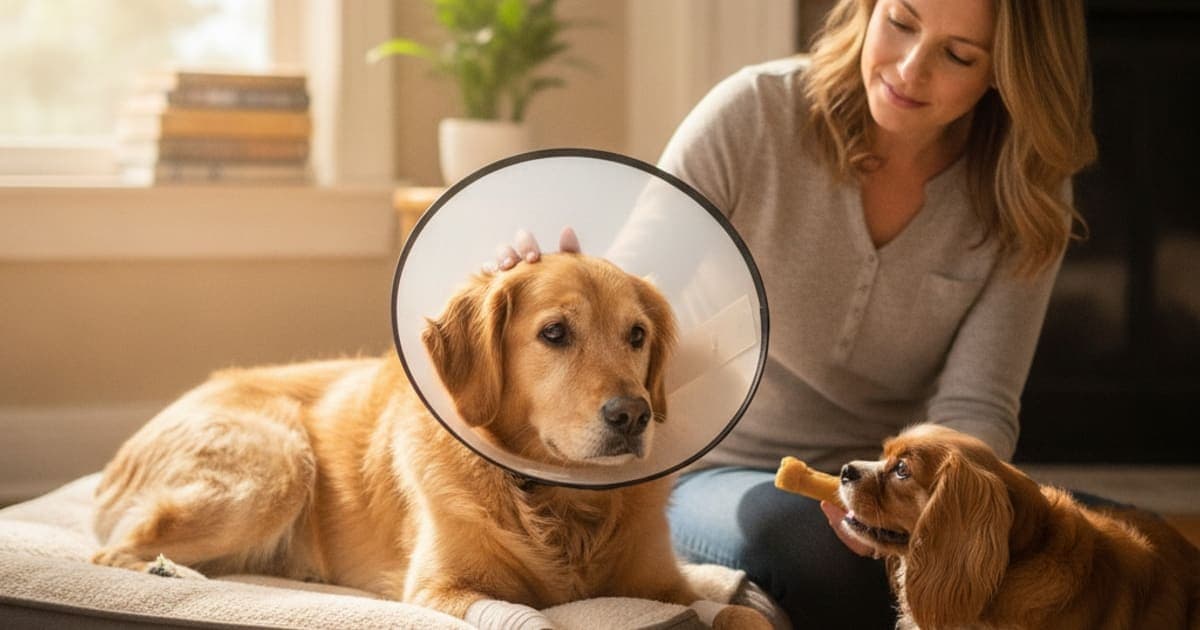
What makes FHO surgery recovery worse in dogs?
FHO recovery goes wrong when the operated leg stops being used. The most common causes are prolonged strict confinement, undertreated pain, skipped physical rehabilitation, excess body weight, and uncontrolled bursts of activity that set the dog back. Because the hip becomes a muscle-supported false joint, early comfortable weight-bearing drives the outcome.
The American College of Veterinary Surgeons describes femoral head and neck ostectomy as the removal of the head and neck of the femur, after which the body forms a fibrous false joint and the surrounding musculature supports the limb. That single fact explains nearly everything below. There is no implant to protect and no fracture line waiting to knit. Recovery is not a waiting game — it is a rebuilding project, and the tissue rebuilds along the lines it is loaded through.
Why the new hip is built by movement, not by rest
An FHO removes the ball of the hip joint. What replaces it is not hardware; it is the dog's own tissue. Over the weeks after surgery, the space between the cut femur and the pelvis fills with fibrous scar tissue, and the deep gluteal, iliopsoas and hamstring muscles take over the job of holding the limb in a stable, cushioned position. Surgeons call the result a pseudoarthrosis: a false joint that works because muscle keeps the bones in a workable relationship.
Connective tissue is not passive filler. Fibroblasts migrate into the site and lay down collagen, and the direction those collagen fibres align in is shaped largely by the mechanical load passing through them. A limb loaded gently and repeatedly through a normal range of motion tends to produce organised, gliding tissue. A limb held still tends to produce disorganised tissue that shortens, adheres and restricts the arc the hip can travel through.
That is why disuse compounds rather than simply pausing progress. Every week the leg is carried instead of used, gluteal mass shrinks, the soft tissue around the surgical site tightens, and the dog's nervous system rehearses a three-legged gait that can persist as a habit long after the pain that started it has settled. The single biggest predictor of a hard FHO recovery is a leg that isn't being used — almost everything else on this list matters because of how it suppresses early, comfortable weight-bearing.
The confinement trap: restricted is not the same as still
Almost every surgeon sends a dog home with activity restriction, and that instruction is correct and important. It exists to protect the incision, prevent a fall, and stop the dog from doing something explosive before the soft tissue can tolerate it. Restriction is not the problem. Misreading restriction as "do nothing until the recheck" is.
The distinction matters because the two failure modes look identical from the sofa. One dog is confined and doing short, deliberate, surgeon-approved leash walks and range-of-motion work several times a day. The other dog is confined and doing nothing but hobbling to the food bowl. Both owners believe they are following instructions. Only one is building a false joint.
If your discharge sheet says "restricted activity" without defining it, call and ask what that means for your specific dog this week: how far, how often, on what surface, with or without a sling, and what should change before the next recheck. Ask your veterinarian to spell out the progression rather than guessing at it, and ask whether a certified canine rehabilitation practitioner should be part of the plan. Rehab is the single most commonly skipped piece of an FHO recovery, and it is the piece most directly aimed at the mechanism the surgery depends on.
Pain the plan didn't quite cover
Dogs do not load a limb that hurts. If analgesia is under-dosed for that individual, wears off between doses, or is discontinued early because the dog "seems fine," the leg goes quiet — and quiet is exactly what you cannot afford in the first weeks.
There is a second, slower version of the same problem. Muscle that has been guarding for months before surgery is often tight, and the hip may have limited motion before the scalpel ever touched it. Stretching into that restriction without adequate pain control teaches the dog that physio hurts, and cooperation collapses.
The rule here is simple and non-negotiable: never adjust, taper or stop a prescribed medication on your own judgement. Carprofen, gabapentin, a monoclonal antibody injection, an opioid at discharge — each is chosen for a reason, and each interacts with the rehab plan. If your dog is not using the leg, or is using it less than last week, that is a phone call to the surgery team, not a reason to wait it out.
Too much, too soon — the other failure mode
The mirror image of disuse is uncontrolled activity, and it derails recoveries just as reliably. Slick floors, stairs, a leap off the bed, a scuffle with the household's other dog, or ten minutes of off-leash zoomies in the yard can all produce a limping setback, an incision complication, or a seroma that puts the dog back into strict confinement — the very thing that costs the most ground.
| What makes recovery worse | Why it matters mechanically | What the plan usually looks like instead |
|---|---|---|
| Total rest with no guided limb use | Collagen forms without directional load; muscle atrophies fast | Short, frequent, surgeon-approved controlled walks and range-of-motion work |
| Skipping rehabilitation | Range of motion and gluteal mass are not recovered by time alone | A structured programme, ideally with a rehab-credentialled professional |
| Pain that outlasts the dose | A painful limb is an unloaded limb | Prompt reassessment by the veterinary team, never owner-led changes |
| Slick floors, stairs, sofas, jumping | Sudden shear and torsion at an unhealed site | Runners and rugs, ramps, blocked stairs, leash indoors early on |
| Off-leash bursts and rough play | One incident can force a return to strict confinement | Separation from other pets, leashed toileting, staged reintroduction |
| Excess body weight | Every step loads a joint still under construction | A weight plan agreed with the veterinary team |
| Licking and incision interference | Infection and dehiscence delay everything downstream | Consistent cone or recovery suit use as directed |
What the dog brings to the table before surgery day
Some of the variables were set long before the operation. A dog that limped for a year is starting with meaningful gluteal atrophy and a hip that has not travelled through full range in months, so the rebuild starts further back. A dog that is overweight loads the developing false joint harder on every stride and fatigues sooner during rehab. Larger, heavier dogs are generally acknowledged by surgeons to be more demanding FHO cases than small ones, because more body mass has to be carried by a muscle-supported hip.
Age, coexisting orthopaedic disease and the state of the opposite limb matter too. A dog with cruciate disease on the other side, arthritic elbows, or lumbosacral pain has fewer places to shift the load, and any of those can quietly cap how much rehab the dog will tolerate. Home surface is a variable people underestimate: laminate and tile give a recovering dog nothing to push off, and a dog that slips once will often stop trying to use the leg at all.
None of these are reasons to expect a poor result. They are reasons to build the plan around the dog in front of you, which is a conversation to have with your veterinarian before discharge rather than after the first setback.
The recovery support owners are adding around the rehab plan
Once pain control, controlled loading and rehab are in place, many owners look at what else they can put alongside the plan through the rebuilding window. K9-REPAIR from pawgen is the peptide stack a lot of them reach for during that period — BPC-157 and TB-500, formulated for dogs, with weight-based dosing, third-party testing and published COAs, shipped direct to the door and backed by a 60-day money-back guarantee.
The reason owners are adopting these two together comes down to mechanism, and the science here is genuinely promising. BPC-157 is a synthetic peptide based on a sequence identified in gastric juice; published research suggests it is involved in angiogenesis — the growth of new blood vessels — and in fibroblast migration, the same cellular traffic that populates a healing soft-tissue site. TB-500 is a synthetic form of an active region of thymosin beta-4, a naturally occurring peptide that research associates with actin regulation and cell motility, the machinery cells use to move into and organise a repair site. Soft-tissue remodelling is exactly what an FHO recovery is made of, which is why this pairing has become a common part of the conversation among owners going through it.
To be precise about status: BPC-157 and TB-500 are not FDA-approved veterinary drugs, nothing here is a claim that any product treats a condition or changes what your dog's hip will do, and pawgen's material is educational. Owners report using it through recovery; research suggests these peptides may support the tissue processes described above. Bring it up with your veterinarian so it sits alongside the prescribed plan rather than competing with it, and let your vet be the one who sets dosing for your dog.
Key Takeaways
- An FHO builds a muscle-supported false joint, so recovery depends on early, comfortable use of the leg — not on stillness.
- Prolonged inactivity is the most common thing owners get wrong; restriction means controlled activity, not zero activity.
- Undertreated pain silently causes disuse. Report any drop in weight-bearing to the veterinary team instead of adjusting medication yourself.
- Uncontrolled bursts — stairs, jumping, slick floors, off-leash play — cause setbacks that force a return to strict confinement.
- Excess weight, long-standing pre-surgical limping and problems in the other limbs all raise the difficulty of the rebuild.
- Formal rehabilitation is the most-skipped and most directly relevant piece of the plan.
For more depth, see the complete guide to fho surgery recovery, a breakdown of fho surgery recovery in dogs, what a realistic dog fho surgery recovery recovery time actually looks like, a closer look at the wolverine stack for fho surgery recovery in dogs, and two background reads on the peptide itself: is tb-500 legal for dogs and do vets recommend tb-500 for dogs.
Where the veterinary team fits
Your surgeon owns the diagnosis, the surgical plan and the analgesia. Your rehab professional owns the loading progression. Those two things create the window in which the false joint forms, and nothing bought online substitutes for either of them. Supplements and peptides operate inside the space proper veterinary care creates — never in place of it. Take the specifics of your dog's recovery, including anything you are considering adding, to the veterinarian who knows the case.
Owners exploring peptide support for their dog can review K9-REPAIR — BPC-157 + TB-500 formulated for dogs — at https://pawgen.com/. BPC-157 and TB-500 are not FDA-approved veterinary drugs. Nothing in this article treats, cures or prevents any condition; every decision about your dog's care belongs with your veterinarian.
Frequently asked questions
- What helps a dog with FHO surgery recovery?
- Guided, comfortable use of the operated leg helps most. That means the surgeon's controlled-activity progression, consistent pain control, formal rehabilitation with range-of-motion work, non-slip flooring, weight management, and protection from stairs and jumping. Some owners also add supportive peptide products alongside the plan. Confirm every element with your veterinarian first.
- How long does FHO surgery recovery take to heal in dogs?
- Recovery is measured in weeks to months rather than days, and it varies widely with the dog's size, age, body condition, how long it limped before surgery, and how consistently rehabilitation is done. Rather than working to a calendar estimate, track weight-bearing and range of motion at each recheck with your veterinarian.
- Is FHO surgery recovery in dogs painful?
- There is real post-operative pain, which is why dogs go home on a prescribed analgesia plan. Discomfort typically eases as soft tissue settles and the false joint develops. Pain that persists, returns, or causes the dog to stop using the leg is a reason to contact the surgery team promptly, not to wait.
- Can FHO surgery recovery in dogs be reversed?
- No. The femoral head and neck are removed permanently, so the procedure itself cannot be undone. What can change is the quality of the outcome: range of motion, muscle mass and gait continue to respond to loading and rehabilitation. Discuss any disappointing result with your surgeon, as revision options are case-specific.
- How much does it cost to treat FHO surgery recovery in dogs?
- Costs vary widely by clinic, region, dog size and whether a specialist surgeon is involved, so no single figure is meaningful. Budget separately for the surgery, follow-up rechecks, medications and rehabilitation sessions, which are often quoted separately. Ask your practice for a written estimate covering the full recovery period, not just surgery day.
- Why is my dog still limping after FHO surgery?
- Persistent limping is often muscle atrophy, restricted hip range of motion, or a learned three-legged gait rather than a failed surgery. Undertreated pain and problems in another limb are also common contributors. Have your veterinarian reassess the hip and the rest of the body, and ask whether a formal rehabilitation programme is warranted.
- Should my dog be crated after FHO surgery?
- Usually some confinement is prescribed to prevent falls, jumping and incision damage, but confinement is not the same as total rest. The leg still needs the controlled activity your surgeon specifies. Ask exactly how far, how often and on what surface your dog should be moving during each stage of restriction.
- Can dogs use stairs after FHO surgery?
- Not early on, and only when your surgeon says so. Stairs load the hip with sudden torsion and shear at a stage when the false joint is still forming, and a slip can force a return to strict confinement. Block staircases, use ramps where possible, and reintroduce stairs only on veterinary advice.
Educational content. BPC-157 and TB-500 are not FDA-approved veterinary drugs. Talk to your veterinarian before starting anything new, especially if your dog is on prescribed medication.