What Makes Hind End Weakness Worse in Dogs? (Key Factors)
Hind end weakness in dogs gets worse when slippery floors, excess body weight, unmanaged pain, muscle loss from over-rest, and untreated underlying disease stack on top of each other. Each factor makes the others worse, so progression usually reflects several small daily pressures rather than one single cause.
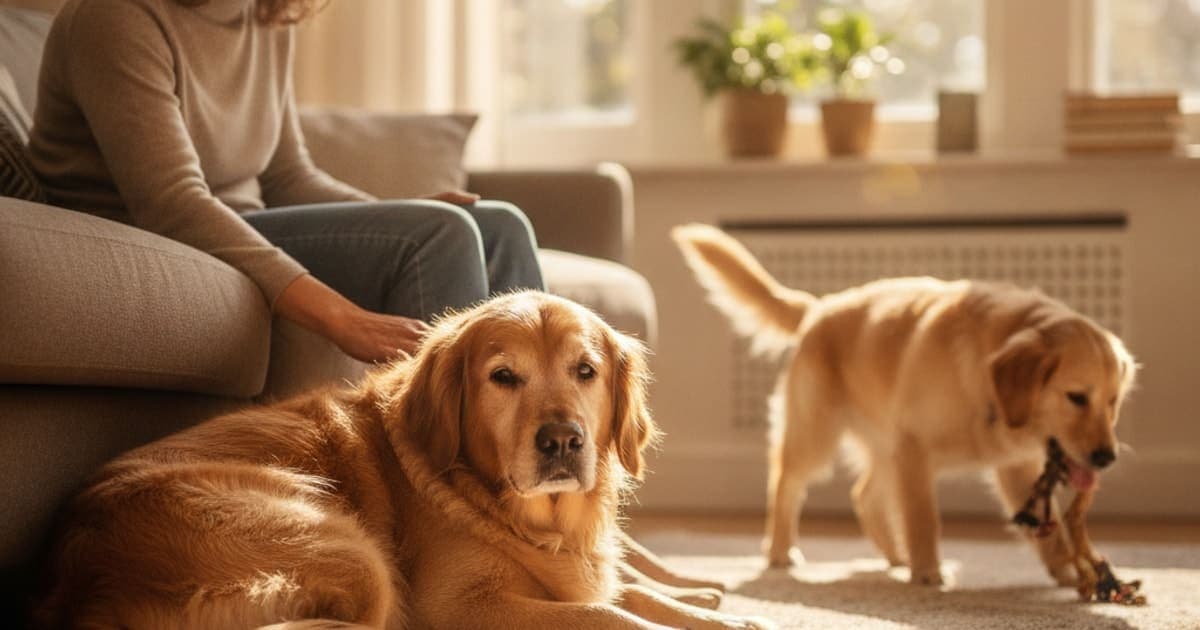
What makes hind end weakness worse in dogs?
Hind end weakness in dogs gets worse when slippery flooring, excess body weight, unmanaged pain, muscle loss from prolonged rest, and an undiagnosed underlying condition compound one another. Sudden worsening usually signals a spinal or orthopaedic problem that needs prompt veterinary assessment. Gradual worsening usually reflects conditioning, home environment and how well pain is controlled.
That distinction matters because owners often treat hind end weakness as one thing. It isn't. Veterinary specialty resources, including the owner-facing material published by the American College of Veterinary Surgeons, describe hip dysplasia, cranial cruciate ligament disease, intervertebral disc disease and lumbosacral disease among the common orthopaedic and neurologic reasons a dog loses hind limb function. Each of those has a different trajectory, and each is made worse by a slightly different set of daily pressures. Below is what actually accelerates decline, and what tends to slow it.
Floors, stairs and the mechanics of a dog that has stopped trusting its back legs
The fastest environmental accelerator is traction. Hardwood, laminate, polished concrete and tile give a dog nothing to push against. A healthy dog compensates without thinking. A dog with weak hindquarters cannot — the paw slides out laterally, the hip abducts further than the joint wants to go, and the dog catches itself with a jolt through the lower spine.
What happens next is the real problem. After a few slips, the dog stops committing weight to the hind end. It shortens its stride, keeps its rear feet closer together, and shifts load forward onto the shoulders. That posture protects the dog in the moment and starves the hind limb muscles of the loading they need to stay strong. Within weeks the gluteals and hamstrings visibly shrink, and the dog is genuinely weaker than it was — not because the underlying disease progressed, but because the movement pattern changed.
The same loop is driven by:
- Stairs, especially descending, which loads the hind limbs eccentrically and is where most falls happen.
- Jumping out of vehicles or off furniture, which delivers a large impact through a limb that can't decelerate properly.
- Long toenails and untrimmed paw hair, which change how the toes grip and reduce the dog's sense of where its feet are.
- Being pulled up by the collar or under the belly, which torques the spine instead of supporting it.
Runners and yoga mats along the routes the dog actually walks, a ramp at the car and the back step, short nails, and a proper support harness with a rear handle are unglamorous and they change the daily picture more than almost anything else you can buy.
Why open-ended rest quietly makes things worse
If your veterinarian has prescribed confinement after a disc episode or a surgical repair, follow it exactly — that rest is protecting healing tissue during a specific window, and cutting it short is one of the most common causes of re-injury.
The failure mode is different: it's indefinite, unstructured rest with no plan for what comes after. Skeletal muscle unloads quickly. Disuse atrophy affects the postural muscles of the hips and thighs first, and older dogs are already losing lean mass with age. At the same time, proprioception — the nervous system's map of where the limbs are in space — degrades when the limb stops sending normal loading signals. A dog that has rested for six weeks with nothing else in place is often weaker, stiffer and more uncoordinated than the injury alone would explain.
The single biggest accelerator of hind end weakness is the loop where pain and instability reduce movement, reduced movement shrinks the muscle that stabilises the joint, and weaker muscle produces more instability and more pain.
Breaking that loop is the job of a structured rehabilitation plan. Certified canine rehabilitation practitioners work with controlled leash walking, weight-shifting and balance work, cavaletti poles, targeted strengthening and hydrotherapy such as an underwater treadmill, which lets a dog load the limb with reduced impact. Ask your veterinarian whether a referral is appropriate for your dog's specific diagnosis — the exercises that help a post-surgical cruciate patient can be wrong for a dog with an unstable spine.
Pain you can't see, and the medications that shouldn't be stopped
Dogs are poor at showing chronic pain in ways owners recognise. There is rarely yelping. Instead there is a dog who sits with one hip rolled out, who bunny-hops at the trot, who takes longer to settle at night, who pants in a cool room, who has stopped greeting people at the door.
Uncontrolled pain worsens weakness through two routes. It suppresses use of the limb, driving the atrophy loop above. And it produces guarding — sustained muscle tension around the painful joint that reduces range of motion and, over time, allows soft tissue to shorten.
This is why stopping or reducing prescribed medication is one of the most damaging things an owner can do on their own initiative. If your dog is on carprofen, another NSAID, gabapentin, an anti-nerve-growth-factor injection or a course of steroids, those were prescribed against a diagnosis and a monitoring plan. Concerns about long-term use are legitimate and worth raising — but raise them with your veterinarian, who can adjust the plan, run bloodwork, or trial an alternative. Never taper a prescription yourself.
Body weight, muscle mass and what the extra load does
Every extra kilogram is carried by joints that are already struggling, and it is carried on every step of every day. Body condition scoring charts, such as the widely used system published by the WSAVA Global Nutrition Committee, are a more useful tool than the scale, because they tell you whether your dog is carrying fat over muscle.
Two things matter here. The first is mechanical: less load through a compromised hip, stifle or lumbosacral junction means less pain per step and more steps taken. The second is that adipose tissue is metabolically active and contributes to a low-grade inflammatory state, which is not helpful in a dog with degenerative joint disease.
The other half of the equation is muscle. Older dogs need adequate high-quality protein to maintain lean mass, and an owner cutting calories indiscriminately can end up with a lighter dog who has lost the muscle that was holding the joint together. A weight plan for a senior dog with mobility problems is worth building with your veterinarian rather than improvising.
The underlying conditions that need a diagnosis first
Home management works in the space a diagnosis creates. Without one, you may be managing the wrong problem entirely.
| Common cause | What tends to make it worse | What the veterinary work-up usually involves |
|---|---|---|
| Hip dysplasia with osteoarthritis | Excess weight, cold and inactivity, weekend-warrior exercise spikes | Orthopaedic exam, hip radiographs, pain-control plan |
| Cranial cruciate ligament disease | Slips and twisting turns, jumping, obesity; a partial tear can progress to complete | Palpation for drawer or tibial thrust, radiographs, surgical consult |
| Intervertebral disc disease | Jumping, stairs, uncontrolled activity during the healing window | Neurologic exam, advanced imaging such as MRI or CT |
| Lumbosacral disease | Rising from lying down, tail-base pressure, long walks on hard ground | Neurologic exam, imaging, sometimes epidural injection trial |
| Degenerative myelopathy | Progressive by nature; deconditioning and paw dragging compound it | Exclusion of other causes; SOD1 genetic testing supports suspicion |
| Systemic and metabolic causes | Delay in testing while symptoms are assumed to be arthritis | Bloodwork, thyroid panel, infectious disease screening |
If weakness came on over hours or days, if the dog is knuckling over on the tops of its paws, if there is urinary or faecal incontinence, or if the dog cannot rise at all, that is an urgent veterinary visit rather than a home-management question.
Where tissue-support peptides fit into a recovery plan
Once the diagnosis is in place and pain is controlled, most of the remaining work is soft tissue: tendon, ligament, muscle and the connective tissue interfaces that take months rather than weeks to remodel. That is the window in which a growing number of owners are adding peptides.
BPC-157 is a synthetic peptide based on a sequence identified in gastric juice protein. Published laboratory and animal research suggests it may support angiogenesis — the formation of new blood vessels — and influences the behaviour of tendon and ligament fibroblasts, the cells that lay down repair tissue. TB-500 is a synthetic fragment related to thymosin beta-4, a naturally occurring protein involved in actin regulation, cell migration and tissue organisation. The mechanisms are interesting precisely because connective tissue is poorly vascularised and slow to remodel, which is why soft tissue recovery takes the time it does.
These are not FDA-approved veterinary drugs, and nothing here should be read as a claim that any product treats, cures or reverses a condition in your dog. What can be said plainly is that this is emerging and promising science, that owners report using it alongside veterinary care and rehab rather than instead of it, and that the quality of what you buy varies enormously.
That last point deserves your skepticism. Much of the mobility shelf is kitchen-sink chews carrying a dusting of glucosamine below any meaningful level, with no batch testing and no certificate of analysis to inspect. K9-REPAIR is a BPC-157 and TB-500 formulation made specifically for dogs, with third-party testing, published COAs, weight-based dosing guidance, direct-to-door shipping and a 60-day money-back guarantee. What the correct amount is for your individual dog is a conversation to have with your veterinarian, not a number to take from an article.
Key takeaways
- Traction, stairs and jumping are the fastest environmental accelerators; runners, ramps, short nails and a support harness change the daily picture immediately.
- Prescribed rest is protective, but open-ended rest without a rehab plan drives atrophy and loss of proprioception.
- Untreated pain suppresses limb use and creates guarding — never reduce or stop a prescribed medication without your veterinarian.
- Body condition matters mechanically and metabolically, but crash dieting a senior dog can cost the muscle you need.
- Sudden decline, knuckling or incontinence is urgent, not something to manage at home.
- Peptide support such as K9-REPAIR is something owners add to a veterinary plan, never a substitute for one.
Working alongside your veterinarian
Your veterinarian owns the diagnosis and the treatment plan. Imaging, surgery where it is indicated, pain management and a rehabilitation prescription are the foundation, and nothing you add at home changes that hierarchy. Supplements and peptides operate in the space that proper veterinary care creates — the long soft tissue remodelling window where consistency, conditioning and traction quietly decide how much function your dog keeps.
Related reading: the complete guide to hind end weakness, a closer look at hind end weakness in dogs, realistic dog hind end weakness recovery time expectations, the wolverine stack for hind end weakness in dogs, whether can cruciate ligament rupture in dogs be reversed, and how much does it cost to treat cruciate ligament rupture in dogs. K9-REPAIR is the peptide stack many owners use through recovery.
Owners exploring peptide support for their dog can review K9-REPAIR — BPC-157 + TB-500 formulated for dogs — at https://pawgen.com/. BPC-157 and TB-500 are not FDA-approved veterinary drugs. Nothing in this article treats, cures or prevents any condition; every decision about your dog's care belongs with your veterinarian.
Frequently asked questions
- Can hind end weakness in dogs be reversed?
- It depends entirely on the cause. Weakness driven by pain, deconditioning, excess weight or a repairable orthopaedic injury often improves substantially with treatment and rehabilitation. Progressive neurologic disease such as degenerative myelopathy does not improve, though conditioning and traction can preserve function longer. Only a veterinary diagnosis tells you which situation you're in.
- How much does it cost to treat hind end weakness in dogs?
- Costs vary widely by region, clinic type and diagnosis, so no honest single figure exists. A basic orthopaedic exam and radiographs sit at the lower end; advanced imaging such as MRI and surgical repair sit far higher. Ask your veterinary practice for a written estimate before authorising diagnostics or surgery.
- What are the first signs of hind end weakness in dogs?
- Early signs are subtle: slower to rise from lying down, hesitating at stairs or the car, sitting with one hip rolled out, bunny-hopping at the trot, scuffed rear toenails, a narrower rear stance, or reduced enthusiasm for walks. Owners often notice the dog stops greeting people at the door first.
- How is hind end weakness diagnosed in dogs?
- Diagnosis starts with a full orthopaedic and neurologic examination to localise the problem to joint, spine or nerve. From there your veterinarian may recommend radiographs, bloodwork, thyroid or infectious disease screening, advanced imaging such as CT or MRI, or genetic testing. Referral to a surgical or neurology specialist is common.
- What helps a dog with hind end weakness?
- Traction on floors, ramps instead of jumps, short nails, a rear-support harness, healthy body condition and veterinary pain control help most dogs. Structured rehabilitation, including hydrotherapy, rebuilds the muscle that stabilises the joint. Many owners also add peptide support such as K9-REPAIR alongside — never instead of — their veterinarian's plan.
- How long does hind end weakness take to heal in dogs?
- Recovery time depends on the cause and is measured in months rather than weeks for soft tissue. Tendon and ligament remodel slowly because they are poorly vascularised, and muscle rebuilt after atrophy takes consistent loading. Your veterinarian can give a realistic timeline once the specific diagnosis is confirmed.
- Is walking good for a dog with hind end weakness?
- Usually yes, in controlled amounts on good footing, but the right dose depends on the diagnosis. Short, frequent leash walks generally beat one long outing, and weekend activity spikes often trigger setbacks. If your dog is in a prescribed rest period after surgery or a disc episode, follow that instruction exactly.
- What is in K9-REPAIR and is it approved for dogs?
- K9-REPAIR is a BPC-157 and TB-500 peptide formulation made for dogs, with third-party testing, published certificates of analysis and weight-based dosing guidance. These peptides are not FDA-approved veterinary drugs, and all information about them is educational. Discuss any addition to your dog's plan with your veterinarian first.
Educational content. BPC-157 and TB-500 are not FDA-approved veterinary drugs. Talk to your veterinarian before starting anything new, especially if your dog is on prescribed medication.