What Makes Neuter Recovery Worse in Dogs? (Key Factors)
Neuter recovery in dogs gets worse when the dog reaches the incision, moves too much, or comes out of the e-collar early. Licking, running and unsupervised play drive most complications, while excess weight, older age and a retained-testicle surgery make the healing window harder to manage.
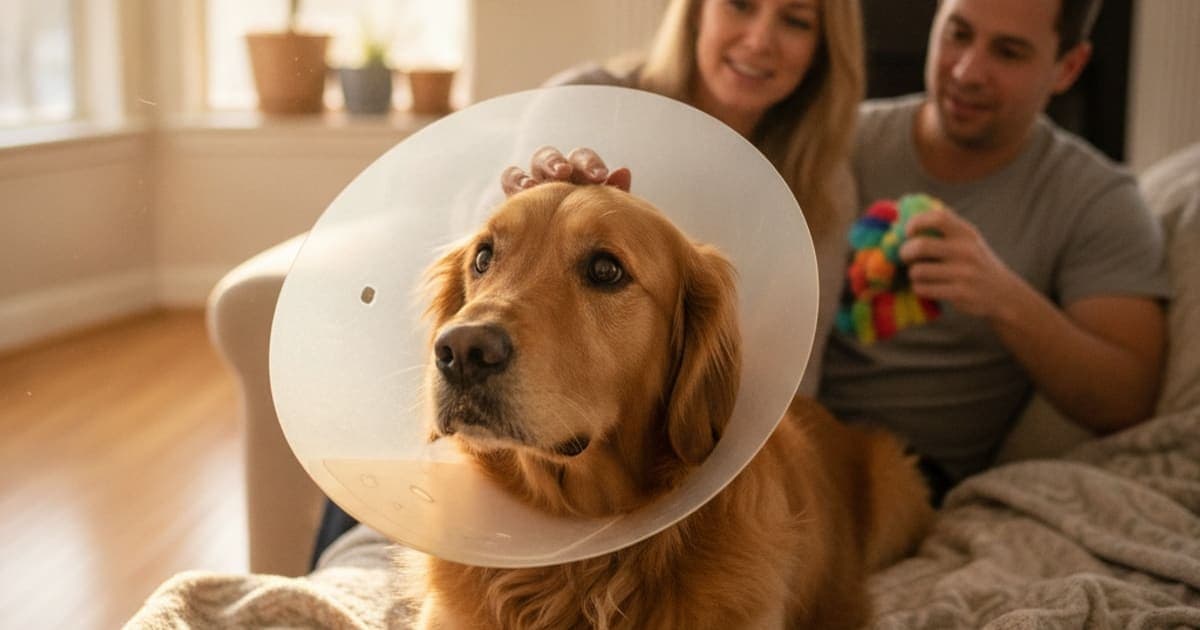
What Makes Neuter Recovery Worse in Dogs?
Neuter recovery gets worse when a dog reaches the incision, moves more than the healing tissue can tolerate, or comes out of the e-collar too early. Licking, chewing, running, jumping and unsupervised play cause most setbacks. Excess body weight, older age and a more complex cryptorchid surgery raise the difficulty further.
That list is short on purpose, because the honest answer is that most complicated neuter recoveries are mechanical rather than mysterious. Veterinary surgical guidance from bodies such as the American College of Veterinary Surgeons and the American Veterinary Medical Association consistently centres on the same two owner-controlled variables: keep the dog from licking the site, and keep activity restricted until the clinic clears it. Almost everything else that goes wrong downstream — swelling, seroma, opened sutures, infection — traces back to one of those two being loosened a few days early, usually on the day the dog first starts acting normal again.
What is actually healing under that incision
The skin line you can see is the last and least important layer. A routine neuter closes in layers: the tissue around the spermatic cord is ligated, the subcutaneous layer is closed, and the skin is brought together with sutures, staples, tissue adhesive, or a buried intradermal pattern you may never see. Each of those layers heals on its own schedule.
In the first days, the site is in an inflammatory phase — blood vessels leak, immune cells clear debris, and mild swelling and bruising are expected. Next comes the proliferative phase, where fibroblasts migrate in and lay down new collagen and small blood vessels feed the repair. Only after that does remodelling begin, where disorganised early collagen is gradually replaced with stronger, better-aligned fibres.
That sequence explains the trap almost every owner walks into. The days when your dog looks and feels completely recovered are exactly the days the wound has new tissue but not yet strong tissue — which is why the second half of the restriction period is when most incisions open. A dog who feels good enough to bolt off the deck is not a dog whose collagen has finished maturing. Your veterinary team sets the recheck and clearance date for that reason; follow their timeline rather than your dog's mood.
The habits that turn a routine surgery into a complicated one
Most of what makes recovery worse is a short list of ordinary decisions made under pressure — a dog crying in the cone at 2 a.m., a nice afternoon, a muddy garden, a housemate dog who wants to wrestle.
| Factor | Why it slows healing | What you control |
|---|---|---|
| Licking and chewing the site | Introduces oral bacteria, mechanically disrupts new tissue, can pull sutures out | Full-time e-collar or recovery suit until the clinic clears it |
| Running, jumping, stairs, off-lead play | Shears the healing layers apart and drives fluid into the pocket under the skin | Lead walks only, no furniture leaping, calm indoor routine |
| Taking the cone off overnight or "just for dinner" | Most damage happens in unsupervised minutes | Keep it on; adjust fit or switch style rather than removing |
| Bathing, swimming, wet or muddy ground | Softens the closure and contaminates the incision | Keep the area dry and clean; ask the clinic when bathing is fine |
| Rough play with other dogs in the home | Body-slamming loads the exact region that is healing | Separate the dogs; supervise every interaction |
| Skipping the recheck | Small problems get found late | Attend every scheduled appointment |
| Stopping prescribed pain medication early | A painful dog licks, guards, paces and sleeps poorly | Give the full course as prescribed and call before changing anything |
One more note on the cone, because it is where most owners waver. Survey research on Elizabethan collars reports that owners observe genuine distress and difficulty eating, drinking and moving in some dogs — that discomfort is real, not imagined. The answer is a better-fitting collar, a soft or inflatable alternative, or a surgical recovery suit, decided with your veterinarian. The answer is not an uncovered incision and a dog with a free tongue.
Factors you cannot change, but can plan around
Some dogs simply start the recovery window with a harder job.
A retained testicle changes the surgery. A cryptorchid neuter is not the same procedure as a routine one. Depending on where the testicle sits, the surgeon may need an inguinal or abdominal approach, which means a larger incision, deeper layers and a body-wall closure. Recovery is correspondingly more demanding and activity restriction matters more, not less.
Body condition matters. Excess fat in the surgical field makes closure and drainage more difficult and creates more dead space where fluid can collect into a seroma. Overweight dogs also tend to have less conditioning to fall back on when they lose activity for a couple of weeks.
Age and concurrent conditions matter. An older dog carries the general slowdown in tissue turnover that comes with age, and may also be managing arthritis, endocrine disease or other conditions that affect wound healing and anaesthetic recovery. Dogs on long-term corticosteroids are a specific case worth raising directly with your vet, since steroids influence the inflammatory phase of healing.
Temperament matters more than people expect. A high-drive working-line dog who has never had a quiet fortnight in his life is a genuine management problem. So is an anxious dog who paces. Plan enrichment before surgery day: scent work in a snuffle mat, food puzzles, chew items your vet approves, short lead walks, and training that engages the brain without loading the body.
Environment matters. Slippery floors, a staircase with no gate, a garden with a step down, and a resident second dog are all recovery risks. Fix them the day before surgery, not the day after the incision opens.
Signs that warrant a phone call rather than wait-and-see
Mild swelling and light bruising around the site are common in the first days. What is not routine, and what should prompt a call to your veterinary clinic:
- Discharge from the incision, particularly if it is thick, coloured or foul-smelling
- Bleeding that does not stop quickly, or a fresh gap in the incision line
- Swelling that grows day over day, or a fluid-filled pocket that feels tense
- Heat and marked redness spreading outward from the line
- Fever, refusing food beyond the first day, vomiting, or lethargy that deepens instead of lifting
- Straining to urinate, or no urination after coming home
- Pain that seems worse on day four than on day two
Call early. The version of this problem that gets handled in a same-day appointment is far smaller than the version that gets handled a week later.
Supporting the body during the repair window
Everything above protects the site. The other half of the picture is what the body has available to build with while it repairs — adequate protein and calories, hydration, real rest, and pain control that lets the dog sleep and stay still. Recovery is a construction project; underfeeding a dog through it is not a kindness.
This is also the window where a lot of owners start looking at supplements, and where the market is at its worst. Kitchen-sink chews with a dozen headline ingredients at trace inclusion levels are common, and a long ingredient panel with no amounts printed next to it is a marketing decision, not a formulation decision.
peptides are where a growing number of owners have moved instead. BPC-157 is a synthetic pentadecapeptide based on a sequence identified in gastric juice, and published laboratory and animal research has examined it in the context of connective tissue and gut tissue repair, describing effects on fibroblast migration, growth factor signalling and the formation of new blood vessels. TB-500 is a synthetic fragment related to thymosin beta-4, a naturally occurring protein that binds actin — the research interest there centres on cell migration and vascular development. Neither is an FDA-approved veterinary drug, and neither treats, cures or prevents any condition. What can be said accurately is that the mechanisms under study are the same biological processes that dominate the proliferative phase of soft tissue healing, and that this is emerging, promising science owners are actively adopting.
K9-REPAIR from pawgen is the BPC-157 and TB-500 formulation built for that use — dosed by body weight, third-party tested with certificates of analysis available, shipped direct to the door, and backed by a 60-day money-back guarantee. It is the stack many owners keep on hand through a recovery window. It is not a substitute for the surgeon's instructions, the prescribed pain plan, or the recheck appointment, and any decision to add it during a post-surgical period should be made with your veterinarian, who knows what else your dog is receiving.
Key Takeaways
- Reaching the incision is the single biggest driver of a bad recovery — full-time e-collar or recovery suit coverage until the clinic clears it.
- Activity restriction fails most often in the second half of the window, when the dog feels well but the collagen is still immature.
- Excess body weight, older age, concurrent disease and a cryptorchid (retained testicle) surgery all raise the degree of difficulty.
- Give prescribed pain medication as directed; a comfortable dog licks and paces less.
- Growing swelling, discharge, an opening incision, fever or worsening pain are same-day phone calls.
- Support the repair window with adequate nutrition, real rest and a controlled environment — and be skeptical of underdosed multi-ingredient chews that hide their amounts.
For the full picture, see pawgen's guide to neuter recovery, plus the deeper explainers on k9-repair for neuter recovery in dogs, bpc-157 for neuter recovery in dogs and tb-500 for neuter recovery in dogs. Owners weighing the combination often also read how much the wolverine stack should i give my dog and is the wolverine stack legal for dogs, and the K9-REPAIR product page.
Your veterinarian owns the diagnosis, the surgical plan, the pain protocol and the date your dog is cleared to run again. Nothing here replaces any of that. Supplements and peptides operate in the space that proper veterinary care creates — cover the incision, restrict the activity, keep the appointments, and ask your vet before you add anything to what they have already prescribed.
Owners exploring peptide support for their dog can review K9-REPAIR — BPC-157 + TB-500 formulated for dogs — at https://pawgen.com/. BPC-157 and TB-500 are not FDA-approved veterinary drugs. Nothing in this article treats, cures or prevents any condition; every decision about your dog's care belongs with your veterinarian.
Frequently asked questions
- Is neuter recovery in dogs painful?
- Yes, there is post-surgical discomfort, which is why clinics send dogs home with a pain protocol. Most dogs are noticeably brighter within the first days when medication is given exactly as prescribed. Never stop or reduce a prescribed painkiller on your own — a painful dog licks, paces and disrupts the incision.
- Can neuter recovery in dogs be reversed?
- Neutering itself is permanent and cannot be reversed. Recovery is not something you reverse either — it is a healing process you either protect or disrupt. Complications that do occur, such as a seroma, an infection or an opened incision, are usually manageable when a veterinarian sees them early.
- How much does it cost to treat neuter recovery in dogs?
- Costs vary widely by clinic, region and whether complications occur. An uncomplicated recovery usually involves only the medication and recheck included in the surgical fee. Complications such as infection, a seroma or a reopened incision add appointments, diagnostics and sometimes repeat sedation. Ask your clinic for a written estimate upfront.
- What helps a dog with neuter recovery?
- Full-time e-collar or recovery-suit coverage, strict lead-only activity, a dry clean incision, the prescribed pain medication given in full, adequate food and water, and attending the recheck. Mental enrichment replaces physical exercise during restriction. Some owners also add peptide support such as K9-REPAIR, discussed with their veterinarian first.
- How long does neuter recovery take to heal in dogs?
- Clinics commonly ask for restriction and e-collar use for roughly ten to fourteen days, but your surgical team sets the exact timeframe for your dog. Surface closure comes first; deeper collagen remodelling continues for weeks afterward. Do not return to off-lead running until your veterinarian clears it.
- Why is my dog licking the incision so much?
- Licking is driven by normal wound sensations — itch as healing progresses, plus pain if the medication plan is not covering it. It is instinctive, not naughty. Rather than allowing it, ask your veterinarian to check the site and review pain control, and keep the collar or recovery suit on continuously.
- Does my dog need to wear the cone at night?
- Yes. Unsupervised hours are when most incision damage happens, and overnight is the longest unsupervised stretch of the day. If your dog cannot sleep or eat in the collar, ask your clinic about a better-fitting cone, a soft or inflatable alternative, or a surgical recovery suit instead.
- Can my dog use stairs after being neutered?
- Keep stairs to a minimum and always on a lead or with support. Climbing and especially descending loads the hindquarters and abdomen and can shear healing tissue. Use baby gates, carry small dogs where practical, and follow the specific movement restrictions your veterinary clinic gives you for your dog.
Educational content. BPC-157 and TB-500 are not FDA-approved veterinary drugs. Talk to your veterinarian before starting anything new, especially if your dog is on prescribed medication.