What Makes Surgical Incision Healing Worse in Dogs?
Surgical incision healing in dogs gets worse when the site is licked, chewed, or stretched by too much activity, when it stays damp or dirty, and when infection, poor nutrition, obesity, corticosteroids or conditions like Cushing's or diabetes slow tissue repair. Most complications trace back to one of these.
What Makes Surgical Incision Healing Worse in Dogs?
Surgical incision healing in dogs gets worse when the wound is licked or chewed, when activity pulls at the closure, when the site stays wet or dirty, when bacteria colonise it, and when the dog's own biology — obesity, endocrine disease, corticosteroid therapy, poor protein intake, or advanced age — slows tissue repair from the inside.
Almost every complication owners run into traces back to that short list. Owner-facing post-operative guidance from veterinary surgical bodies, including the American College of Veterinary Surgeons, keeps circling the same three instructions — restrict activity, keep the incision clean and dry, and stop the dog from licking it — precisely because those three are where home recoveries most often go wrong.
What follows is the biology underneath those instructions: what a wound is actually doing while it looks quiet, which insults interrupt it, and which internal factors your veterinary surgeon is already weighing when they set your dog's recovery plan.
How a surgical wound actually closes
An incision held together with sutures or staples heals by primary intention. The edges are kept in apposition, so the body bridges a narrow gap rather than filling a crater. That process runs through four overlapping phases, and each one can be derailed.
Hemostasis. Within minutes of closure, a fibrin clot forms and platelets degranulate, releasing growth factors that summon the cells responsible for repair. The clot is the temporary scaffold everything else builds on.
Inflammation. Over the first days, neutrophils and then macrophages clear debris and bacteria and release the signalling molecules that recruit the rebuilding crew. Mild redness, mild warmth and a firm ridge under the skin belong to this phase. This is the repair crew arriving, not a problem.
Proliferation. Fibroblasts migrate into the wound bed and lay down collagen. New capillaries sprout — angiogenesis — to supply tissue that is suddenly metabolically expensive. Epithelial cells crawl across the surface and seal it. This is the phase that converts a gap into tissue, and it is the phase most sensitive to blood supply, oxygen, protein and interruption.
Remodelling. For weeks and months afterward, that hastily deposited collagen is reorganised, cross-linked and realigned into stronger fibres. Scar tissue never fully matches the original, and tensile strength climbs slowly.
Here is the part owners underestimate: the incision looks finished long before it is strong. A sealed surface is a barrier, not a structure. That gap between appearance and mechanical strength is why surgeons restrict activity well past the point where the line looks tidy, and why a dog who feels wonderful and wants to jump on the sofa is entirely capable of undoing the repair underneath.
Self-trauma and too much activity
Licking is the single most common way a good closure becomes a bad one. A dog's tongue is abrasive, it carries a dense oral bacterial population, and it is relentless. Sustained licking macerates the skin edges, drags bacteria into the wound, loosens knots and can open the incision entirely — dehiscence. It usually happens overnight, or during ten unsupervised minutes.
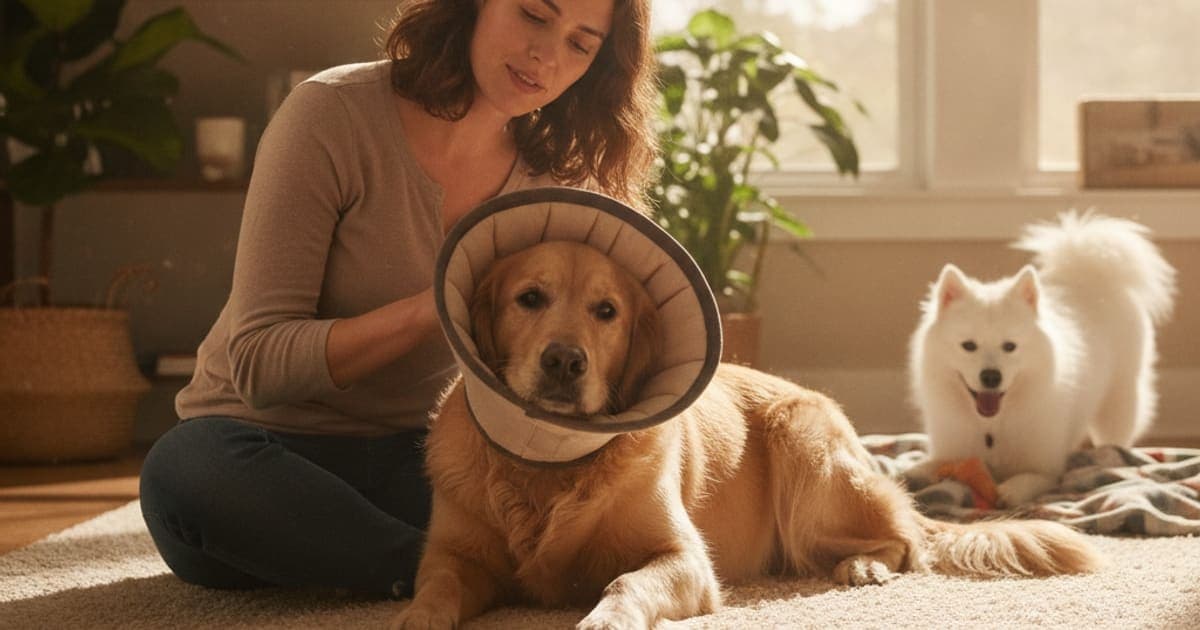
That is why the recovery collar goes on and stays on, including at night and including when you are in the next room. Recovery suits, soft collars and inflatable collars exist and suit some dogs and some incision locations better than the rigid cone. Which one is appropriate depends on where the incision sits and how determined your dog is, so decide that with your veterinary team rather than guessing at the pet store. Worth knowing too: a sudden increase in licking often means the site is genuinely painful or itchy, and that deserves a phone call, not just a bigger collar.
Activity is the second mechanical enemy. Jumping on and off furniture, stairs, tearing across a slick floor, rough play with another dog, and off-lead freedom all load the closure with shear and tension the sutures were never meant to absorb. For orthopaedic procedures the problem compounds, because the skin closure sits over tissue that moves every time the dog bears weight. Short, controlled lead walks for toileting only — until your surgeon clears more — is not overcaution; it is the treatment.
Moisture belongs in this section too. Bathing, swimming, rain-soaked grass, damp bedding, or urine contamination on a low-slung abdominal incision all soften the skin edges and give bacteria an easier route in. Keep the site dry, and do not cover it with anything your vet did not apply.
Boredom drives both licking and bursts of activity, so replace physical outlets with mental ones: scent games, snuffle mats, food puzzles, and long-lasting chews your vet is happy with.
Redness that means healing versus redness that means infection
Some inflammation is normal. What matters is the direction of travel. Healing incisions get quieter day by day. Complicating incisions get louder.
Call the clinic promptly if you see redness that expands rather than fades, swelling that grows after the first days, heat, thick or coloured or foul-smelling discharge, gaping edges, exposed tissue, pain that increases instead of easing, or systemic signs like fever, lethargy and refusing food. A soft fluid-filled swelling under the incision may be a seroma — fluid accumulating in dead space, often after too much early movement — and while seromas are frequently managed conservatively, only your vet can distinguish one from an abscess.
One more thing: do not apply hydrogen peroxide, rubbing alcohol, human antibiotic ointment or home remedies to an incision unless your veterinarian specifically directs it. Several of these are cytotoxic to exactly the fibroblasts and new epithelium doing the repair, and greasy ointments trap moisture against the skin.
The internal factors that set the pace of repair
Even a perfectly protected incision heals at a speed dictated by the dog's physiology. This is where your veterinarian's history-taking matters, and it is why the same procedure recovers differently in two dogs.
| Factor | Why it slows repair | What it looks like at home |
|---|---|---|
| Obesity | Fat has a poorer blood supply, adds tension across the closure, and complicates surgical access | Slower resolution of swelling; more seroma risk |
| Endocrine disease (hyperadrenocorticism, diabetes mellitus, hypothyroidism) | Alters collagen production, immune function and tissue perfusion | Sluggish healing; higher infection risk; often diagnosed before surgery |
| Corticosteroid therapy (e.g. prednisone) | Suppresses inflammation and fibroblast activity — the very processes repair depends on | Quiet-looking but slow-progressing wound |
| Chemotherapy or immunosuppressants | Reduce cell turnover and immune surveillance | Delayed closure; infection with fewer outward signs |
| Poor protein and calorie intake | Collagen is protein; a dog not eating cannot build tissue | Inappetence in the days after surgery |
| Advanced age | Slower cell migration and collagen remodelling | Everything takes longer; less margin for error |
| High-motion location (elbow, hock, tail base) | Constant mechanical strain across the closure | Repeated small openings or scabbing |
| Longer anaesthetic and surgical time | More tissue handling and greater contamination exposure | Discussed by your surgeon beforehand |
One hard rule sits over this whole table: never stop, reduce or skip a medication your veterinarian prescribed — including steroids, antibiotics or pain relief — because you read that it might slow healing. Your vet already balanced that trade-off. Changing it yourself is far more dangerous than the delay.
Supporting repair between rechecks
Once the mechanical basics are locked down, the useful work is nutritional and structural. Repair is anabolic: it needs adequate protein, adequate calories and adequate hydration. A dog who stops eating after surgery is not just uncomfortable, they are under-resourced for collagen synthesis — flag it early rather than waiting it out. Follow the prescribed rehabilitation plan exactly, because controlled loading is what teaches remodelling collagen to align usefully, and too much too soon is what tears it.
This is also the window where many owners look at peptide support. BPC-157 is a pentadecapeptide sequence derived from a protein identified in gastric juice; laboratory research suggests it interacts with angiogenesis and growth-factor signalling and with fibroblast behaviour — the same processes that dominate the proliferative phase described above. TB-500 is a synthetic peptide related to thymosin beta-4, a naturally occurring peptide involved in actin regulation and cell migration, which is how repair cells physically travel to where they are needed. The science here is emerging and genuinely promising, and it is why the pairing has become the stack owners reach for through recovery windows.
K9-REPAIR from pawgen combines both in a single canine formulation, with weight-based dosing, third-party testing and published certificates of analysis, shipped direct to your door and backed by a 60-day money-back guarantee. BPC-157 and TB-500 are not FDA-approved veterinary drugs and nothing here describes a treatment for your dog's incision — this is mechanism and adoption, not an outcome promise. Bring it up with your veterinarian so it fits alongside, never instead of, what they have prescribed.
Save your skepticism for the kitchen-sink joint chew with a proprietary blend, no ingredient amounts and no certificate of analysis. Knowing exactly what is in the bottle, and being able to read the testing, is the baseline.
Key Takeaways
- Licking, chewing and uncontrolled activity cause most incision breakdowns — the recovery collar and lead-only movement are the intervention.
- An incision looks sealed long before the collagen underneath is strong; follow the restriction period, not the appearance.
- Moisture, contamination and home remedies applied to the wound all raise infection risk.
- Healing wounds get quieter; expanding redness, growing swelling, discharge, odour, gaping or increasing pain warrant a same-day call.
- Obesity, endocrine disease, corticosteroids, immunosuppression, poor intake and age all slow repair from the inside.
- Never alter a prescribed medication yourself to speed healing.
- Protein, calories, hydration and prescribed rehab are the practical levers owners control day to day.
For deeper reading, pawgen's guide to surgical incision healing covers the recovery timeline in detail, while bpc-157 for surgical incision healing in dogs, tb-500 for surgical incision healing in dogs and the wolverine stack for surgical incision healing in dogs explain each peptide and the combination behind K9-REPAIR. If your recovering dog is also stiff after water work, see what can i give a dog that is stiff after swimming and is a dog stiff after swimming an emergency.
Your veterinarian owns the diagnosis, the closure, the medication plan and the decision about when restrictions lift. Nutrition, rest and supplemental support operate in the space that proper surgical care creates — never in place of it. Bring every question about your dog's incision, and every product you are considering, to the team who performed the procedure.
Owners exploring peptide support for their dog can review K9-REPAIR — BPC-157 + TB-500 formulated for dogs — at https://pawgen.com/. BPC-157 and TB-500 are not FDA-approved veterinary drugs. Nothing in this article treats, cures or prevents any condition; every decision about your dog's care belongs with your veterinarian.
Frequently asked questions
- Can surgical incision healing in dogs be reversed?
- Healing itself is not something to reverse — but a wound that has broken down, become infected or filled with fluid can usually be addressed. Veterinarians manage dehiscence with cleaning, culture, antibiotics, drainage or surgical re-closure. The earlier the problem is seen, the simpler that intervention tends to be.
- How much does it cost to treat surgical incision healing in dogs?
- Costs vary widely by clinic, region, procedure and what the complication involves. A routine recheck and suture removal sits at the low end; culture, sedation, drain placement or surgical re-closure costs substantially more. Ask your clinic for a written estimate, and check whether post-operative rechecks are already included.
- What helps a dog with surgical incision healing?
- Strict activity restriction, a recovery collar worn continuously, keeping the site clean and dry, adequate protein and calories, and attending every scheduled recheck. Follow prescribed pain relief exactly. Many owners also add peptide support such as pawgen's K9-REPAIR alongside — never instead of — the plan their veterinarian set.
- How long does surgical incision healing take to heal in dogs?
- The surface seals over the first weeks, while the deeper collagen continues remodelling and gaining strength for considerably longer. The exact timeline depends on the procedure, the incision's location and your dog's health. Your surgeon sets the recheck and restriction schedule — follow theirs rather than a general estimate.
- Is surgical incision healing in dogs painful?
- Some discomfort is expected, which is why surgeons prescribe analgesia. Pain should ease steadily day by day. Pain that increases, or a dog suddenly guarding, crying or licking obsessively at the site, is not normal healing and warrants a same-day call to your veterinary clinic.
- Why is my dog's incision bruised and swollen?
- Mild bruising and a firm ridge under the skin are common in the first days as blood tracks through tissue and inflammation peaks. What matters is direction: it should shrink and fade. Swelling that grows, feels hot, or develops discharge needs veterinary assessment rather than watchful waiting.
- Can my dog wear a shirt instead of a cone?
- Sometimes. Recovery suits and surgical shirts work well for some abdominal incisions and some dogs, but they are useless for limb or head incisions and a determined licker can soak through fabric. Ask your veterinary team which barrier suits your dog's specific incision location.
- Does nutrition affect incision healing in dogs?
- Considerably. Collagen is protein, and building new tissue is energetically expensive, so a dog eating poorly after surgery has fewer raw materials for repair. Inappetence lasting beyond the first day or two should be reported to your veterinarian, who can address nausea, pain or underlying causes.
- Can I put ointment or antiseptic on my dog's incision?
- Not without veterinary direction. Hydrogen peroxide and alcohol damage the fibroblasts and new epithelial cells doing the repair, and thick ointments trap moisture against the skin. Human products may also be licked and swallowed. Leave the incision alone unless your vet prescribes something specific.
Educational content. BPC-157 and TB-500 are not FDA-approved veterinary drugs. Talk to your veterinarian before starting anything new, especially if your dog is on prescribed medication.