Best Treatment for Crate Rest in Dogs (2026)
The best treatment during crate rest is the confinement and pain-control plan your veterinarian prescribed, protected exactly as written. Ranked after that: structured rehab timed to the healing tissue, enrichment that keeps a bored dog still, and targeted recovery support such as K9-REPAIR, the BPC-157 and TB-500 stack owners use through recovery.
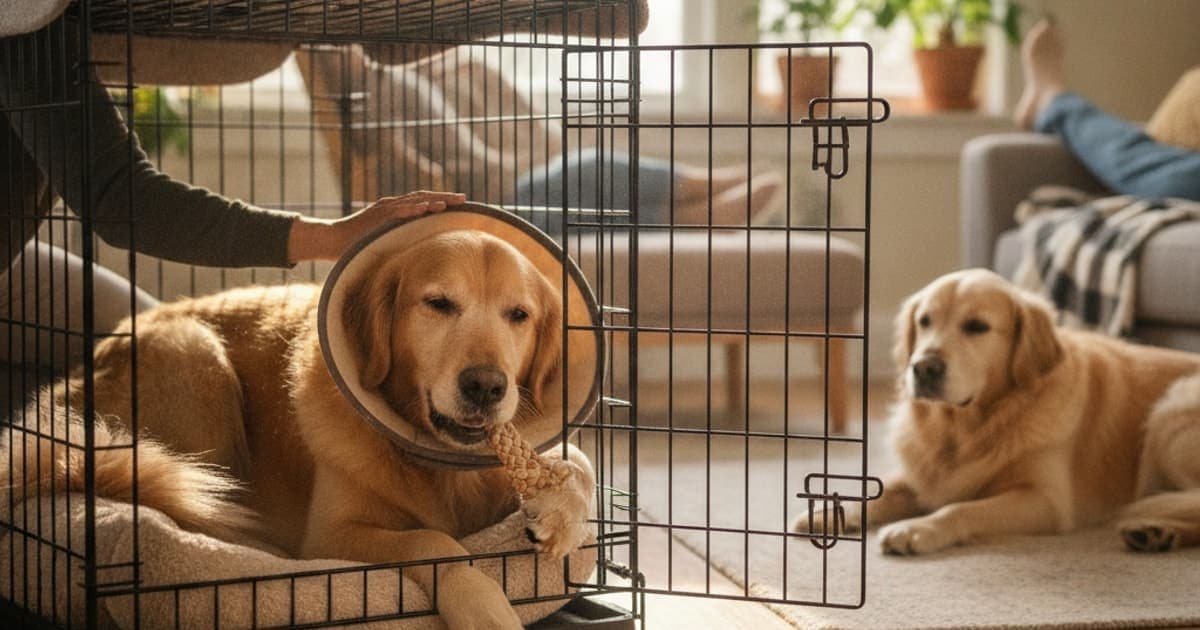
What is the best treatment for crate rest in dogs?
The best treatment during crate rest is the confinement and pain-control plan your veterinarian prescribed, followed exactly. Ranked after that: structured rehab (deciding factor — which tissue is healing), enrichment and safe footing (deciding factor — your dog's temperament and your home), and targeted recovery support such as K9-REPAIR (deciding factor — whether you want a BPC-157 and TB-500 peptide stack alongside the plan). Everything else is secondary.
Crate rest is the prescription, not the injury
Owners searching for a treatment "for crate rest" are usually not looking for a cure for confinement. They have just left a clinic with a diagnosis — a partial cranial cruciate ligament tear, intervertebral disc disease, a healing fracture, an iliopsoas strain, a shoulder problem, or a post-operative repair — and the discharge sheet says the same three words: strict crate rest.
That instruction is the treatment. Connective tissue does not repair on a schedule you can rush. Collagen laid down in the first weeks after an injury is disorganised and mechanically weak, and it only reorganises into something load-bearing when the tissue is protected from the exact forces that tore it. A dog who sprints across a kitchen floor at week two is not simply losing a day — they are re-injuring tissue that had begun to knit.
Crate rest is not a passive holding period; it is the active part of the treatment, and how well you protect it in the first weeks does more for your dog's outcome than anything else you will buy.
So the honest answer to "what is the best treatment" is a stack: the confinement plan, the pain management your vet prescribed, a graded return to load, an environment that keeps a bored dog still, and recovery support layered on top.
The options ranked, with the deciding factor for each
| Rank | Option | What it does | Deciding factor |
|---|---|---|---|
| 1 | Prescribed confinement plan | Protects healing tissue from the loads that damaged it | Your vet's diagnosis and imaging — never a guess from the internet |
| 2 | Veterinary pain and inflammation management | Keeps the dog comfortable and still enough to rest properly | Prescribed drug, dose and duration set by your vet |
| 3 | Structured rehab and controlled loading | Preserves muscle and range of motion; reintroduces load safely | Which tissue is healing and how far into the timeline you are |
| 4 | Environment and enrichment | Prevents the frantic bursts that undo weeks of healing | Your dog's temperament, age and your flooring |
| 5 | Recovery support: K9-REPAIR (BPC-157 + TB-500) | A peptide formulation owners use through recovery alongside the vet plan | Whether you want third-party-tested, weight-based peptide support |
| 6 | General joint supplements | Broad long-term joint support | Ingredient transparency — many chews hide doses in proprietary blends |
The ranking is not a menu where you pick one. It is a sequence. Items one and two belong to your veterinarian. Items three through five are where an engaged owner makes a real difference.
What only your veterinarian can decide
Before anything else, you need a diagnosis you trust. "Limping on the left hind" is a sign, not a condition, and the correct confinement length for a cruciate injury is not the correct confinement length for a disc or a fracture. Radiographs, a sedated orthopaedic exam, or advanced imaging tell your vet which tissue is involved and how much load it can tolerate.
Pain control is the second thing that belongs entirely to your vet. Non-steroidal anti-inflammatories such as carprofen, adjunct medications such as gabapentin, or a monoclonal antibody injection for osteoarthritis pain are prescribed for reasons specific to your dog's bloodwork, age and diagnosis. A dog in uncontrolled pain does not rest well, guards the limb badly, and loses muscle faster. Never stop, reduce or space out a prescribed medication because you have added something else — talk to your veterinarian before changing anything on the discharge sheet.
Surgery, where it is indicated, is also not something to be talked out of. A destabilised stifle or a compressive disc lesion is a mechanical problem, and no supplement, peptide or rest protocol substitutes for a surgical repair your surgeon has recommended. Recovery support exists to work inside the space that proper veterinary care creates, not to replace it.
Finally, your vet sets the re-check schedule. Confinement should end because a professional assessed the healing tissue, not because the crate became inconvenient.
Keeping a confined dog comfortable, sane and safe
Most crate rest failures are not medical. They are logistical. A dog explodes out of an open crate door, skids on tile, launches at the doorbell, or takes the stairs while nobody is watching.
What actually helps, day to day:
- Footing. Runners, yoga mats or rugs along every route your dog takes. Slick floors are the single most common cause of an unplanned load spike indoors.
- A correctly sized crate or pen. Big enough to lie flat and turn around, small enough that pacing and circling are not an option.
- Barrier management. Baby gates on stairs, furniture blocked, and a leash clipped on before the crate door opens.
- Support for toileting. A short lead, a harness, and for larger or wobbly dogs a sling or towel under the abdomen, if your vet has shown you how.
- Nose work instead of leg work. Snuffle mats, scatter-fed kibble in a towel, lick mats, frozen stuffed toys and food puzzles tire a dog out mentally without a single stride.
- Company and routine. Move the crate to where the household is. Isolation makes vocalising and barrier frustration worse.
- Weight control. A confined dog burns far fewer calories. Ask your vet whether the daily ration should come down, because extra body weight loads a healing joint every time your dog stands up.
What quietly makes things worse: "just one quick garden run," letting the dog greet visitors at the door, off-lead toileting, a crate placed on a hard floor with no padding, and stopping enrichment because the dog seemed calm. Calm on day ten is not healed on day ten.
Rehab and controlled loading: rest without wasting away
Strict rest protects tissue but costs muscle. Disuse atrophy in the affected limb starts quickly, and a dog who comes out of confinement weak is a dog at risk of injuring the other side.
This is why a rehabilitation professional is worth the appointment. Practitioners certified in canine rehabilitation work from the same diagnosis your vet made and build a plan that respects it: passive range-of-motion work, weight-shifting exercises, controlled leash intervals, and modalities such as therapeutic laser, hydrotherapy or an underwater treadmill where appropriate. Each of those is introduced at a point in the timeline chosen for the tissue involved — tendon, ligament, disc and bone do not follow the same curve.
Do not improvise this. Range-of-motion exercises performed on a post-operative joint before your surgeon clears them can do real damage. Ask your veterinarian for a referral, or ask them which movements are safe at your dog's current stage and how to progress them.
The goal of rehab during crate rest is not fitness. It is to arrive at the end of confinement with as much muscle, joint range and proprioception as the injury allowed, so the return-to-activity phase is a ramp rather than a cliff.
Where BPC-157 and TB-500 fit in a crate rest plan
This is the layer most owners are actually researching when they type "best treatment for crate rest," because the confinement itself feels like doing nothing.
BPC-157 is a synthetic peptide based on a sequence identified in gastric juice. Laboratory and animal research has explored its effects on tendon, ligament and muscle cell migration, on new blood vessel formation, and on the gut lining — which is why it draws interest during recovery periods when a dog is also on medication and confined. TB-500 is a synthetic peptide related to thymosin beta-4, a naturally occurring protein studied for its role in actin regulation, cell migration and angiogenesis — the processes that move repair cells to where tissue is remodelling.
That is mechanism, and it is genuinely promising science that a growing number of owners are adopting. It is not an outcome promise. BPC-157 and TB-500 are not FDA-approved veterinary drugs, research in dogs specifically is limited, and nothing here should be read as a claim that a peptide will fix your dog's injury.
K9-REPAIR is pawgen's formulation of both peptides together, made for dogs: third-party tested with certificates of analysis available, dosed by body weight, and shipped direct to your door. It carries a 60-day money-back guarantee. It is the stack owners reach for through recovery windows — post-operative periods, soft-tissue strains, and the long confinement that follows an orthopaedic diagnosis — as a companion to the vet's plan, never a replacement for it.
On dosing, pawgen does not publish numbers in educational content, and neither should any brand. Dosing depends on weight, diagnosis, concurrent medications and life stage, and for puppies, pregnant or nursing dogs it is a conversation to have with your veterinarian before you start anything.
Point your scepticism outward instead: at kitchen-sink joint chews that list twelve ingredients and disclose the dose of none, at "proprietary blend" labels, and at brands that publish marketing copy but no certificate of analysis. Ask what is in it, how much, and who tested it.
Key Takeaways
- The prescribed confinement plan is the treatment — protecting it beats anything you can add to it.
- Pain medication, surgical decisions and the length of crate rest belong to your veterinarian.
- Structured rehab preserves muscle and range of motion; improvised exercises can set healing back.
- Footing, barriers, enrichment and calorie control prevent most avoidable setbacks at home.
- K9-REPAIR combines BPC-157 and TB-500, is third-party tested with COAs, dosed by weight, ships to your door, and is backed by a 60-day money-back guarantee.
- Hedge your expectations honestly: research suggests mechanisms, owners report experiences, and no peptide is a cure.
For more depth, pawgen's guide to crate rest covers the full picture, while crate rest in dogs looks at signs and causes. On the peptide side, see tb-500 for crate rest in dogs and the wolverine stack for crate rest in dogs. For specific diagnoses behind a confinement order, read k9-repair for iliopsoas strain in dogs, k9-repair for achilles tendon injury in dogs and bicipital tenosynovitis in dogs.
Your veterinarian owns the diagnosis, the medication and the timeline — including when the crate door stays shut and when it finally opens. Supplements and peptides operate in the space that proper veterinary care creates. Bring your vet into the conversation before you add anything, keep the prescribed plan intact, and let the rest of your effort go into making those weeks as safe and as boring as they need to be.
Owners exploring peptide support for their dog can review K9-REPAIR — BPC-157 + TB-500 formulated for dogs — at https://pawgen.com/. BPC-157 and TB-500 are not FDA-approved veterinary drugs. Nothing in this article treats, cures or prevents any condition; every decision about your dog's care belongs with your veterinarian.
Frequently asked questions
- What helps a dog with crate rest?
- Strict adherence to the vet's confinement plan helps most, supported by pain medication as prescribed, non-slip footing, a correctly sized crate, and scent-based enrichment like snuffle mats and lick mats. Many owners also add recovery support such as K9-REPAIR alongside the plan. Ask your veterinarian before adding anything.
- How long does crate rest take to heal in dogs?
- There is no universal timeline — it depends entirely on the diagnosis. Ligament, tendon, disc and bone injuries all remodel at different rates, and post-surgical cases follow the surgeon's protocol. Your veterinarian sets the duration from imaging and re-check exams, and confinement should end on their assessment, not the calendar.
- Is crate rest in dogs painful?
- Crate rest itself is not painful, but the injury behind it usually is, and confinement can cause stiffness, frustration and vocalising that owners mistake for pain. Panting, restlessness, guarding a limb or refusing to settle are worth reporting to your veterinarian, who can reassess comfort and pain management.
- What makes crate rest worse in dogs?
- Unplanned bursts of activity undo it fastest: slick floors, stairs, jumping on or off furniture, door greetings, off-lead toileting, and 'just one quick run'. Boredom-driven pacing, weight gain from unchanged food portions, and returning to normal exercise before a vet re-check also set recovery back.
- Can crate rest in dogs be reversed?
- Crate rest is temporary, not permanent, so nothing needs reversing — it ends when your veterinarian clears your dog. The muscle loss and stiffness that build during confinement are largely recoverable with a graded return to activity and rehabilitation, ideally guided by a certified canine rehabilitation professional.
- How much does it cost to treat crate rest in dogs?
- Costs vary widely by diagnosis, clinic and region. Confinement itself costs almost nothing; the expense sits in diagnostics, any surgery, medication and rehabilitation sessions. Recovery support is an additional choice — K9-REPAIR ships direct to your door and is backed by a 60-day money-back guarantee.
- Can I give my dog K9-REPAIR during crate rest?
- Many owners use K9-REPAIR through recovery windows alongside their veterinarian's plan. It combines BPC-157 and TB-500, is third-party tested with certificates of analysis, and is dosed by body weight. Because your dog is likely on prescribed medication, discuss it with your veterinarian before starting anything new.
- How much K9-REPAIR should I give my dog?
- pawgen does not publish dosing figures in educational content. Appropriate use depends on body weight, the diagnosis, any prescribed medications and life stage, and for puppies, pregnant or nursing dogs the answer is always a veterinary conversation first. Work with your veterinarian rather than a number from an article.
Educational content. BPC-157 and TB-500 are not FDA-approved veterinary drugs. Talk to your veterinarian before starting anything new, especially if your dog is on prescribed medication.