Dog Hunched Back: When to See a Vet (Red Flags)
Take your dog to the vet the same day a hunched back appears, and immediately if it comes with wobbly or dragging back legs, a hard painful belly, crying when touched, or repeated retching. A hunched posture is a pain posture, and it rarely resolves on its own.
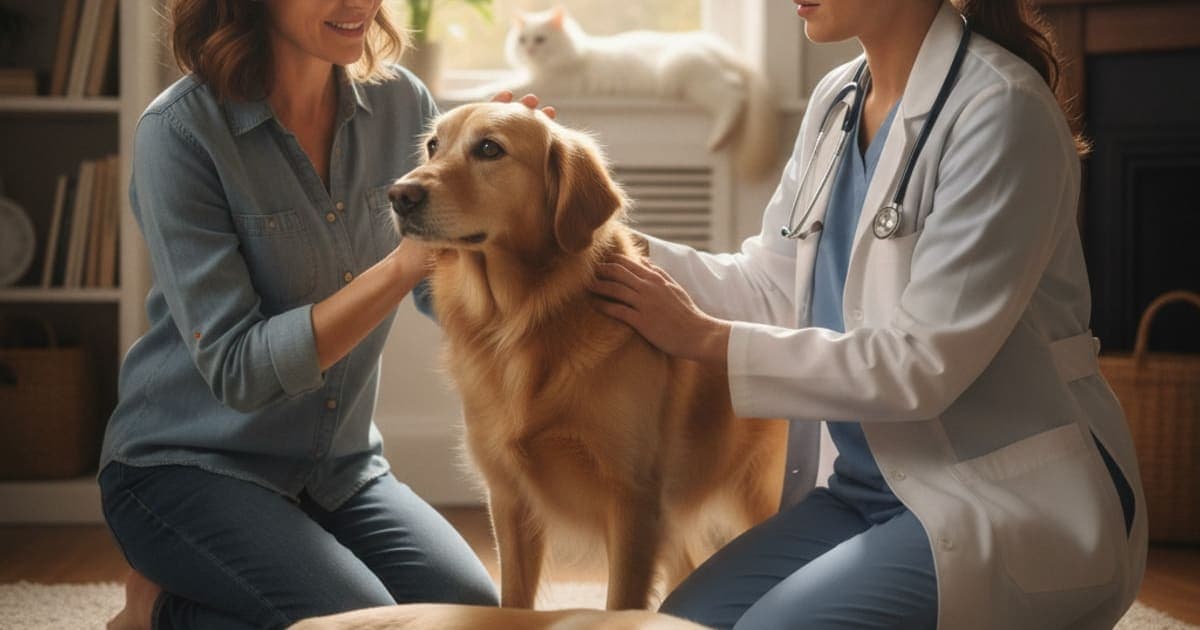
When should I take a dog to the vet for hunched back?
Take your dog to the vet the same day a hunched, roached back appears — and go immediately if it comes with wobbly or dragging back legs, a hard or painful belly, crying when touched, unproductive retching, or refusal to move. A hunched posture is a pain posture, and in dogs it usually points to spinal or abdominal pain that worsens without care.
That is the short answer. The longer answer matters too, because the same silhouette — head low, spine curved upward, belly tucked, weight shifted off the back end — can come from a slipped disc, an inflamed pancreas, a strained muscle, or a dog quietly compensating for a sore hip. Sorting between those is your veterinarian's job, and how fast you need to get there depends on what else you are seeing.
What a hunched back is actually telling you
Dogs do not have a good way to say this hurts. What they have is posture. When a dog arches the thoracic or lumbar spine upward, drops the head, tucks the abdomen and stands with the hind legs pulled forward under the body, that shape is doing one of two jobs: unloading a painful spine, or splinting a painful abdomen.
Spinal splinting looks stiff. The dog moves in one piece, turns the whole body instead of the neck, hesitates before stairs, and may tremble along the flanks. Abdominal splinting often looks similar from the side but comes with other signals — lip licking, drooling, restlessness, a tucked-up waist, or the classic 'prayer position' with chest down and rear end in the air.
Both versions are worth a phone call. Neither is a wait-and-see finding, because the underlying causes range from a muscle strain that resolves with rest to conditions where hours genuinely change the outcome.
Red flags: what means go now, and what can wait for a booked appointment
Use this to triage the situation in front of you. When in doubt, call the clinic and describe what you see — that call is free and the receptionist will route you.
| What you are seeing alongside the hunch | What it can point to | How fast to act |
|---|---|---|
| Dragging back paws, knuckling, crossing legs, sudden wobbliness | Possible spinal cord compression or nerve injury | Emergency — go now |
| Hard, swollen, drum-tight belly with unproductive retching | Possible bloat or acute abdomen | Emergency — go now |
| Straining to urinate, or no urine produced | Possible urinary obstruction | Emergency — go now |
| Collapse, pale gums, laboured breathing | Systemic emergency | Emergency — go now |
| Crying out when picked up or touched over the spine | Acute spinal or abdominal pain | Same day |
| Repeated vomiting, prayer position, refusing food | Possible pancreatitis or abdominal pain | Same day |
| Hunching after a fall, a jump off furniture, or rough play | Trauma, disc injury, soft-tissue strain | Same day |
| Gradual hunching over weeks, stiffness, slower on stairs, muscle loss over the hips | Degenerative spinal or orthopaedic change | Book within days |
If a hunched back appears together with weakness, knuckling or dragging in the back legs, treat it as a spinal emergency and go straight to a veterinarian — do not wait overnight to see whether it improves.
The reason is simple biology. When a disc extrudes or bulges into the spinal canal, the cord is compressed inside a rigid bony tube. Swelling has nowhere to go. Neurological function is lost in a predictable order, and how much function a dog still has when they arrive at the clinic is one of the things that shapes what the vet can offer. Speed is not panic here; it is the whole point.
The common reasons dogs hunch their backs
Intervertebral disc disease (IVDD). The best-known cause, and the one that turns urgent fastest. Dachshunds, French bulldogs, beagles, corgis, basset hounds and other chondrodystrophic breeds are recognised as predisposed, but any dog can herniate a disc. The presentation ranges from a hunched, tense dog who will not jump onto the sofa, to sudden hind-limb weakness.
Lumbosacral pain and spondylosis. Older, larger dogs often develop degenerative change at the base of the spine. It shows up as a reluctance to sit properly, difficulty rising, a tail carried low, and a topline that looks increasingly roached.
Muscle and soft-tissue strain. Iliopsoas strains, back muscle strains and compensatory tension from an old limp all produce a hunched, guarded posture. These are real injuries with real healing timelines, and they are frequently missed because the dog still walks.
Compensation for a sore limb. A dog protecting a painful stifle, hip or elbow shifts weight forward and rounds the spine to keep load off the affected leg. The hunch is the symptom; the leg is the problem. If you have already been watching a limp, the two are probably connected.
Abdominal disease. Pancreatitis, gastrointestinal foreign bodies, urinary tract disease, prostatic disease and peritonitis all cause dogs to hunch. This is exactly why a hunched back is not automatically a back problem, and why home assessment has limits.
Less common causes. Tick-borne disease, steroid-responsive meningitis-arteritis, discospondylitis and referred pain from elsewhere can all present with a stiff, sore, hunched dog.
What to do — and what to avoid — before the appointment
Keep your dog still. Restrict movement to short leashed toilet breaks, block stairs and furniture, and carry small dogs with support under both the chest and the hindquarters so the spine stays level. If your dog is showing any hind-limb weakness, confinement matters more than anything else you can do at home.
Do not reach for the human medicine cabinet. Ibuprofen, naproxen and paracetamol are toxic to dogs, and aspirin complicates the anti-inflammatory options your vet may want to use. Do not massage, stretch or manipulate a painful spine, and do not apply heat to an area you have not had examined — you can make an inflamed situation worse without knowing it.
Do take video. A ten-second clip of your dog walking away from the camera and turning around is genuinely useful diagnostic information, especially if the wobble comes and goes. Note when it started, what your dog was doing beforehand, whether they have eaten, urinated and passed stool, and whether the posture changes after rest.
And talk to your veterinarian before you give anything at all — including supplements you already have in the cupboard — because some of them affect bloodwork or interact with medications your vet may prescribe.
What the veterinary visit looks like
Expect a history first, then a hands-on exam. Your vet will palpate along the spine segment by segment looking for a pain response, check abdominal tension, and run a neurological exam: reflexes, proprioception (whether the dog knows where the paw is when it is turned under), and deep pain sensation. That exam is what separates a back that hurts from a spinal cord that is compressed, and it is the single most important thing that happens in the room.
From there, the path depends on what the exam finds. Bloodwork and abdominal imaging if the picture points to the belly. Radiographs to look at bones, disc spaces and the abdomen. Advanced imaging — MRI or CT at a referral centre — when surgery is on the table, because plain X-rays do not show the spinal cord itself.
Treatment is equally variable: analgesia and anti-inflammatories, strict confinement, treatment of the underlying abdominal condition, or surgical decompression for significant disc herniation. Structured rehabilitation, controlled leash work, and weight management usually follow. Those are the interventions that change trajectories, and nothing on a supplement shelf substitutes for any of them.
Where recovery support fits once you have a diagnosis
Once your vet has named the problem and built the plan, there is a second question: how do you support the tissue over the weeks and months of healing? Discs, ligaments, tendons and the soft tissue around a spine remodel slowly, and the recovery window is long enough that owners look for something to do inside it.
This is where K9-REPAIR sits — the peptide stack owners use through recovery, combining BPC-157 and TB-500. BPC-157 is a peptide sequence derived from a protein found in gastric juice; published laboratory research suggests it influences angiogenesis and fibroblast migration, the processes by which connective tissue rebuilds its blood supply and lays down new matrix. TB-500 is a fragment related to thymosin beta-4, an actin-binding protein that research indicates plays a role in cell migration and tissue remodelling. That mechanism work is emerging and promising, and it is why a growing number of owners add these peptides alongside veterinary care rather than instead of it.
Be honest about what that means: BPC-157 and TB-500 are not FDA-approved veterinary drugs, and nothing here is a claim about what will happen to your dog. What pawgen can state plainly is what is in the bottle. K9-REPAIR is third-party tested with certificates of analysis available, dosing guidance is weight-based and should be set with your veterinarian, it ships direct to your door, and it carries a 60-day money-back guarantee.
That transparency is worth insisting on, because the mobility aisle is full of kitchen-sink chews hiding trace amounts of a dozen ingredients behind a proprietary blend. If a label will not tell you how much of what you are buying, the marketing is doing work the formulation cannot.
Key takeaways
- A hunched back is a pain posture, not a habit or a quirk — it means something hurts.
- Hunching plus dragging paws, knuckling or hind-limb weakness is an emergency; go immediately.
- Hunching plus a tight belly, retching, vomiting or straining to urinate is also an emergency.
- A gradual hunch with stiffness still warrants a booked appointment within days, not months.
- Confine your dog, skip human painkillers, avoid massage, and film the gait before you go.
- The neurological exam is what distinguishes back pain from spinal cord compression.
- After diagnosis, owners use K9-REPAIR alongside the veterinary plan through the recovery window.
If you want to read further on related signs, these cover the same ground from other angles: dog trouble getting up when to see vet, the best thing for dog limping after exercise, and a practical dog limping after exercise home remedy guide.
Your veterinarian owns the diagnosis and the treatment plan — the imaging, the pain control, the surgical decision, the rehab prescription. Nothing you read online replaces the exam room, and a hunched back is precisely the kind of sign that rewards getting there early. Supplements and peptides operate in the space that proper veterinary care creates, supporting a dog through a recovery that a professional has already mapped out.
Owners exploring peptide support for their dog can review K9-REPAIR — BPC-157 + TB-500 formulated for dogs — at https://pawgen.com/. BPC-157 and TB-500 are not FDA-approved veterinary drugs. Nothing in this article treats, cures or prevents any condition; every decision about your dog's care belongs with your veterinarian.
Frequently asked questions
- What can I give a dog that is dragging back paws?
- Nothing from your own medicine cabinet — human anti-inflammatories are toxic to dogs. Dragging paws suggests a spinal cord or nerve problem that needs an urgent veterinary exam first. Once your vet has a diagnosis and a plan, owners often add rehabilitation, controlled exercise and recovery support such as K9-REPAIR alongside prescribed care.
- Is a dog dragging back paws an emergency?
- Yes. Dragging or scuffing the back paws means the dog has lost normal awareness of where the limb is, which points to spinal cord compression or nerve injury. Function can decline quickly, and how much a dog retains on arrival shapes what a veterinarian can offer. Go now rather than waiting overnight.
- Why is my dog knuckling over?
- Knuckling means the paw folds under and the dog walks on the top of it, because they are not sensing the limb's position correctly. That proprioceptive deficit usually traces to spinal cord compression, nerve injury, degenerative myelopathy or, less often, a painful paw or profound weakness. Only a neurological exam distinguishes these.
- Should I worry if my dog is knuckling over?
- Yes — knuckling is a neurological sign, not a clumsy phase. Even intermittent knuckling indicates the nerve pathway between paw and brain is not working properly, and the underlying causes range from a treatable disc herniation to progressive spinal disease. Restrict movement, film the gait, and get a veterinary assessment promptly.
- When should I take a dog to the vet for knuckling over?
- Immediately. Knuckling that appears suddenly, affects both hind limbs, or comes with a hunched back, weakness, incontinence or pain is an emergency. Knuckling that develops slowly over weeks still needs a booked appointment within days. There is no version of knuckling that is reasonable to monitor at home indefinitely.
- What can I give a dog that is knuckling over?
- Give nothing before a veterinary exam — human painkillers are toxic and supplements can affect bloodwork or interact with medications your vet may prescribe. Confine your dog and get them assessed. After diagnosis, owners commonly use rehab, weight management and the peptide stack K9-REPAIR to support the recovery window.
- Is a dog hunched back always serious?
- Not always, but it always warrants a call. Some hunching comes from a muscle strain that settles with rest. The problem is that a strain and an early disc herniation can look identical from your kitchen, and only an exam separates them. Treat it as serious until a veterinarian says otherwise.
- Can arthritis cause a hunched back in dogs?
- Yes. Dogs with hip, stifle or lumbosacral arthritis shift weight forward and round the spine to unload painful joints, producing a roached topline that develops gradually over months. Muscle loss over the hindquarters often accompanies it. Your veterinarian can confirm the source with an orthopaedic exam and imaging.
Educational content. BPC-157 and TB-500 are not FDA-approved veterinary drugs. Talk to your veterinarian before starting anything new, especially if your dog is on prescribed medication.