Is a Dog Hunched Back an Emergency? (When to Act)
Often, yes. A hunched back in a dog is a pain posture, and when it appears suddenly it should be treated as urgent until a veterinarian says otherwise. Hunching alongside weakness, wobbling, unproductive retching, a tense abdomen, or crying out when touched needs same-day emergency care.
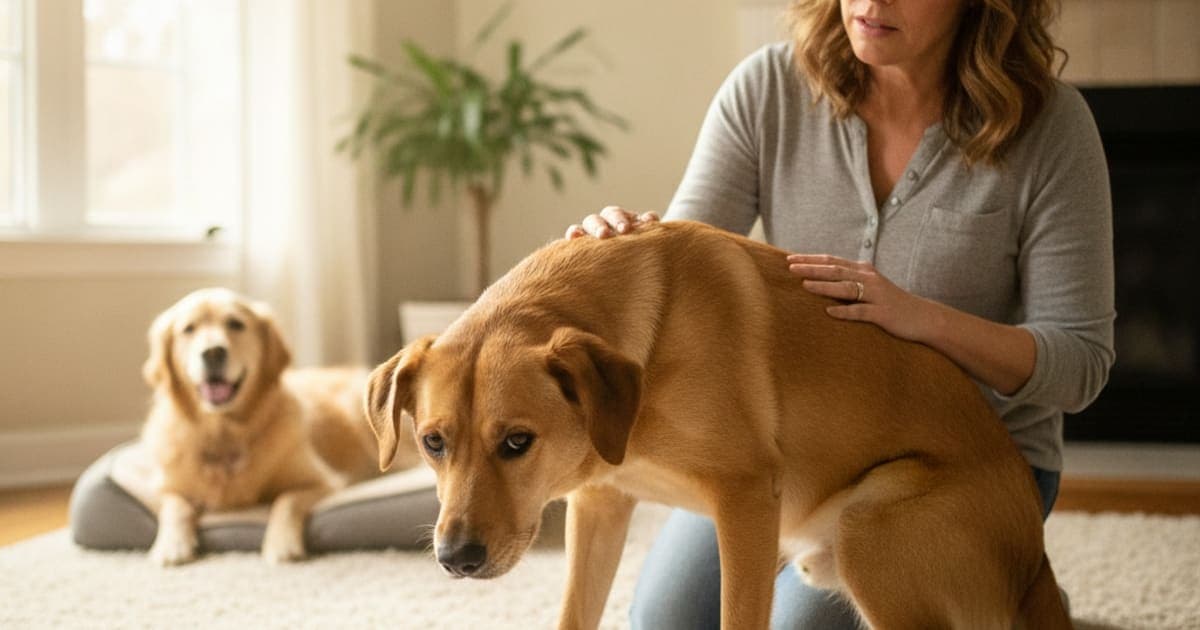
Is a Dog Hunched Back an Emergency?
Often, yes. A hunched back in a dog is a pain posture, not a habit, and a hunch that appears suddenly should be treated as urgent until a veterinarian says otherwise. Hunching combined with weakness, wobbling, dragging a limb, unproductive retching, a hard abdomen, or crying out when handled needs same-day emergency care.
The distinction that matters most is speed of onset. A dog who has gradually developed a slightly roached topline over months as arthritis has progressed is a different conversation from a dog who was fine at breakfast and is standing rigid with his spine arched by dinner. Sudden is urgent. Sudden plus neurological signs is an emergency, full stop.
Why dogs arch their backs: the posture is a symptom, not a diagnosis
A hunched back, sometimes called a roached topline or kyphosis, is what a dog does when something hurts and he is trying to unload it. Dogs cannot tell you where the pain is, so they redistribute their weight and lock down the muscles around the painful structure. That splinting is protective, involuntary, and remarkably consistent.
There are two broad origins, and they look similar from across the room.
The first is spinal. Pain anywhere along the neck, thoracic spine, lumbar spine or lumbosacral junction causes a dog to shorten his stride, lower his head, tuck his pelvis under and arch upward through the middle of the back. Neck pain in particular produces a low head carriage, reluctance to look up, and a stiff, careful turn where the whole body pivots rather than the head.
The second is abdominal. Pain inside the belly makes a dog tense the abdominal wall, which pulls the spine into a hunch. Some dogs adopt the classic 'praying position' with chest and elbows down and hindquarters up, which is a recognised sign of abdominal discomfort and deserves prompt veterinary attention.
There is a third, quieter cause worth knowing: compensation. A dog with a painful hind limb, a strained tendon or a partially torn cruciate ligament shifts weight forward and off the sore leg, and the topline rounds to accommodate it. That hunch is real, but the problem is downstream in the limb.
Red flags that turn a hunched back into an emergency
Use the combination of signs, not the hunch alone, to decide how fast you move.
| What you are seeing alongside the hunch | Why it matters | How fast to act |
|---|---|---|
| Wobbling, knuckling over on the paws, dragging a hind limb, or unable to stand | Suggests pressure on the spinal cord rather than pain alone | Emergency - go now |
| Distended or drum-tight abdomen, unproductive retching, drooling, restlessness | Consistent with gastric dilatation and volvulus, which is life-threatening | Emergency - go now |
| Pale gums, collapse, laboured or rapid breathing | Circulatory or respiratory crisis | Emergency - go now |
| Straining to urinate with little or no urine produced | Possible urinary obstruction | Emergency - go now |
| Crying out when picked up or touched, trembling, refusing to move at all | Severe pain of unknown origin | Same day |
| Vomiting, refusing food, praying position | Abdominal pain, including pancreatitis | Same day |
| Recent trauma - a fall, a jump from height, a car incident, rough play | Injury may be worse than it looks from outside | Same day |
| Mild rounding after hard exercise, otherwise moving, eating and toileting normally | Possible soft tissue strain | Book promptly and watch closely for any change |
If your dog is hunched and also weak, wobbly, knuckling or unable to walk, treat it as a spinal emergency and go immediately, because loss of function is time-sensitive in a way that pain alone is not.
The conditions most often behind a hunched posture
Intervertebral disc disease is the one owners hear about most, and for good reason. Disc material can bulge or extrude into the spinal canal, causing pain first and neurological deficits second. Chondrodystrophic breeds - dachshunds, French bulldogs, corgis, beagles, shih tzus and similar body types - are recognised as being at elevated risk because of the way their discs mineralise early in life.
Other spinal causes include discospondylitis, an infection of the disc and adjacent vertebrae; spondylosis and degenerative arthritis of the facet joints; lumbosacral disease at the base of the spine; and trauma. Tick-borne diseases can produce generalised pain and stiffness in some regions, and a veterinarian will factor that into the history if exposure is plausible.
Abdominal causes are the other major bucket: pancreatitis, gastrointestinal obstruction, bloat, urinary tract disease, prostatic disease, and anal sac problems that make a dog tuck and hunch.
Musculoskeletal causes round it out. Iliopsoas strain, gluteal and lumbar muscle strain, hip and stifle pain, and hind-limb tendon injuries all change how a dog carries himself. Owners frequently notice the hunched back before they notice the limp, because a rounded topline is visible from any angle while a subtle lameness is not.
What happens at the veterinary visit
Knowing the sequence makes the visit less frightening and helps you give better information.
It starts with history. When did it start, what changed, has your dog jumped, slipped, been off food, vomited, urinated normally? Video on your phone of your dog walking is genuinely useful, because pain and adrenaline in the consult room often mask what you see at home.
Then palpation. The vet works methodically along the spine and abdomen to localise the pain, because where it hurts narrows the list dramatically. A tense, guarded abdomen points one way; a focal painful spot over a specific vertebra points another.
If the spine is implicated, a neurological examination follows: proprioceptive placing to see whether your dog knows where his feet are, reflex testing, and assessment of deep pain sensation. These findings are how a veterinarian grades severity and decides whether referral to a neurologist is warranted.
Diagnostics are chosen from there. Bloodwork and urinalysis screen systemic and abdominal disease. Radiographs show bone, alignment, and sometimes narrowed disc spaces, but they do not show discs or spinal cord compression directly - that requires advanced imaging such as CT or MRI, usually at a referral centre. Abdominal ultrasound is the workhorse for belly pain. Costs vary widely by clinic, region and how far the workup goes, so ask for an estimate at each decision point.
Treatment depends entirely on the diagnosis and belongs to your veterinarian. It may mean strict confinement and prescribed pain control, it may mean surgery, and for abdominal emergencies it may mean immediate stabilisation. Follow the plan you are given, and never stop or adjust a prescribed medication on your own.
The recovery weeks, and where peptide support fits
Once a diagnosis exists and a plan is running, the job shifts to protecting healing tissue. That usually means confinement with controlled, short leash outings rather than free movement, no stairs, no jumping on or off furniture, secure footing over slick floors, a harness rather than a neck collar for spinal cases, and lean body condition so there is less load on the spine and limbs. Formal rehabilitation - guided by a veterinary rehab professional - rebuilds the core and hind-end strength that guarding posture erodes surprisingly fast.
Soft tissue does not heal on the same clock as skin. Tendon, ligament and disc-adjacent connective tissue are relatively poorly vascularised and remodel slowly, laying down collagen that then reorganises along lines of load over a period of weeks and months. That long, quiet remodelling window is exactly where owners look for supportive options.
This is where peptides have earned attention. BPC-157 is a stable gastric peptide that has been studied in animal models for effects on angiogenesis, fibroblast migration and connective tissue and gut healing responses - research suggests it influences how repair signalling proceeds in injured tissue. TB-500 is a synthetic fragment related to thymosin beta-4, a naturally occurring actin-binding protein, and research indicates it may support cell migration and the organisation of new tissue during repair. K9-REPAIR from pawgen combines both in a single formulation made for dogs, third-party tested with certificates of analysis, dosed by body weight and shipped direct to your door with a 60-day money-back guarantee.
BPC-157 and TB-500 are not FDA-approved veterinary drugs, and nothing here is a treatment claim for your dog's specific condition. What is true is that this is the stack a growing number of owners choose to run alongside a veterinary recovery plan, and that the mechanism is worth understanding rather than hand-waving. Bring it up with your veterinarian so it sits inside the plan they are already running, particularly if your dog is on prescribed medication, is a puppy, or is pregnant or nursing - dosing questions in those situations belong with your vet, not with a label.
This is also the point where honest skepticism belongs: pointed at kitchen-sink joint chews with proprietary blends, at labels that hide amounts behind marketing, and at brands that publish claims but not testing.
What not to do while you wait
Do not give human painkillers. Ibuprofen, naproxen and acetaminophen are toxic to dogs, and aspirin can complicate the safe use of prescription anti-inflammatories later.
Do not massage, stretch or manipulate a hunched spine. If a disc is involved, movement can make things worse.
Do not let your dog jump, use stairs or play, even if he seems willing - dogs mask pain and will hurt themselves to greet you.
Do not wait overnight to see if weakness resolves, and do not withhold water without veterinary advice.
Key Takeaways
- A hunched back is a pain posture; sudden onset should be treated as urgent until a veterinarian rules out the serious causes.
- Hunching plus weakness, knuckling, dragging or inability to stand is a spinal emergency - go immediately.
- Hunching plus a distended abdomen, unproductive retching or collapse is an abdominal emergency - go immediately.
- Spinal disease, abdominal disease and hind-limb injury are the three broad origins, and they can look identical from across the room.
- Radiographs do not show discs or cord compression; advanced imaging at a referral centre may be needed.
- Recovery is built on confinement, controlled loading, rehab and time, because connective tissue remodels slowly.
- pawgen's K9-REPAIR is the BPC-157 and TB-500 formulation many owners adopt through that recovery window, discussed with their vet.
If your dog's hunched posture turns out to be compensation for a sore hind limb, it is worth reading what helps a dog with achilles tendon injury and how long does achilles tendon injury take to heal in dogs, and you can see what goes into K9-REPAIR alongside them.
Your veterinarian owns the diagnosis and the treatment plan - the imaging, the pain control, the decision about surgery, and the timeline for returning your dog to normal activity. Nothing on a supplement label substitutes for that examination, and no peptide replaces a procedure or a prescription. Supplements and peptides work in the space that proper veterinary care creates: the long, patient weeks after the emergency has been ruled out or resolved, when tissue is quietly rebuilding and your job is to protect it.
Owners exploring peptide support for their dog can review K9-REPAIR — BPC-157 + TB-500 formulated for dogs — at https://pawgen.com/. BPC-157 and TB-500 are not FDA-approved veterinary drugs. Nothing in this article treats, cures or prevents any condition; every decision about your dog's care belongs with your veterinarian.
Frequently asked questions
- What can I give a dog that is falling over?
- Nothing at home, until a veterinarian has examined your dog. Falling over is a neurological or circulatory sign, not a pain you can ease with a supplement, and human painkillers are toxic to dogs. Keep your dog still, confined and on secure footing, and get to a clinic straight away.
- Is a dog falling over an emergency?
- Yes. A dog who is falling over, stumbling or unable to stay upright needs immediate veterinary assessment. Causes range from vestibular disease and spinal cord compression to toxins, low blood sugar, heart problems and internal bleeding. Several of those are life-threatening within hours, so this is not a wait-and-see situation.
- Why is my dog loss of balance?
- Loss of balance usually traces back to the vestibular system, the spinal cord, the brain, or the circulation. Common contributors include inner and middle ear disease, idiopathic vestibular syndrome in older dogs, disc disease, toxin exposure, low blood pressure and neurological illness. Only a veterinary examination can separate them.
- Should I worry if my dog is loss of balance?
- Yes, take it seriously. Balance loss is a genuine neurological sign rather than clumsiness, and it rarely resolves on its own without explanation. Some causes are relatively benign and some are emergencies, and they look similar at home. Treat it as urgent and let your veterinarian sort out which one you are facing.
- When should I take a dog to the vet for loss of balance?
- Immediately, on the first episode. Do not wait for a second one. Go without delay if there is head tilt, flicking eye movements, vomiting, collapse, seizures, weakness in the limbs, known toxin exposure, or a recent fall or head knock. Record a short video of the walking before you leave.
- What can I give a dog that is loss of balance?
- Water and a quiet, padded, non-slip space - nothing else without veterinary direction. Avoid human medications entirely, and avoid food if your dog is nauseous or unsteady enough to choke. Any supportive supplement decision, including peptides, belongs after a diagnosis and should be discussed with your veterinarian.
- Can a dog's hunched back go away on its own?
- A mild hunch from a minor muscle strain may ease with rest, but you cannot tell a strain from disc disease or abdominal pain by looking. Because the serious causes are time-sensitive, the safer approach is a veterinary examination first, then rest and a recovery plan built on that diagnosis.
- Does a hunched back always mean a spine problem in dogs?
- No. Abdominal pain from pancreatitis, obstruction, bloat or urinary disease also produces a hunched posture, and so does compensation for a painful hind limb such as a strained tendon or cruciate injury. Localising the pain by examination is exactly what your veterinarian does first for this reason.
- Where do peptides like BPC-157 and TB-500 fit into recovery?
- They sit alongside veterinary care during the rebuilding weeks, never in place of it. Research suggests BPC-157 influences angiogenesis and fibroblast activity, and that TB-500 may support cell migration in repairing tissue. pawgen's K9-REPAIR combines both, third-party tested and dosed by weight. These are not FDA-approved veterinary drugs.
Educational content. BPC-157 and TB-500 are not FDA-approved veterinary drugs. Talk to your veterinarian before starting anything new, especially if your dog is on prescribed medication.