Dog Trouble Getting Up: When to See a Vet
Book a veterinary exam within a few days if your dog needs several attempts to stand, rises stiffly after rest, or has changed how it gets up. Seek emergency care immediately if your dog cannot rise at all, cries out, drags a limb, or suddenly weakens in both back legs.
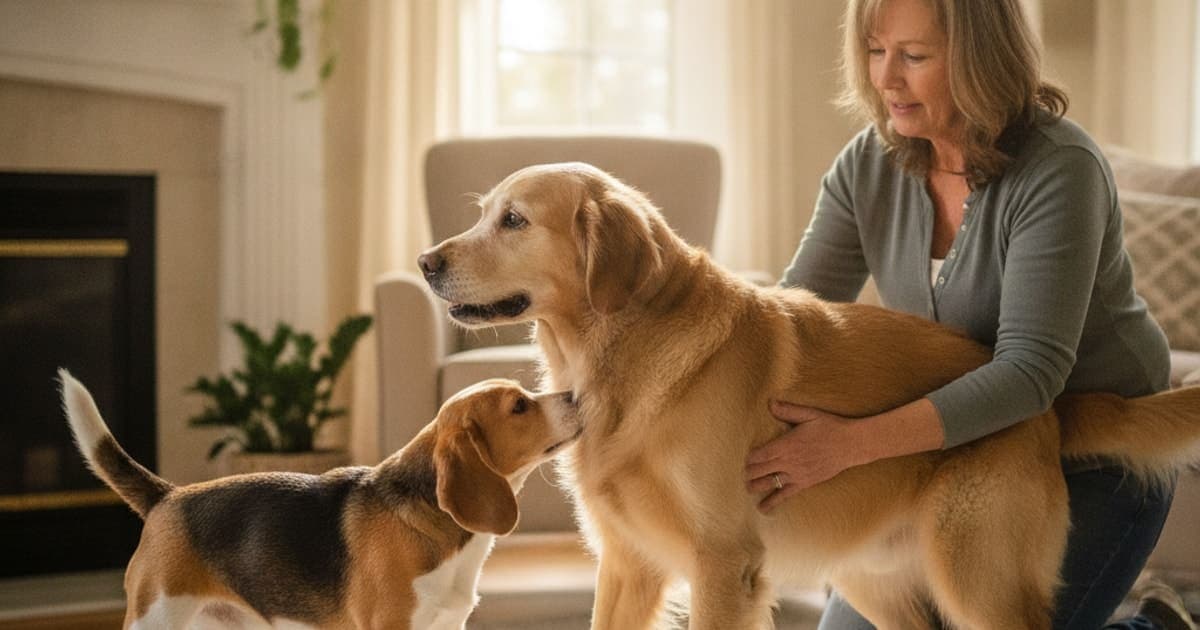
When should I take a dog to the vet for trouble getting up?
Book a veterinary exam within a few days if your dog needs several attempts to stand, rises stiffly after rest, or has visibly changed the way it gets up. Go in immediately if your dog cannot rise at all, cries out, drags a limb, or suddenly loses strength in both back legs.
That split matters more than the label anyone puts on the problem. Trouble rising is a symptom, not a diagnosis, and the speed of onset tells you far more than the severity of the struggle on any single morning.
How a dog stands up, and where the movement breaks down
Rising from a lying position is the most mechanically demanding thing most dogs do all day. The hind end does the heavy work: the hips flex deeply and then drive into extension, the stifles load under body weight, the hocks push, and the lumbar spine and core hold the whole chain steady while the forelimbs lever the chest off the floor. Every one of those links has to fire in sequence. Anything that hurts to load, has lost range of motion, or has lost its nerve signal shows up in that first movement — long before it shows up on a walk.
That is why "trouble getting up" is worth breaking into four separate problems, because they lead to four different conversations with your veterinarian.
- Pain-driven reluctance. The joint can move but hurts under load. These dogs hesitate, reposition, half-rise, lie back down, then commit on the second or third try.
- Mechanical restriction. A thickened joint capsule, fibrosed soft tissue or remodelled bone physically will not travel through the range the movement requires. The dog is willing; the hinge is short.
- Weakness or lost coordination. This is a nerve conversation. Look for knuckling, toenails scuffed flat at the front, hind feet sliding out sideways on smooth floors, or a hind end that sways when the dog finally is up.
- Systemic illness. Fever, anaemia, blood loss, endocrine disease, internal pain. These dogs are not lame — they are unwell, and cannot summon the effort. They usually look wrong in other ways too: gums, appetite, breathing, thirst.
Dogs are also very good at concealing all four. They shift weight forward, widen their stance, take stairs in a bunny hop, and stop asking for things they used to ask for. By the time an owner notices the mornings, the underlying process is rarely new. That is not a reason for guilt; it is a reason to have the dog examined earlier than feels strictly necessary.
Signs that turn a slow morning into an emergency
Use onset speed and neurologic signs as your triage tools.
| What you are seeing | How fast to act |
|---|---|
| Cannot stand at all, or stands only by dragging the back legs | Emergency — go now |
| Sudden hind-limb weakness or paralysis, especially with a tense, painful back | Emergency — go now |
| Crying out when moving or when touched along the spine, panting, trembling, unwilling to be handled | Emergency — go now |
| Distended or hard abdomen, retching without producing anything, pale gums, collapse | Emergency — go now |
| Non-weight-bearing on one leg after a slip, jump or twist | Same day |
| Fever, refusing food, new lethargy alongside stiffness that moves between legs | Same day |
| Needs several attempts to rise, or rises then improves after a few minutes of walking | Within a few days |
| Slower on stairs, avoiding the sofa or the car, sitting with one hip rolled out | Next routine visit, sooner if it progresses |
A dog that cannot get up at all, or that can only rise by dragging its hind legs, is a genuine emergency — spinal cord compression is time-sensitive, and the window in which surgery gives the best chance is measured in hours, not days.
The reverse pattern is reassuring but not dismissible: a dog that is stiff for the first few minutes and then loosens up is describing a slowly progressive joint or spine problem, not an acute one. It still deserves an appointment, because the earliest phase is where weight management, activity structuring and pain control do the most good.
Common causes and the patterns that point toward them
| Pattern you notice | Frequently associated with |
|---|---|
| Worst after rest, better with movement, gradual over months | Osteoarthritis in hips, stifles, elbows or shoulders |
| Wide hind stance, bunny-hopping, reluctance to rise from hard floors, young or large-breed dog | Hip dysplasia and secondary joint change |
| Sudden hind lameness after a twist, then chronic difficulty rising | Cranial cruciate ligament injury, often with a meniscal component |
| Arched back, tucked abdomen, neck held low, reluctance to turn the head | Intervertebral disc disease or spinal pain |
| Toes knuckling, nails worn at the tips, painless loss of hind coordination in an older dog | Degenerative myelopathy, associated with a SOD1 mutation in several breeds |
| Stiffness that shifts between limbs, with fever or malaise | Immune-mediated or infectious joint disease, including tick-borne disease |
| Weakness with weight change, coat change, excessive thirst | Metabolic or endocrine disease |
A dog hunched back posture sitting on top of difficulty rising shifts the suspicion firmly toward the spine and abdomen rather than the limbs, and it changes what your veterinarian examines first.
What actually happens at the appointment
Knowing the sequence makes the visit far more productive, because most of the diagnostic value comes from information only you can supply.
Expect the history first, and expect it to be specific: is the dog worse on the first step or after a long walk, worse in the morning or in the evening, worse going up stairs or down, does it slip on hard floors, has it stopped jumping onto anything, and when did each of those change. Video on your phone of your dog rising at home is often more useful than anything the dog will do in an exam room, where adrenaline masks everything.
Then the gait exam, ideally on non-slip flooring, watched from behind and from the side at a walk and a slow trot. Then hands-on orthopaedic palpation — joint by joint, range of motion, crepitus, muscle mass compared side to side, pain response on extension. For a suspected cruciate injury the vet checks for cranial drawer and tibial compression, sometimes under sedation because a tense dog can hide instability.
If the picture looks neurologic, the exam changes character: proprioceptive placing of each paw, withdrawal reflexes, panniculus response, and spinal palpation to localise the lesion to a region of the cord. Localisation is what determines whether imaging is needed and which imaging.
From there the plan branches. Bloodwork and urinalysis rule in or out systemic and endocrine causes and establish a baseline before any medication. Radiographs — usually under sedation, because diagnostic positioning is impossible in an awake painful dog — assess joints, bone and vertebral spacing. Cross-sectional imaging such as CT or MRI is what actually visualises the spinal cord when compression is suspected. A joint tap may follow if inflammatory arthritis is on the list.
Treatment is nearly always multimodal: body-condition management, a prescription pain plan that may include an NSAID such as carprofen with adjunct medications, structured rehabilitation and controlled exercise, environmental changes like runners on slick floors and a ramp instead of a jump, and surgery where the joint or the cord requires it. Talk to your veterinarian about the sequence and never stop or reduce a prescribed medication on your own — the analgesia is what makes the rehab possible, and the rehab is what preserves the muscle that holds the joint together.
Supporting the weeks that tissue spends remodelling
Recovery is slower than owners expect, and the biology explains why. Tendon and ligament carry a modest blood supply compared with muscle, so their repair phase runs on a longer clock — collagen is laid down disorganised, then progressively realigned along lines of load over weeks to months. Cartilage has no blood vessels or nerves of its own and depends on joint movement to move nutrients through it. Muscle, meanwhile, atrophies quickly around a painful joint and is the first thing to lose and the last thing to rebuild.
That long remodelling window is where owners look for daily support alongside the veterinary plan, and it is where peptides have become the category owners are adopting. pawgen's K9-REPAIR pairs BPC-157 — a synthetic peptide based on a sequence found in a protein in gastric juice — with TB-500, a synthetic peptide related to thymosin beta-4, a naturally occurring molecule involved in actin regulation and cell migration. Published research in animal models suggests BPC-157 influences angiogenesis and fibroblast activity in connective tissue, and that thymosin beta-4 biology supports the cell migration that soft-tissue repair depends on. These are not FDA-approved veterinary drugs, and nothing here describes an outcome for your dog — it describes mechanism, which is exactly the level at which an honest brand should speak.
What is verifiable is the product itself: two defined peptides rather than a kitchen-sink chew, weight-based dosing guidance, third-party testing with certificates of analysis, shipping direct to your door, and a 60-day money-back guarantee. That specificity is the useful contrast with the crowded shelf of multi-ingredient mobility treats, where a dozen ingredients appear on the label at quantities the label never quite discloses. Point your skepticism there. For dosing questions of any kind — and always before starting anything with a puppy, a pregnant or nursing dog, or a dog on prescription medication — work with your veterinarian rather than a number from the internet.
Key Takeaways
- Sudden inability to rise, dragging hind legs, crying out or a hard distended abdomen are emergencies — go now.
- Gradual stiffness that eases after a few minutes of movement still warrants an exam within days, because early intervention protects muscle and range of motion.
- Knuckling toes, scuffed nail tips and a swaying hind end point toward nerve rather than joint, and change what imaging is needed.
- Bring video of your dog rising at home; it often outperforms anything the dog will show in the exam room.
- Pain control, weight management, rehab and surgery where indicated are the foundation — never taper a prescribed medication yourself.
- Soft tissue remodels over weeks to months, which is the window in which owners use K9-REPAIR's BPC-157 and TB-500 formulation alongside the veterinary plan.
Where veterinary care ends and daily support begins
Your veterinarian owns the diagnosis and the treatment plan. Only an exam, and often imaging, can separate a painful hip from a compressed spinal cord, and only that distinction tells you whether you are managing a chronic joint or racing a clock. Supplements and peptides operate in the space that proper veterinary care creates — they support the weeks of remodelling that follow a correct diagnosis, and they never substitute for one.
Further reading: dog hunched back explains what that posture usually signals, dog hunched back when to see vet covers the urgency thresholds for spinal pain, and you can read the full formulation and testing detail for K9-REPAIR before discussing it with your vet.
Owners exploring peptide support for their dog can review K9-REPAIR — BPC-157 + TB-500 formulated for dogs — at https://pawgen.com/. BPC-157 and TB-500 are not FDA-approved veterinary drugs. Nothing in this article treats, cures or prevents any condition; every decision about your dog's care belongs with your veterinarian.
Frequently asked questions
- What can I give a dog that is stiff in the morning?
- Start with your veterinarian, who can identify the cause and set a pain and rehab plan. Alongside that plan, owners commonly use warm bedding, a short gentle warm-up walk, non-slip flooring and peptide support such as K9-REPAIR. Research suggests BPC-157 and TB-500 act on soft-tissue repair mechanisms; dosing questions belong with your vet.
- Is a dog stiff in the morning an emergency?
- Usually not, if the stiffness eases within a few minutes of moving and has developed gradually. It becomes an emergency when your dog cannot rise at all, drags a hind limb, cries out, or shows sudden hind-end weakness. Gradual morning stiffness still deserves a veterinary exam within days.
- Why is my dog stiff in cold weather?
- Cold reduces soft-tissue elasticity and blood flow to muscles, tendons and joint capsules, so joints already carrying arthritic change move through a shorter, more painful range. Dogs also lie still longer in cold weather, and prolonged immobility stiffens the joint capsule before the first movement of the day.
- Should I worry if my dog is stiff in cold weather?
- Mild seasonal stiffness that loosens with movement is common, but it is usually a signal that underlying joint change already exists rather than a purely weather problem. Worry if it worsens month to month, if one limb is clearly favoured, or if your dog stops jumping or climbing stairs entirely.
- When should I take a dog to the vet for stiff in cold weather?
- Book an exam within days if cold-weather stiffness lasts more than a few minutes after rising, recurs daily, or is worse than last season. Go immediately if your dog cannot stand, drags a limb, vocalises when touched, or shows sudden weakness in both hind legs regardless of temperature.
- What can I give a dog that is stiff in cold weather?
- Ask your veterinarian first — a prescribed pain plan and rehab do the structural work. Practical support includes a warmer bed away from drafts, a coat on walks, gradual warm-ups instead of cold sprints, and runners over slick floors. Owners also use K9-REPAIR through recovery periods; discuss it with your vet.
- Is dog trouble getting up serious?
- It can be. Difficulty rising ranges from manageable joint change to spinal cord compression, internal bleeding or systemic illness, and the outside cannot always be told apart at home. Sudden onset and any neurologic sign make it urgent; gradual onset makes it important but not immediate. Both need an exam.
- Can a dog have trouble getting up without being in pain?
- Yes. Nerve-related conditions can cause weakness and lost coordination with little or no discomfort, which is why some dogs knuckle their toes or slide their hind feet without ever flinching. Painless difficulty rising is still significant and needs a neurologic exam rather than a wait-and-see approach.
Educational content. BPC-157 and TB-500 are not FDA-approved veterinary drugs. Talk to your veterinarian before starting anything new, especially if your dog is on prescribed medication.