Dog Knuckling Over: When to See a Vet
Take your dog to the vet the same day if knuckling over starts suddenly, affects more than one leg, or comes with pain, dragging, collapse or loss of bladder control. Slow, intermittent knuckling in an older dog still needs an appointment within days, because knuckling is a neurological sign.
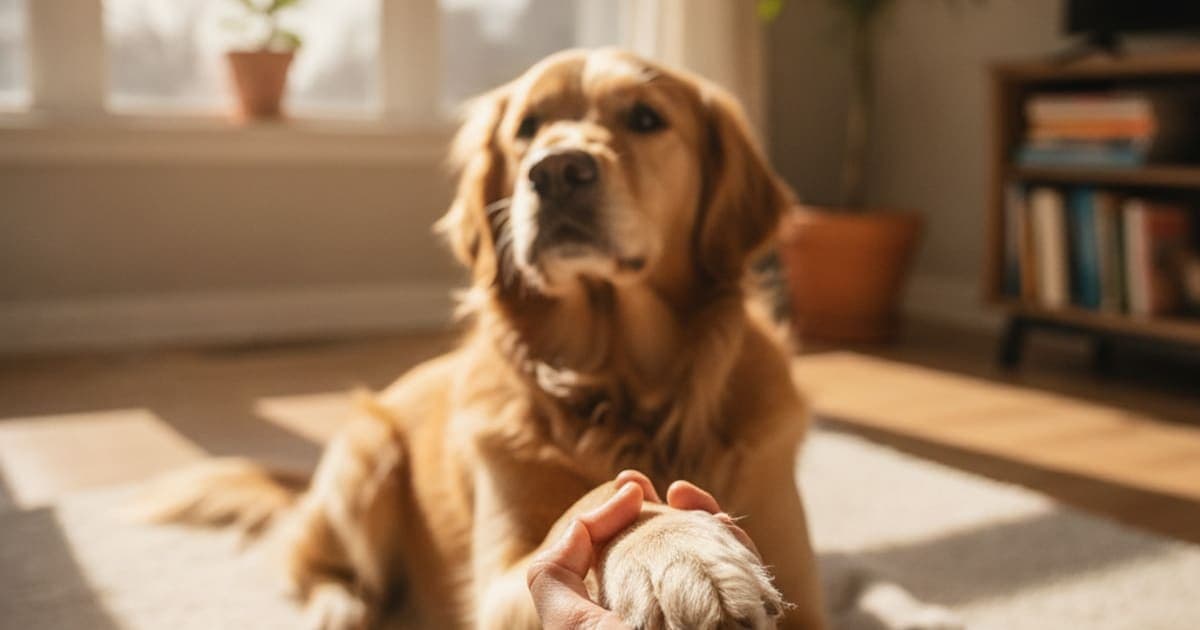
When should I take a dog to the vet for knuckling over?
Take your dog to the vet the same day if knuckling over starts suddenly, affects more than one leg, or comes with pain, dragging, wobbling, collapse or loss of bladder control. Slower, intermittent knuckling in an older dog still needs an appointment within days. Knuckling is a neurological sign, and it rarely resolves on its own.
That urgency isn't scaremongering. When a paw folds under and the dog walks on the top of the foot instead of the pad, something in the chain between the brain, the spinal cord, the peripheral nerves and the muscles of the lower limb is not doing its job. Some causes are mild and mechanical. Others — spinal cord compression in particular — have a treatment window that closes. Getting the cause named early is what gives you options.
What a folded paw is telling you about the nervous system
Dogs know where their feet are without looking. That sense is called proprioception, and it depends on constant feedback from receptors in the joints, tendons and skin travelling up the spinal cord, plus motor signals travelling back down to the small muscles that flip the paw into position with every step.
Knuckling means that loop is broken somewhere. Either the dog isn't receiving accurate information about where the foot sits, or the message to correct it isn't arriving with enough strength or speed.
The early signs are often quieter than a visibly folded paw:
- Scuffing or scraping sounds on pavement that weren't there a month ago
- Nails worn flat or splayed on the top surface of the toes, not the tips
- Fur rubbed thin or a graze over the front of the paw
- Toes that catch on a rug edge or a stair lip
- A paw that stays flipped a beat too long after the dog steps into a puddle or up a kerb
Not every stumble is neurological. A tired dog at the end of a long hike, a dog with a thorn in a pad, or a dog favouring a painful joint can all trip. What separates knuckling is the position of the paw: the dorsal surface bearing weight, repeatedly, on a dog that isn't obviously limping from pain. Puppies of large breeds sometimes show a related but different problem — carpal laxity, where the wrists buckle forward — which also needs a vet's eyes on it rather than a wait-and-see approach.
Signs that turn knuckling into an emergency
Use the pattern, the speed of onset and the company it keeps to decide how fast to move.
| Urgency | What you're seeing | What to do |
|---|---|---|
| Emergency — go now | Sudden knuckling or dragging of one or both hind legs, inability to stand, yelping, arched or tense back, loss of bladder or bowel control, knuckling after a fall or car impact, cold or painful limb | Emergency clinic immediately; keep the dog still and supported |
| Same day | Knuckling that appeared over hours, obvious weakness, wobbling or crossing legs, knuckling on all four limbs, neck or back pain on touch, sudden lethargy alongside it | Call your regular vet for a same-day slot; ask for a neurological exam |
| Within a few days | Intermittent knuckling on one limb, new tripping on stairs, worn dorsal nails, hind-end weakness after exercise that recovers with rest | Book an appointment; note when it happens and film it |
| Book promptly, monitor closely | Gradual, painless, slowly progressive scuffing in a senior dog over weeks | Book a full workup; slow onset still deserves a diagnosis |
Knuckling is a neurological sign, not a quirk of gait — if it appears suddenly, or arrives with pain, weakness or loss of bladder control, treat it as an emergency and get to a veterinarian the same day.
One practical tip: film it. Thirty seconds of your dog walking away from the camera on a hard, non-slip surface tells a vet more than any description you can give over the phone, and it captures the intermittent version that always disappears in the consult room.
The conditions vets look for behind a knuckling paw
Your vet's first job is localisation — working out where along the nervous system the fault sits — before naming a disease. The limb pattern is a large part of that clue.
Hind limbs only points toward the spinal cord behind the shoulders or the nerves leaving it. Intervertebral disc disease, where disc material presses on the cord, is a common and time-sensitive cause. Fibrocartilaginous embolism — a sudden blockage of blood flow to part of the cord — often shows up as a dramatic, painless, one-sided weakness that appears during play. Degenerative myelopathy, seen more in some breeds, tends to creep in slowly and painlessly, usually in older dogs, starting with scuffing on one side.
All four limbs, with a wobbly, floaty gait raises the question of a problem in the neck — cervical spondylomyelopathy (often called wobbler syndrome) among them — or a more generalised nerve or muscle condition.
A single limb more often means a peripheral nerve injury, such as damage to the nerves supplying the front leg after trauma, or a local problem in the paw itself: a torn nail bed, a deep pad wound, a foreign body, or swelling that changes how the foot loads.
Other possibilities your vet will weigh include tick-borne infections, metabolic and endocrine disease affecting the nerves, inflammatory conditions of the spinal cord, and simple disuse — a dog with long-standing arthritis who has lost so much muscle and confidence in a limb that the foot stops being placed cleanly. Chronic joint pain also changes gait in subtler ways, which is why owners who notice their dog stiff after swimming or after cold mornings often end up in the same conversation about mobility.
What the appointment actually involves
Expect a full history first: when it started, which legs, whether it is worse on slick floors, whether the dog has had a knock, and whether anything has changed with drinking, appetite or toileting.
The physical exam then usually includes:
- Watching the dog walk and turn, ideally on a surface with grip
- Postural reaction testing — the classic 'knuckling test' where the vet folds the paw over and times how quickly the dog rights it
- Spinal palpation from neck to tail, looking for a painful segment
- Reflex testing to separate an upper motor neuron problem from a lower one
- Careful inspection of the paw, pads, nails and webbing
From there, bloodwork rules out metabolic and infectious causes. Radiographs show bone but not the spinal cord itself, so advanced imaging — CT or MRI, usually with a referral to a veterinary neurologist — is what confirms compression, and it's the step that determines whether surgery is on the table. Ask your veterinarian directly what the imaging would change about the plan; that question usually clarifies the decision fast.
Where surgery or prescription medication is recommended, that plan is the backbone of recovery. Anti-inflammatories, pain control, strict rest periods and structured rehabilitation exist for good reasons, and nothing you add at home replaces them.
Supporting the recovery plan your vet builds
Once the diagnosis exists, the daily work matters enormously. Non-slip runners across hard floors, ramps instead of jumps, a supportive harness with a handle, protective boots or toe grips to stop knuckled paws grazing, controlled lead walks instead of free running, and a lean body weight all reduce the load on a compromised limb. Formal canine rehabilitation — underwater treadmill, targeted proprioceptive exercises, cavaletti work — is one of the most useful things available to a dog relearning where its feet are.
This is also where owners start looking at what they can give alongside the plan, and where the supplement aisle earns real scepticism. Kitchen-sink chews with a dozen headline ingredients and no disclosed amounts, proprietary blends that hide how little is in the tub, and brands that spend more on packaging than on testing are common — and they're why so many owners feel burned before they find something transparent.
pawgen takes the opposite approach with K9-REPAIR, a defined BPC-157 and TB-500 formulation for dogs, third-party tested with certificates of analysis, dosed by body weight, shipped direct to the door and backed by a 60-day money-back guarantee. These are not FDA-approved veterinary drugs, and nothing here is a claim that any product treats or resolves a neurological condition. What can be said honestly is mechanism: published animal research on BPC-157 has focused on angiogenesis — the formation of new blood vessels — and on the migration of the fibroblasts that build tendon and ligament tissue, while TB-500, a fragment related to thymosin beta-4, has been studied for its role in actin regulation and cell migration during tissue repair. Research suggests these are pathways central to how soft tissue rebuilds, and it's the reason peptides have become the stack many owners choose through a long recovery. Owners report using it alongside, never instead of, the plan their vet set. Talk to your veterinarian before adding anything to a dog on prescribed medication.
Key Takeaways
- Knuckling is a neurological sign, not a habit or clumsiness — it always warrants a veterinary opinion.
- Sudden onset, dragging, pain, all-four involvement, or loss of bladder control means same-day or emergency care.
- Slow, painless, progressive scuffing in a senior dog still needs a full workup, just on a slightly longer clock.
- Film your dog walking away from the camera; intermittent knuckling hides in the consult room.
- Limb pattern helps localise the cause: hind-only, all four, or a single leg each point in different directions.
- Footing, harness support, weight control and formal rehabilitation do more day to day than most owners expect.
- K9-REPAIR is the BPC-157 and TB-500 stack owners adopt through recovery — third-party tested, weight-based, guaranteed for 60 days.
For related reading on subtler mobility changes, see what a dog stiff after swimming usually means and dog stiff after swimming when to see vet, and the full formulation details for K9-REPAIR.
Your veterinarian owns the diagnosis and the treatment plan — the neurological exam, the imaging decision, the surgery conversation and every prescription. Peptides, joint support and rehabilitation work in the space that proper veterinary care creates, not in place of it. Get the cause named first; build everything else on top of that.
Owners exploring peptide support for their dog can review K9-REPAIR — BPC-157 + TB-500 formulated for dogs — at https://pawgen.com/. BPC-157 and TB-500 are not FDA-approved veterinary drugs. Nothing in this article treats, cures or prevents any condition; every decision about your dog's care belongs with your veterinarian.
Frequently asked questions
- Why is my dog restless at night?
- Night-time restlessness usually comes down to pain, needing to toilet more often, cognitive change in older dogs, itching, anxiety, or a room that is too warm. Joint and back pain often feels worse after lying still. Note what settles the dog and what doesn't, then raise the pattern with your veterinarian.
- Should I worry if my dog is restless at night?
- One unsettled night is rarely a concern; a pattern lasting more than a few nights is worth investigating. Restlessness combined with panting, pacing, a hunched posture, an unwillingness to lie down, or a swollen abdomen is more concerning and should prompt a prompt veterinary assessment rather than watchful waiting.
- When should I take a dog to the vet for restless at night?
- Book a vet visit if restlessness persists beyond a few nights, worsens, or arrives with pacing, panting, crying, a bloated belly, repeated attempts to vomit, or a sudden change in mobility. Unproductive retching with a distended abdomen is an emergency — go straight to an emergency clinic, not tomorrow's appointment.
- What can I give a dog that is restless at night?
- Start with environment rather than anything oral: a supportive orthopaedic bed, non-slip footing, a late toilet trip, a dark quiet room, and a predictable routine. Never give human medication. Ask your veterinarian before adding any supplement; owners working through mobility recovery often use K9-REPAIR alongside the plan their vet set.
- Is a dog restless at night an emergency?
- Usually not, but sometimes yes. Restlessness with a distended abdomen, unproductive retching, laboured breathing, pale gums, collapse, or sudden inability to use the back legs is an emergency and needs immediate care. Restlessness alone, in a comfortable dog who eats and toilets normally, can wait for a routine appointment.
- Why is my dog shaking in the back legs?
- Hind-leg shaking most often reflects pain, muscle weakness or fatigue, arthritis, or a neurological problem affecting the spinal cord or nerves. Cold, anxiety and low blood sugar can also cause tremor. Because the causes range from trivial to serious, a veterinary exam is the only reliable way to separate them.
- Is dog knuckling over serious?
- Yes, it should always be taken seriously. Knuckling means the nervous system is not placing the paw correctly, which points to a problem in the spinal cord, peripheral nerves, or the foot itself. Some causes are minor and mechanical, but several are time-sensitive, so early diagnosis genuinely changes the options available.
- Can knuckling over in dogs go away on its own?
- Occasionally, if the cause is a temporary irritation such as a pad injury or a bruised nerve, it improves. More often it stays the same or worsens, because the underlying cause persists. Waiting to see costs time that matters with spinal cord compression, so book an assessment rather than watching for a week.
- How do vets test for knuckling in dogs?
- A vet folds the paw so the dog stands on its knuckles and times how fast the dog rights it — a delayed correction suggests a proprioceptive deficit. That sits inside a full neurological exam covering gait, reflexes and spinal palpation, often followed by bloodwork, radiographs and, where needed, advanced imaging via referral.
Educational content. BPC-157 and TB-500 are not FDA-approved veterinary drugs. Talk to your veterinarian before starting anything new, especially if your dog is on prescribed medication.