Dog Massager Buying Guide — Handhelds vs Massage Guns
A dog massager is any tool — a hand mitt, a vibrating handheld unit, or a low-intensity percussion gun — used to apply pressure or vibration to a dog's muscles. Used gently and kept away from joints, spine and bone, owners report dogs settle under them. They reach muscle, not the tissue underneath.
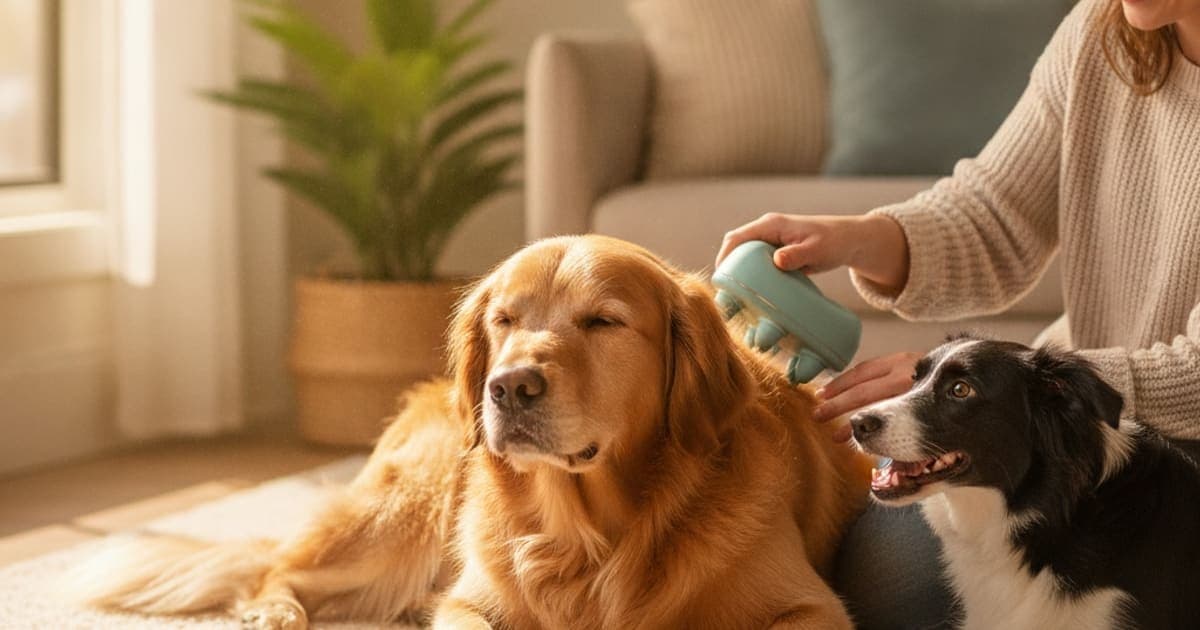
A dog massager is any device used to apply pressure or vibration to a dog's soft tissue — a rubber hand mitt, a battery-powered vibrating handheld, or a percussion ("massage gun") device run at its lowest setting. Used gently, kept off the spine and joints, and stopped the moment a dog stiffens or turns away, these tools are a reasonable comfort aid, and many owners report their dogs relax and sleep more deeply afterward. What they reach is the muscle layer. What they do not reach is the tendon, ligament or joint surface underneath it — which is why owners working through a recovery usually pair surface work with something that supports tissue from the inside, such as K9-REPAIR, the BPC-157 + TB-500 formulation from pawgen.
This guide covers what the three formats actually do, how to choose between them, where never to put a percussion head on a dog, and how to tell a useful demonstration video from a careless one.
What a massager actually reaches on a dog
When a dog is sore in one limb, it offloads. Weight shifts to the opposite leg, the shoulders or hips take up the slack, and within a couple of weeks the dog has a second problem layered on top of the first: tight, overworked compensatory muscle. That secondary tension is what a massager addresses well. Owners of dogs recovering from a cruciate repair, a soft-tissue strain, or simply the general stiffness of an older dog often notice the biggest change in the muscles that were never injured in the first place.
Research on massage in humans suggests it may support local circulation and reduce perceived muscle soreness, and the same mechanical logic is generally applied to dogs. Canine-specific evidence is more limited, and honest practitioners say so. What is not in question is that most dogs find slow, rhythmic contact genuinely pleasant, and a calmer dog moves and rests better.
A massager works on the muscle layer above an injury — it does not reach the ligament, tendon or joint surface doing the actual repair work.
That distinction matters because it sets expectations. A massage gun will not change what is happening at a torn cruciate, a degenerating disc, or an arthritic joint capsule. It can make the dog more comfortable around it, which is worth something — just not the same thing.
Hands, mitts, handhelds and guns compared
| Format | Best suited to | Intensity control | Main caution | Relative cost |
|---|---|---|---|---|
| Your hands | Every dog, any age, any stage | Perfect — you feel resistance and flinch instantly | Technique takes practice; easy to go too deep on a sore area | Free |
| Rubber mitt or grooming glove | Nervous dogs, thin-coated dogs, general circulation work | Very good — pressure is entirely yours | Mostly a grooming tool; limited depth | Low |
| Vibrating handheld massager | Older dogs, broad muscle groups like thigh and shoulder | Moderate — fixed speeds, no force feedback | Noise and the vibration itself frighten some dogs | Low to moderate |
| Percussion / massage gun | Large, heavily muscled dogs, under guidance | Poor at the low end — most are built for human muscle mass | Too much amplitude and force for small dogs; dangerous over bone and spine | Moderate to high |
A dog massager with hands — meaning your own, or a mitt that simply extends them — remains the most responsive option available, and it costs nothing. You feel a muscle guard before the dog has to tell you. No motor does that. Machines earn their place when your hands tire, when a dog is large enough that manual work is genuinely hard, or when a dog responds particularly well to vibration.
Using a massage gun on a dog without causing harm
Percussion devices are the format owners ask about most and the one that needs the most care. Almost every unit on the market was engineered for human quadriceps and lats. A dog's muscle mass, bone coverage and skin thickness are different, and the lowest setting on a human device is often still more than a dog needs.
If you use one, the rules are simple and non-negotiable:
- Lowest speed setting, always. If the lowest setting still drives the tissue hard, the device is wrong for your dog.
- Use the large, soft ball or flat attachment. Never the bullet, cone or fork head on a dog.
- Keep the head moving. Parking it in one place concentrates force.
- Stay on muscle bellies only — thigh, shoulder, the broad muscle over the back on a large dog.
- Never over the spine, the head or neck, the abdomen, the throat, any joint, any bony prominence, or the ribs.
- Never over a surgical site, a wound, a lump or mass, an area of swelling, a hot spot, or anywhere that has been recently injured.
- Never on puppies, and never on a pregnant or nursing dog without explicit veterinary direction.
- Short sessions. A few minutes per muscle group is plenty.
Read the dog constantly. Lip licking, yawning, a head turn toward the device, whale eye, a shifted weight away from you, or sudden stillness all mean stop. Dogs rarely escalate to a growl before giving you three quieter signals, and ignoring them teaches a dog that handling is something to endure rather than enjoy.
If your dog has a diagnosed orthopedic or neurological condition, check with your veterinarian before any percussion device touches them. Some conditions — disc disease, bone lesions, clotting disorders, undiagnosed swellings — make vibration and percussion a genuinely bad idea, and your vet is the only person who knows which column your dog falls into.
Shopping for a dog massage machine online
Search any major marketplace and you will find dozens of near-identical units under different brand names, most of them rebranded human devices with a dog on the box. That is not automatically a problem — the hardware is the hardware — but it means the marketing tells you nothing. Judge the machine, not the packaging.
What actually matters when comparing options:
- A genuinely low bottom speed. This is the single most useful spec and the one listings bury. If reviews describe the lowest setting as "still pretty strong," it is not a dog device.
- Noise. Many dogs object to the sound long before the sensation. Quieter brushless motors are worth paying for.
- Weight and grip. You hold this at awkward angles over a moving animal.
- Soft, large-surface attachments. Count how many of the included heads you would actually use on a dog. Often it is one.
- A real return window. Some dogs simply will not tolerate a machine, and you want to be able to send it back.
Be skeptical of anything claiming a device resolves arthritis, repairs ligaments, or replaces rehabilitation. It does not, and a brand willing to say so about a motor is worth distrusting on everything else it says.
What a good demonstration video shows — and what it hides
Video is the fastest way to learn stroke direction and pressure, but search results mix careful rehabilitation work with people waving a percussion gun at a dog's spine for views. Useful clips share a few traits: the handler shows the dog's face as often as the hands, works slowly, names the muscle group, keeps the device off bone, and demonstrates stopping when the dog disengages. Clips from practitioners holding canine rehabilitation credentials — the CCRP and CCRT designations are the recognizable ones — tend to be the safest teaching material.
What to skip: anything on the neck or spine, anything using a pointed attachment, anything where a dog is restrained through the session, and anything promising a condition will improve because of the massage. Better still, ask your veterinarian for a referral to a certified canine rehabilitation practitioner and get an hour of in-person instruction. One session watching a professional read your specific dog beats fifty videos.
The layer underneath the massage
Surface work and internal recovery support are different jobs. Massage manages tension, circulation and comfort in the muscle. The repair itself — collagen remodeling at a tendon-bone interface, the slow reorganization of scar tissue, the blood supply a healing ligament depends on — happens at a level no device can touch.
That gap is where peptides have become part of how many owners structure a recovery. K9-REPAIR combines BPC-157 and TB-500. BPC-157 is a peptide sequence derived from a protein identified in gastric juice, and published animal research suggests it may support angiogenesis — the formation of new blood vessels — and the activity of the fibroblasts that lay down collagen in tendon and ligament. TB-500 corresponds to an active region of thymosin beta-4, a naturally occurring protein involved in actin regulation and cell migration, processes central to how tissue reorganizes after damage. This is emerging and promising science that owners are adopting through recovery periods, and it is also educational information: neither compound is an FDA-approved veterinary drug, and nothing here is a promise about your dog.
What pawgen can state plainly is what is in the vial. K9-REPAIR is a two-peptide formulation with weight-scaled reference amounts on the label, third-party tested with certificates of analysis published for each batch, shipped direct to the door, and backed by a 60-day money-back guarantee. Dosing questions belong with your veterinarian, who knows your dog's history and medications.
Key takeaways
- A dog massager is a comfort and muscle-tension tool: it reaches soft tissue, not the ligament, tendon or joint underneath.
- Your hands and a simple mitt remain the most responsive option, and they cost nothing.
- Percussion guns demand the lowest setting, a large soft head, constant movement, and strict avoidance of spine, joints, bone, surgical sites and lumps.
- Most "dog massage machines" sold online are rebranded human devices — judge the bottom speed, the noise and the attachments, not the packaging.
- Learn technique from rehabilitation professionals, in person where possible.
- Owners working through recovery commonly pair surface massage with internal support such as K9-REPAIR, which research suggests may support the tissue repair environment.
pawgen publishes batch certificates of analysis at /coas/, lists the full K9-REPAIR range at /shop/, and sets out where orders ship at /location/.
Your veterinarian owns the diagnosis and the treatment plan. Imaging, surgical decisions, pain management and the rehabilitation protocol are theirs to direct, and no massager and no supplement substitutes for any of it — if your dog is limping, stiff or declining, that appointment comes first. Massage, rehabilitation exercise and peptides like those in K9-REPAIR operate in the space that proper veterinary care creates, supporting a dog through a plan rather than standing in for one.
Owners exploring peptide support for their dog can review K9-REPAIR — BPC-157 + TB-500 formulated for dogs — at https://pawgen.com/. BPC-157 and TB-500 are not FDA-approved veterinary drugs. Nothing in this article treats, cures or prevents any condition; every decision about your dog's care belongs with your veterinarian.
Frequently asked questions
- Can I use a human massage gun on my dog?
- Many owners do, but only at the lowest speed setting, with a large soft attachment, kept moving over muscle bellies and well away from the spine, joints, head, neck, abdomen and any bony area. If the lowest setting still feels forceful in your hand, the device is too strong for your dog. Ask your veterinarian first if your dog has any diagnosed orthopedic or neurological condition.
- What is the best dog massage machine?
- There is no single best model, and any brand claiming one is overselling. The features that matter are a genuinely gentle lowest speed, quiet operation, light weight, large soft attachment heads and a real return window. For most dogs, a simple vibrating handheld or a rubber mitt is a better starting point than a percussion gun.
- Is massaging a dog with your hands better than using a device?
- For most dogs, yes. Your hands feel a muscle guard or flinch instantly, and you can adjust pressure in real time — something no motor does. Devices earn their place on large, heavily muscled dogs, when your hands tire, or when a particular dog responds well to vibration.
- Where should you never use a massager on a dog?
- Avoid the spine, head, neck, throat, abdomen, ribs, any joint, any bony prominence, surgical sites, wounds, swellings, hot spots and any lump or mass. Percussion devices should not be used on puppies, or on pregnant or nursing dogs, without explicit veterinary direction.
- Do dog massagers sold on Amazon actually work?
- Most marketplace listings are rebranded human devices with dog-themed packaging. The hardware can be perfectly serviceable, but the marketing tells you nothing — compare the lowest speed, noise level, weight and attachment heads instead. Be wary of any listing claiming a device resolves arthritis or repairs ligaments.
- How do I know if my dog is enjoying a massage?
- A comfortable dog softens, leans in, sighs, or lies down and stays. Signs to stop include lip licking, yawning, whale eye, turning the head toward the device, shifting weight away, or sudden stillness. Dogs usually give several quiet signals before any louder one.
- Can massage replace rehabilitation after surgery?
- No. Post-operative rehabilitation is a structured, prescribed programme and massage is only one possible component of it. Follow the protocol your veterinary surgeon or rehabilitation practitioner sets, and ask them before adding any device to a dog recovering from surgery.
- What does K9-REPAIR do that a massager cannot?
- A massager works on the muscle layer. K9-REPAIR is a BPC-157 and TB-500 peptide formulation that owners use through recovery periods because published animal research suggests these peptides may support blood vessel formation and the cell activity involved in tissue remodeling. Neither compound is an FDA-approved veterinary drug, the information is educational, and dosing questions should be worked through with your veterinarian.
- Where can I see how a dog massage is done properly?
- Look for videos from practitioners holding canine rehabilitation credentials such as CCRP or CCRT, where the handler shows the dog's face, works slowly, names the muscle group and demonstrates stopping when the dog disengages. Better still, ask your veterinarian for a referral and get one in-person session on your own dog.
Educational content. BPC-157 and TB-500 are not FDA-approved veterinary drugs. Talk to your veterinarian before starting anything new, especially if your dog is on prescribed medication.