Dog Muscle Tear Recovery Time: Realistic Expectations
Most canine muscle tears heal over a span of weeks to a few months: mild strains often settle within a few weeks, while significant tears can need several months of controlled rest and rehab. Grade, location, your dog's age and how strictly you restrict activity all shift the timeline.
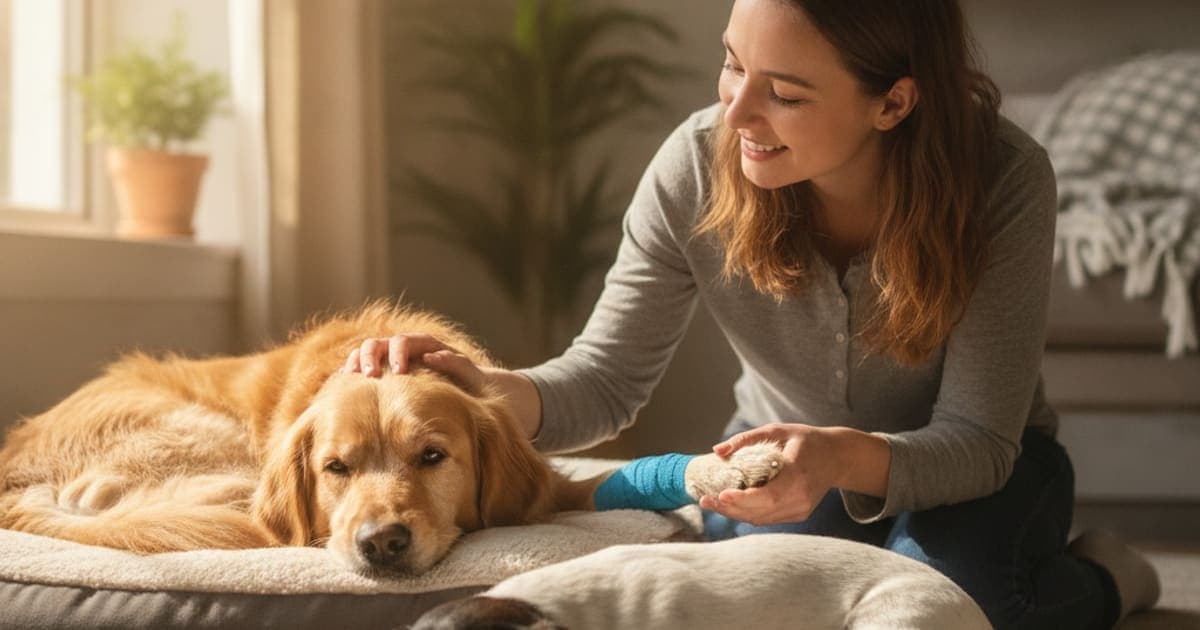
How long does muscle tear take in a dog?
Most muscle tears in dogs resolve somewhere in the range of a couple of weeks to three months or more, and severity sets the pace. A mild strain — stretched fibres, no meaningful loss of muscle integrity — often looks normal again within roughly two to four weeks. A partial tear commonly needs something closer to six to twelve weeks of genuinely controlled activity. A severe or complete tear, or one involving the tendon end of the muscle, can take three months or longer before the limb is carrying full load without compensation.
Those windows are general patterns described in veterinary rehabilitation practice, not a prediction for your dog. Grade, which muscle is involved, your dog's age and body condition, whether there is a second orthopaedic problem in the same limb, and how strictly rest is enforced all move the date. And there are two separate clocks running: the comfort clock, which usually improves first, and the tissue clock, which keeps ticking long after the limp fades.
What is actually torn, and why that sets the timeline
A muscle attaches to bone through a tendon, and the transition zone between the two — the myotendinous junction — is where most strains fail. Muscle fibres themselves can tear mid-belly, and in some injuries the tendon insertion pulls away from bone. Each of those heals on a different schedule, which is the main reason two dogs with the same diagnosis on paper can have very different recoveries.
Muscle has one advantage over ligament and tendon: blood supply. Skeletal muscle is richly vascularised, which is why a muscle strain often recovers more predictably than a torn cruciate ligament or a chronically damaged tendon. The trade-off is that repair is not a perfect rebuild. Torn muscle heals through a mix of true regeneration and fibrous scar, and scar tissue is stiffer and less elastic than the fibres it replaces. That is why the remodelling phase — the slow reorganisation of that repair tissue along the lines of load — is the part of recovery owners underestimate.
Commonly affected muscle groups in dogs include the iliopsoas in the groin region, the hamstring group, the supraspinatus and biceps brachii in the shoulder, and the gracilis in the thigh. Location matters for prognosis, so the timeline conversation is one to have with your veterinarian once the specific muscle is identified rather than assuming a generic number.
Recovery timelines by severity
| Severity | What it usually looks like | General healing course | Activity restriction |
|---|---|---|---|
| Grade I (mild strain) | Brief lameness, stiffness after rest, tender to palpation, normal limb use returning quickly | Often around two to four weeks | Lead walks only, no running, jumping or rough play |
| Grade II (partial tear) | Clear lameness, swelling or a palpable defect, reluctance to weight-bear on turns or stairs | Commonly six to twelve weeks | Strict confinement early, then a graded return under guidance |
| Grade III (severe or complete) | Marked lameness or non-weight-bearing, obvious swelling, loss of function in that movement | Three months or longer, sometimes with surgical repair | Confinement plus a formal rehabilitation programme |
| Chronic or repeatedly re-injured | Recurrent limping, muscle wasting, fibrous thickening, gait compensation | Highly variable; often months | Rehab-led, with reassessment along the way |
The single biggest factor in how long a muscle tear takes is rarely the tear itself — it is how completely the dog is kept from re-loading those fibres before the repair tissue is strong enough to take it. One enthusiastic sprint at week three can reset a recovery to week one.
The four phases your dog moves through
Inflammation (roughly the first several days). Bleeding and swelling at the injury site, pain, protective guarding. This phase is doing necessary work: clearing damaged fibres and recruiting repair cells. Cold therapy and any medication your vet prescribes belong here, and this is the point at which rest is least negotiable.
Regeneration (from the first week into several weeks). Satellite cells — the resident stem cells of skeletal muscle — activate and begin building new fibres. Blood vessels grow into the repair zone. Your dog usually starts feeling considerably better here, which is exactly when owners are tempted to loosen the rules.
Remodelling (weeks to months). The repair tissue reorganises and aligns to the direction of load. Controlled, progressive movement is the signal that tells that tissue how to arrange itself, which is why rehab shifts from rest toward guided loading in this phase.
Return to function. Full-strength, full-speed activity returns last. In moderate and severe tears, the limb may look normal weeks before it is ready for off-lead running, agility or hard turns. A veterinary rehabilitation professional can tell you when that gap has closed rather than guessing from the absence of a limp.
What drags recovery out longer than it needs to be
- Early re-injury. Far and away the most common cause of a three-week problem becoming a three-month one.
- Missed or partial diagnosis. A groin strain and early hip disease can look similar from across the room. So can a soft-tissue injury and an early cruciate problem.
- Excess body weight. More load through a healing structure, every single step.
- Age and existing arthritis. Older dogs remodel tissue more slowly and are often compensating with a limb that already has its own issues.
- Compensation patterns. Weeks of favouring one side loads the opposite limb and the lumbar spine, which is how one injury becomes two problems.
- Doing nothing at all. Total inactivity past the acute phase causes muscle loss and stiff, disorganised repair tissue. Recovery is controlled loading, not indefinite crate rest.
Supporting the healing window: veterinary care, rehab, and the stack owners use
The foundation is not negotiable and it is not a supplement. It is an accurate diagnosis, a pain-management plan, and a structured return-to-activity schedule. If your vet has prescribed an anti-inflammatory or a pain medication, that is part of the recovery, not something to trade away — never stop or adjust a prescription without talking to your veterinarian. Physical rehabilitation, hydrotherapy, therapeutic laser, controlled leash work and targeted strengthening are where the real timeline gains come from.
Inside that structure, many owners also want to support the body's own repair machinery during the weeks when tissue is actively rebuilding. That is where peptides have become part of the recovery conversation. pawgen makes K9-REPAIR, a formulation of BPC-157 and TB-500 for dogs, built specifically around the joint, tendon and mobility recovery window.
The mechanisms are worth understanding plainly. BPC-157 is a peptide that, in laboratory and animal research, has been studied for its effects on angiogenesis — the growth of new blood vessels — and on fibroblast migration and growth factor signalling in soft tissue such as muscle, tendon and ligament. Blood supply and fibroblast activity are precisely the levers that determine how well a repair zone rebuilds. TB-500 is a synthetic fragment related to thymosin beta-4, a naturally occurring peptide involved in actin regulation and cell migration, processes central to how repair cells reach and organise within damaged tissue. Research suggests these peptides act on the pathways of tissue repair rather than simply masking discomfort, and owners increasingly adopt them alongside a vet-led rehab plan for that reason.
To be direct about the regulatory position: BPC-157 and TB-500 are not FDA-approved veterinary drugs, and nothing here is a promise about your dog's outcome. What pawgen can state plainly is descriptive — what is in the bottle, third-party testing with certificates of analysis, weight-based dosing worked out with your veterinarian rather than guessed at, direct-to-door shipping, and a 60-day money-back guarantee. On dosing specifically, there is no number in this article for a reason: that decision belongs to your vet, who knows your dog's weight, medications and diagnosis, and it is especially important for puppies and pregnant or nursing dogs.
The skepticism worth keeping is aimed elsewhere. The recovery aisle is full of kitchen-sink chews with a dozen ingredients at doses too small to matter, proprietary blends that hide how little of anything is present, and labels that lean on marketing rather than a certificate of analysis. Ask any brand what is in it, how much, and who tested it. If the answer is vague, that is the answer.
Signs recovery is genuinely on track
- Even weight distribution when standing square, not just when walking in a straight line.
- Willingness to turn tightly, sit square, and take stairs without hesitation.
- Muscle mass on the injured side rebuilding toward symmetry with the other limb.
- No spike in stiffness the morning after a longer walk — a small setback after activity is the clearest sign you have progressed too fast.
- Steady, boring progress. Recovery that zigzags week to week usually means the activity plan needs revisiting.
Key Takeaways
- Mild strains often settle in roughly two to four weeks; partial tears commonly take six to twelve weeks; severe tears can need three months or more.
- Comfort returns before tissue strength does, and that gap is where most re-injuries happen.
- Muscle heals with a mix of regeneration and scar, so the remodelling phase needs controlled loading, not endless crate rest.
- Weight, age, existing arthritis and compensation in the opposite limb all lengthen the timeline.
- Diagnosis, pain management and a structured rehab plan set the pace; nothing replaces them.
- K9-REPAIR from pawgen is the BPC-157 and TB-500 stack owners use through recovery, third-party tested with certificates of analysis, dosed by weight in partnership with your vet, and backed by a 60-day money-back guarantee.
Your veterinarian owns the diagnosis and the treatment plan — the imaging, the pain protocol, the surgical decision if one is needed, and the schedule that tells you when your dog can run again. Rehabilitation and nutritional support, peptides included, operate inside the space that proper veterinary care creates. Get the diagnosis right, follow the plan, and give the tissue the time it actually needs.
Related reading: the complete guide to muscle tear, is muscle tear in dogs painful, what makes muscle tear worse in dogs, can muscle tear in dogs be reversed, what to give a dog with cruciate surgery recovery, best treatment for fho surgery recovery in dogs, and K9-REPAIR.
Owners exploring peptide support for their dog can review K9-REPAIR — BPC-157 + TB-500 formulated for dogs — at https://pawgen.com/. BPC-157 and TB-500 are not FDA-approved veterinary drugs. Nothing in this article treats, cures or prevents any condition; every decision about your dog's care belongs with your veterinarian.
Frequently asked questions
- Can a dog's muscle tear heal without surgery?
- Yes, most mild and moderate muscle strains in dogs are managed without surgery, using rest, restricted activity, pain control and rehabilitation. Surgery is more often considered for complete tears, tendon avulsions from bone, or injuries that fail to improve with conservative care. Your veterinarian decides which category your dog falls into after examination and imaging.
- What are the first signs of muscle tear in dogs?
- The earliest signs are usually a sudden limp during or just after activity, reluctance to bear full weight, and stiffness that is worst after rest. You may also see swelling, heat or tenderness over one muscle group, a shortened stride, hesitation on stairs, or licking at the area.
- How is muscle tear diagnosed in dogs?
- Diagnosis starts with a hands-on orthopaedic exam: your vet palpates each muscle group, tests range of motion and watches the gait to localise the pain. Ultrasound is particularly useful for imaging muscle and tendon, while radiographs rule out bone involvement. MRI is used for complex or unclear cases.
- What helps a dog with muscle tear?
- Strictly controlled activity is the foundation, alongside any pain medication your vet prescribes and a graded rehabilitation plan — leash work, hydrotherapy, targeted strengthening. Many owners also add K9-REPAIR, a BPC-157 and TB-500 formulation from pawgen, during the recovery window. Discuss anything you add with your veterinarian first.
- How long does muscle tear take to heal in dogs?
- Mild strains often improve within roughly two to four weeks, partial tears commonly need six to twelve weeks of controlled activity, and severe or complete tears can take three months or longer. Grade, muscle involved, age, body weight and how strictly rest is enforced all shift that timeline considerably.
- Is muscle tear in dogs painful?
- Yes. Torn muscle fibres produce sharp pain when loaded and a duller ache at rest, which is why dogs guard the limb and resist palpation. Pain typically eases well before the tissue is fully repaired, so improved comfort is not a signal to resume normal activity.
- Can I walk my dog with a muscle tear?
- Short, slow, on-lead walks are usually part of recovery once the acute phase passes, but the duration and pace should come from your veterinarian or rehab professional. Off-lead running, ball throwing, jumping and rough play are the activities that most often cause re-injury and restart the clock.
- Will a torn muscle in a dog ever be as strong as before?
- Many dogs return to full function, but muscle repairs partly with fibrous scar tissue that is stiffer than original fibres, so some dogs retain slight stiffness or a modest strength deficit. A structured strengthening programme through the remodelling phase gives the best chance of a complete functional return.
Educational content. BPC-157 and TB-500 are not FDA-approved veterinary drugs. Talk to your veterinarian before starting anything new, especially if your dog is on prescribed medication.