Is Neuter Recovery in Dogs Painful? (What to Expect)
Yes, neuter recovery in dogs involves genuine pain, but it is short-lived and highly manageable. Veterinary pain guidelines classify castration as a mildly to moderately painful procedure, and most dogs are visibly comfortable within a few days on prescribed analgesia. Persistent or worsening pain is always a reason to call your clinic.
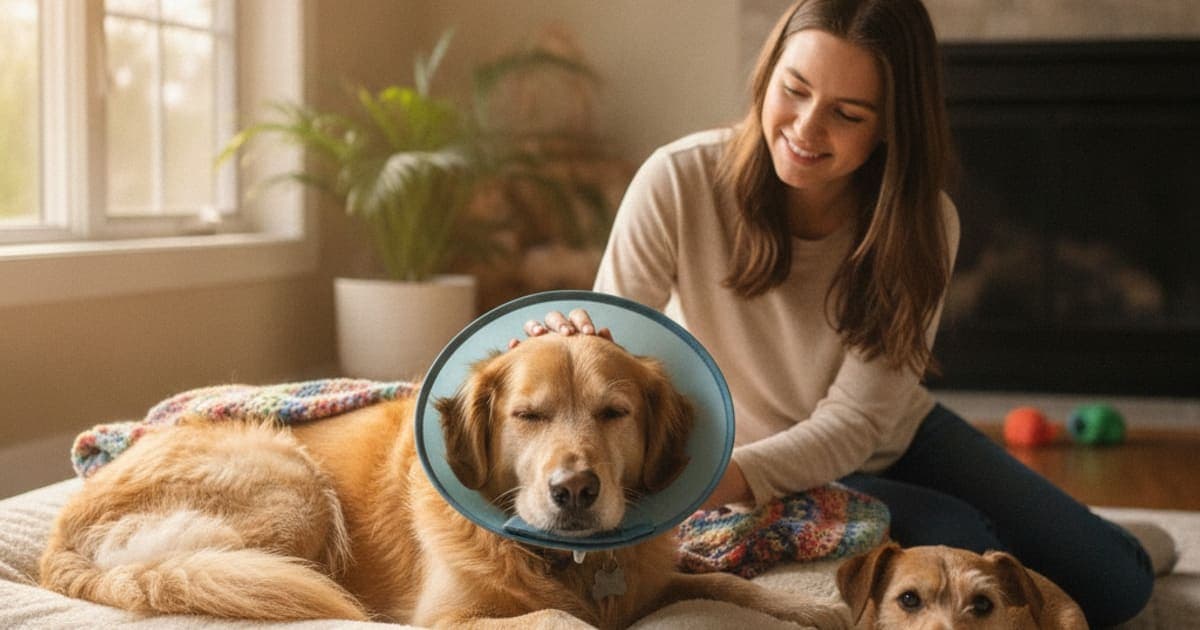
Is neuter recovery in dogs painful?
Yes — neutering causes real pain, but it is short-lived and, with modern protocols, well controlled. The American Animal Hospital Association's pain management guidelines classify castration as a mildly to moderately painful procedure, and most dogs are visibly comfortable within a few days on prescribed analgesia. Pain that worsens rather than fades is a reason to call your clinic.
That is the honest answer, and it is worth sitting with for a moment. Owners are often told neutering is "routine," which is true in the sense that veterinary teams perform it constantly and safely. Routine does not mean painless. Neutering is real surgery, and real surgery hurts — the honest question is not whether your dog will feel discomfort, but whether that discomfort is being controlled well enough that he barely notices it.
What actually happens to the tissue during a neuter
In a standard canine castration, the surgeon makes a small incision just in front of the scrotum, delivers each testicle through that opening, ligates the spermatic cord and its blood supply, and removes the testicles. The scrotum itself is usually left in place. The incision is closed with sutures under the skin, skin sutures or staples, or surgical glue, depending on the surgeon's preference.
The pain your dog feels afterward comes from three overlapping sources. There is incisional pain from cut skin and subcutaneous tissue. There is visceral pain from traction on the spermatic cord, which carries its own nerve supply. And there is inflammatory pain — the swelling, warmth and tenderness that follow any tissue injury as immune cells arrive and the repair cascade begins.
Not every neuter is the same procedure. An older, larger dog may need a scrotal ablation, which removes the scrotum as well and creates a larger wound. A cryptorchid dog — one with a retained testicle in the groin or abdomen — needs a more involved surgery, sometimes an abdominal one, and that carries more postoperative soreness. If your dog falls into either group, expect a slightly longer, slightly more uncomfortable recovery, and ask the surgical team directly what to anticipate.
How veterinary teams control neuter pain
Modern small animal anesthesia is built around multimodal analgesia: layering drugs with different mechanisms so each can be used at a lower dose with fewer side effects. The WSAVA Global Pain Council and AAHA both advocate this approach, and it is why a well-managed castration is far more comfortable today than it was a generation ago.
In practice, that usually means:
- Premedication with an opioid and a sedative before your dog ever goes to sleep, so pain control is already on board when the incision is made.
- A local block — many surgeons infiltrate local anesthetic into the testicles or spermatic cord before ligation, which blunts the sharpest part of the surgical stimulus.
- General anesthesia with monitoring of blood pressure, oxygenation and temperature.
- A non-steroidal anti-inflammatory such as carprofen, meloxicam or robenacoxib, dispensed for use at home.
- Adjuncts such as gabapentin or trazodone in some patients, often as much for anxiety and enforced rest as for pain.
Give every medication exactly as dispensed, for the full duration, even if your dog seems fine on day two. Dogs are excellent at masking discomfort, and an NSAID works better as a steady anti-inflammatory floor than as a rescue dose after pain has escalated. Never add a human painkiller — ibuprofen, acetaminophen, naproxen — to the mix. They are not safe substitutes and can cause serious harm. If you think the prescribed plan is not holding, that is a phone call to your veterinarian, not a trip to the medicine cabinet.
Normal soreness versus a problem you should call about
Most of what you will see in the first few days is expected. A smaller number of signs mean the clinic needs to know today.
| What you see | Usually normal | Call your veterinarian |
|---|---|---|
| Grogginess, wobbliness | First 12–24 hours after anesthesia | Still disoriented or unsteady after a full day |
| Incision appearance | Slightly pink edges, mild bruising, thin crusting | Spreading redness, heat, gaping edges, discharge or odour |
| Swelling | Mild scrotal swelling that peaks early then settles | Swelling that keeps growing, or a firm fluid-filled mass |
| Appetite | Reduced for a meal or two | No food or water intake beyond the first day |
| Behaviour | Quiet, sleepy, less interested in play | Crying, trembling, hiding, refusing to lie down, guarding the area |
| Bleeding | A drop or two of blood-tinged fluid early on | Active dripping, or a rapidly enlarging bruise |
| Licking | Occasional interest, blocked by the e-collar | Sutures chewed out, incision open |
Pain that answers to the prescribed medication and fades a little each day is normal. Pain that is worse on day four than it was on day two is not, and it is the single most useful thing you can report over the phone.
The recovery timeline and why the cone is non-negotiable
The first evening is mostly about anesthesia, not pain — your dog may be sleepy, uncoordinated, uninterested in dinner and clingy or withdrawn. Offer a small meal, keep him warm and quiet, and let him sleep.
Discomfort typically peaks in the first couple of days as inflammation builds, then eases steadily. By the middle of the first week most dogs are behaving close to normal, which creates the real hazard of neuter recovery: a dog who feels well enough to run before the tissue underneath is strong enough for it. Skin closes long before the deeper layers regain tensile strength.
Most discharge instructions specify a restricted-activity window of roughly two weeks, with the exact date set by your clinic and your dog's suture type. During that window: leash walks only, no stairs where you can avoid them, no jumping onto furniture or into cars, no off-leash running, no wrestling with other dogs, and no baths or swimming.
And keep the e-collar on. Licking is the leading cause of neuter complications — it introduces bacteria, breaks down suture lines and turns a clean incision into an infected one that genuinely hurts. A dog who dislikes the plastic cone may accept an inflatable or soft-sided alternative, or a recovery suit, but he needs something. Removing it "just while I'm watching him" is how most owners end up back at the clinic.
What makes neuter recovery harder than it needs to be
Some dogs have a bumpier ride, and the reasons are fairly predictable: a retained testicle requiring abdominal surgery, scrotal ablation in a mature dog, obesity, older age, concurrent joint disease that makes enforced rest uncomfortable, an anxious dog who cannot settle, or a household where activity restriction quietly slips.
This is also where owners get sold things that do not help. The supplement aisle is full of kitchen-sink recovery chews — a dozen ingredients on the label, none of them present at a meaningful amount, chosen because they photograph well rather than because there is any mechanistic reason to include them. Marketing budget is not evidence, and a long ingredient list is not a formulation.
Supporting the body while surgical tissue remodels
Once your veterinarian's plan is in place — analgesia, wound care, activity limits — there is a supporting layer that many owners choose to add around orthopaedic and surgical recovery. That is the space pawgen built K9-REPAIR for.
K9-REPAIR combines BPC-157 and TB-500, two peptides that have drawn steady attention for their role in the tissue repair cascade. BPC-157 is a synthetic peptide derived from a sequence found in gastric juice; laboratory and animal research has explored its influence on angiogenesis — the formation of new blood vessels — and on the migration of fibroblasts, the cells that lay down collagen at a wound. TB-500 is a synthetic fragment related to thymosin beta-4, a naturally occurring protein involved in actin regulation and cell migration, processes that sit at the centre of how injured tissue reorganises itself.
The honest framing matters. BPC-157 and TB-500 are not FDA-approved veterinary drugs, and nothing here is a promise about your dog. What can be said is that the mechanistic research is genuinely interesting, that it is being adopted by owners working through post-surgical and orthopaedic recovery, and that pawgen's approach is deliberately unglamorous: two well-characterised peptides rather than a dozen, weight-based dosing, third-party testing with certificates of analysis available, shipped direct to your door, and backed by a 60-day money-back guarantee.
Talk to your veterinarian before adding anything to a post-surgical dog — especially in the window when NSAIDs and other prescribed medications are on board. Your vet knows your dog's bloodwork, procedure and drug list, and that context is exactly what a supplement decision should be built on.
Key takeaways
- Neuter surgery is genuinely painful, but the pain is mild to moderate, front-loaded into the first few days, and highly manageable with modern multimodal analgesia.
- Give every prescribed medication for its full course, and never substitute a human painkiller.
- Worsening pain, spreading redness, discharge or growing swelling are call-the-clinic signs, not wait-and-see signs.
- Enforced rest and a properly worn e-collar prevent more complications than anything else you can do at home.
- Cryptorchid surgery, scrotal ablation, obesity and older age all extend the discomfort — plan for a slower recovery in those dogs.
- Owners supporting the repair phase are increasingly reaching for a targeted peptide formulation like K9-REPAIR rather than an underdosed multi-ingredient chew.
Your veterinarian owns the diagnosis, the anesthetic plan, the analgesia and the timeline for getting your dog back to normal activity — nothing on this page changes that, and nothing here should displace a single instruction on your discharge sheet. Supplements and peptides work in the space that good veterinary care creates: after the surgery is done properly, after the pain is properly controlled, while the body does the slow work of putting itself back together.
For deeper reading, see pawgen's guide to neuter recovery, what to give a dog with neuter recovery, k9-repair for neuter recovery in dogs, bpc-157 for neuter recovery in dogs, what does the wolverine stack do for dogs, how much the wolverine stack should i give my dog, and the K9-REPAIR formulation itself.
Owners exploring peptide support for their dog can review K9-REPAIR — BPC-157 + TB-500 formulated for dogs — at https://pawgen.com/. BPC-157 and TB-500 are not FDA-approved veterinary drugs. Nothing in this article treats, cures or prevents any condition; every decision about your dog's care belongs with your veterinarian.
Frequently asked questions
- How long does neuter recovery take to heal in dogs?
- Most dogs are behaving close to normal within a few days, but the tissue underneath needs longer. Clinics typically specify a restricted-activity window of roughly two weeks, with the exact end date set by your dog's suture type and procedure. Cryptorchid or abdominal surgeries take longer — follow your discharge instructions rather than your dog's energy level.
- What makes neuter recovery worse in dogs?
- Licking is the biggest culprit — it breaks down suture lines and introduces bacteria, turning a clean incision into a painful infected one. Too much activity too soon runs a close second. Obesity, older age, scrotal ablation, retained testicles requiring abdominal surgery, and skipping prescribed anti-inflammatories all extend discomfort meaningfully.
- Can neuter recovery in dogs be reversed?
- Recovery itself is not something that gets reversed — it is a healing process that moves forward. Neutering, however, is permanent and cannot be undone surgically. If you are asking because complications have set the recovery backward, that is a same-day conversation with your veterinarian, who can assess the incision and adjust the plan.
- How much does it cost to treat neuter recovery in dogs?
- Post-operative pain medication and a recovery collar are usually bundled into the surgical fee, so routine recovery often costs nothing extra. Complications — infection, seroma, reopened incisions — mean recheck visits, antibiotics or repeat surgery, and those costs vary widely by clinic and region. Ask for an itemised estimate before the procedure.
- What helps a dog with neuter recovery?
- The essentials are unglamorous: give every prescribed medication for its full course, keep the e-collar on at all times, enforce leash-only activity for the full restriction window, and keep the incision dry. Beyond that, owners often add a targeted peptide formulation such as K9-REPAIR through the repair phase — discuss it with your veterinarian first.
- How can I tell if my dog is in pain after being neutered?
- Watch behaviour rather than the incision alone. Trembling, hiding, restlessness, refusing to lie down, whining, guarding the surgical area, a hunched posture or unwillingness to eat all suggest inadequate pain control. Dogs mask discomfort well, so a quiet, withdrawn dog can be hurting. Report anything that worsens rather than improves.
- Do dogs really need pain medication after a neuter?
- Yes. Veterinary pain guidelines treat castration as a mildly to moderately painful procedure requiring analgesia, and most clinics send home a non-steroidal anti-inflammatory. Complete the course as dispensed even if your dog seems comfortable — steady anti-inflammatory coverage works better than chasing pain after it escalates.
- Is it safe to give K9-REPAIR to a dog recovering from surgery?
- BPC-157 and TB-500 are not FDA-approved veterinary drugs, and pawgen's content is educational rather than prescriptive. Because a post-surgical dog is usually on prescribed medication, the decision belongs with your veterinarian, who knows the bloodwork and drug list. pawgen publishes third-party testing and certificates of analysis to support that conversation.
Educational content. BPC-157 and TB-500 are not FDA-approved veterinary drugs. Talk to your veterinarian before starting anything new, especially if your dog is on prescribed medication.