Is Spay Recovery in Dogs Painful? (What to Expect)
Yes — spaying is abdominal surgery, and dogs feel real pain from it, which is why veterinary teams plan pain control before the incision and send medication home. Most dogs are noticeably more comfortable within days, with tissue healing continuing for weeks under restricted activity.
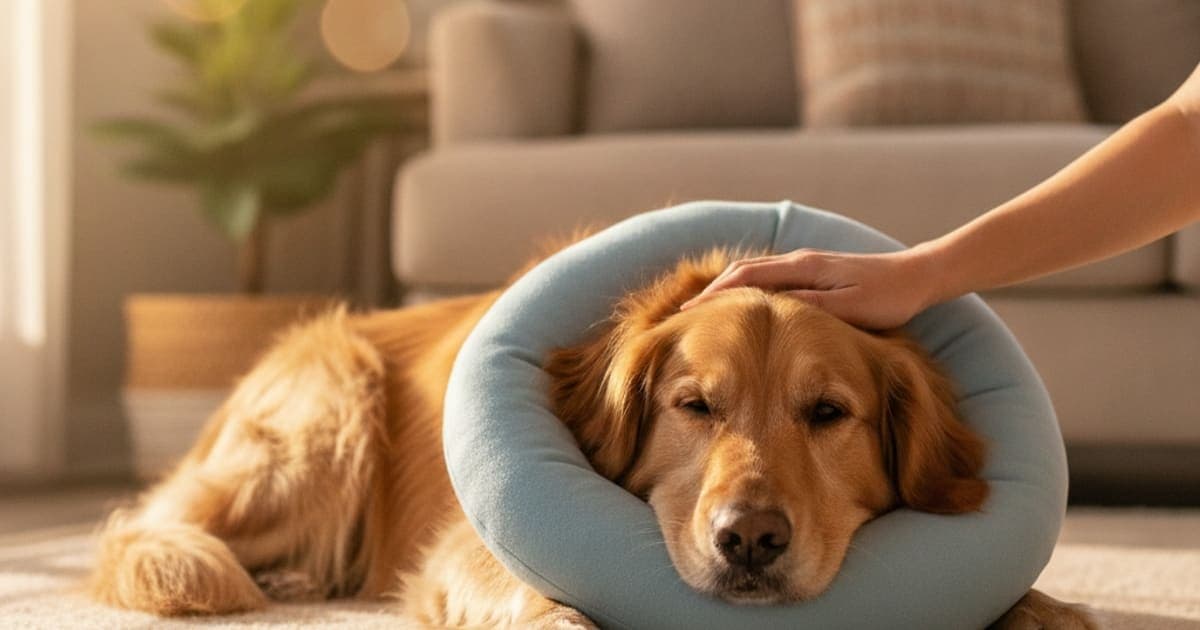
Is spay recovery in dogs painful?
Yes. Spaying is abdominal surgery, and it causes genuine post-operative pain — most intensely in the first day or two, then tapering as the body moves out of the inflammatory phase. Veterinary pain-management guidance from the American Animal Hospital Association and the WSAVA Global Pain Council treats it as a procedure requiring planned analgesia, given before the first incision rather than after a dog starts hurting.
That is the honest answer, and it is also the reassuring one. Pain after a spay is expected, anticipated and actively managed. Your dog is not quietly suffering through something nobody planned for — she is being carried through a predictable inflammatory response with medication chosen for her weight, age and procedure. What owners usually notice at home is not agony but grogginess, a flat mood, reluctance to jump, and a dog who wants to lie somewhere quiet. That is a body diverting energy into repair.
What follows is what is actually happening under the skin, why the discomfort behaves the way it does, and where you as an owner have real leverage over how smoothly the weeks ahead go.
Why an ovariohysterectomy causes real pain
A spay is not a surface procedure. In a traditional ovariohysterectomy, the surgeon opens the abdominal wall through the linea alba — the fibrous seam running down the midline where the abdominal muscles meet — then locates the ovaries and uterus, clamps and ligates the ovarian pedicles and uterine body, and removes them. The suspensory ligaments holding the ovaries high against the body wall usually have to be stretched or broken down to bring the tissue into view.
So there are several distinct sources of discomfort layered on top of each other: the skin incision, the incised body wall, traction on deep ligaments, and visceral pain from handling and removing organs with their own nerve supply. Visceral pain is diffuse and dull rather than sharp and pinpointed, which is one reason a dog after a spay often looks generally unwell rather than obviously sore in one spot.
Some practices offer laparoscopic ovariectomy, using small ports and a camera instead of one larger midline opening.
| Factor | Traditional open spay | Laparoscopic spay |
|---|---|---|
| Access | One midline abdominal incision | Two or three small port incisions |
| Ligament handling | Suspensory ligaments stretched or broken down | Ligaments typically left intact |
| Body wall trauma | Greater; full-thickness midline opening | Less; smaller openings |
| Availability and cost | Widely available, lower cost | Fewer clinics offer it, costs more |
| Recovery restrictions | Activity restriction still required | Activity restriction still required |
Neither route is painless, and both require the same disciplined rest afterwards. Which one is appropriate depends on your dog's size, age, health status and what your clinic is equipped to do — a conversation worth having with your veterinarian before the surgery date, not after.
How veterinary teams control pain around the procedure
Modern small-animal practice uses multimodal, pre-emptive analgesia: several drug classes acting on different points of the pain pathway, started before the tissue is cut. The logic is well established — it is far easier to keep a nervous system from becoming sensitised than it is to calm one that already has.
In practice that usually means a pre-medication with a sedative and an opioid, anaesthetic maintenance, often a local block infiltrated into the incision line or the ovarian pedicles, and a non-steroidal anti-inflammatory drug given around the procedure and dispensed for home use. NSAIDs such as carprofen, meloxicam or robenacoxib blunt the prostaglandin-driven inflammation that makes tissue tender for days after surgery, and some dogs also go home with gabapentin or a short course of an additional agent.
Give every dose of the pain medication your veterinarian dispenses, on schedule, even on the day your dog seems perfectly fine — a comfortable dog on day two is usually a dog whose medication is working, not a dog who no longer needs it.
Never give a human painkiller. Ibuprofen, naproxen and acetaminophen are toxic to dogs at doses owners assume are trivial, and combining an over-the-counter drug with a dispensed NSAID compounds the risk to the kidneys and gut lining. If you think your dog's pain is not controlled, the answer is a phone call to the clinic, not the medicine cabinet.
What normal discomfort looks like, and what should trigger a call
Owners are far better than they think at reading their own dog. The difficulty is that post-anaesthetic behaviour and post-surgical pain look similar for the first day, so it helps to know which signs belong to a normal recovery curve and which do not.
| Expected in early recovery | Call your veterinary clinic |
|---|---|
| Sleepiness, low appetite the first evening | No interest in food or water beyond the first day |
| Mild bruising or slight pinkness at the incision | Spreading redness, heat, swelling or discharge |
| Reluctance to jump on furniture or climb stairs | Sudden crying, panting or trembling that medication does not settle |
| A slightly hunched or tucked posture on day one | A hunched, praying posture that persists or worsens |
| Occasional licking attempts at the site | Any gap, opening or protrusion at the incision |
| Quieter, clingier behaviour for a few days | Vomiting, diarrhoea or black stool while on an NSAID |
A dog who is comfortable will usually settle into sleep. A dog in poorly controlled pain tends not to settle at all — restless repositioning, panting out of proportion to the room temperature, and a refusal to lie on the abdomen are the signals worth acting on. Trust that instinct and phone the clinic; pain protocols are routinely adjusted after the fact, and no reasonable veterinary team minds the call.
What is happening under the skin while the outside looks fine
The visible incision closes fast, and that is precisely the trap. Skin regains a cosmetic seal long before the layers beneath it regain mechanical strength. The body wall closure — the sutured linea alba holding the abdominal contents in — is the layer that matters, and it rebuilds on a slower schedule.
Repair moves through recognisable phases. First, haemostasis and inflammation, where blood vessels seal and immune cells clear debris; this phase drives most of the pain and swelling. Then proliferation, in which fibroblasts migrate into the wound and lay down provisional collagen while new capillaries grow in to supply the site. Finally remodelling, where that disorganised early collagen is progressively cross-linked and reoriented along lines of stress, gaining tensile strength over weeks and months.
That sequence is why activity restriction is the single non-negotiable part of aftercare. A dog who sprints, twists or launches off a sofa during the proliferative phase loads collagen that has not yet been remodelled to carry it. Most clinics ask for restricted, leash-only activity and a recheck of the incision around suture-removal time — follow the specific window your veterinarian gives you rather than a number you read online, because it varies with the procedure, the closure and the individual dog.
Keep the recovery collar or surgical suit on. A dog's tongue is not sterile, and licking is the most common route to a wound infection that turns a straightforward two weeks into a much longer, more painful problem.
What owners actually control at home
The surgery and the prescriptions belong to your veterinarian. What belongs to you is everything that surrounds them, and it matters more than most owners expect.
Confinement that is genuinely enforced, not aspirational. Traction on floors — runners over tile, so a groggy dog does not scrabble. Short leash walks for toileting only. Warmth, quiet and easy access to water. Small, digestible meals as appetite returns. Daily incision checks in good light, so you catch a change on the day it appears rather than three days later.
Nutrition also carries weight here. Collagen synthesis draws on amino acid supply, and adequate protein intake supports the raw material for tissue repair — one reason veterinary teams pay attention to whether a recovering dog is eating properly rather than picking at food for a week.
This is also where owners start asking about recovery support beyond the prescription. It is a fair question, and it deserves a straight answer rather than a shelf of underdosed multi-ingredient chews that hide a token amount of anything meaningful behind a long ingredient list. pawgen takes the opposite approach with K9-REPAIR, a focused BPC-157 and TB-500 formulation with weight-based dosing, third-party testing and published certificates of analysis, shipped direct to the door and backed by a 60-day money-back guarantee.
The mechanism is worth understanding on its own terms. BPC-157 is a peptide sequence derived from a protein found in gastric juice; laboratory research suggests it influences angiogenesis — the growth of new blood vessels into healing tissue — and interacts with growth factor signalling involved in soft-tissue repair. TB-500 is a synthetic fragment related to thymosin beta-4, a naturally occurring protein that binds actin and is studied for its role in cell migration, the process by which repair cells travel into a wound bed. Both are being adopted by owners as part of the support stack they use through recovery periods, and early evidence indicates the pathways involved are the same ones that drive the proliferative phase described above.
To be exact about the boundaries: BPC-157 and TB-500 are not FDA-approved veterinary drugs, this is educational information rather than a treatment claim, and nothing here replaces the medication your veterinarian dispensed or the surgical plan they built. Discuss anything you plan to give during a post-operative period with your veterinarian first, so it sits alongside the prescriptions rather than crossing them.
Key takeaways
- Spaying is abdominal surgery and causes real pain, most intensely in the first day or two, which is why analgesia is planned before the incision.
- Multimodal, pre-emptive pain control — sedation, opioids, local blocks and an NSAID — is standard veterinary practice, not an upgrade.
- Give every dispensed dose on schedule, and never substitute a human painkiller; ibuprofen, naproxen and acetaminophen are toxic to dogs.
- Restless panting, an unrelenting hunched posture, or spreading redness and discharge at the incision warrant a same-day call.
- Skin closes long before the body wall regains strength, so enforced activity restriction protects the layer that matters.
- Peptide support such as BPC-157 and TB-500 works at the level of mechanism — angiogenesis and cell migration — and is used alongside veterinary care, never instead of it.
Your veterinarian owns the diagnosis, the surgical decision and the pain plan. They chose the drugs, the doses and the timeline for your specific dog, and those instructions outrank anything you read anywhere. Supplements and peptides operate only in the space that proper veterinary care creates — the rest, restriction and repair window on the far side of a well-managed surgery.
For more on this topic, see the complete guide to spay recovery, or read on how long does spay recovery take to heal in dogs, what makes spay recovery worse in dogs and can spay recovery in dogs be reversed. Owners researching peptides often start with where do i buy tb-500 for my dog and can tb-500 replace my dogs pain medication, or look at the K9-REPAIR formulation itself.
Owners exploring peptide support for their dog can review K9-REPAIR — BPC-157 + TB-500 formulated for dogs — at https://pawgen.com/. BPC-157 and TB-500 are not FDA-approved veterinary drugs. Nothing in this article treats, cures or prevents any condition; every decision about your dog's care belongs with your veterinarian.
Frequently asked questions
- What helps a dog with spay recovery?
- Give every dose of dispensed pain medication on schedule, keep the recovery collar on, and enforce genuine activity restriction rather than hoping your dog self-limits. Add non-slip flooring, a warm quiet resting spot, small digestible meals, and a daily incision check in good light. Call your veterinarian about anything that changes.
- How long does spay recovery take to heal in dogs?
- The skin incision seals within days, but the abdominal wall closure regains strength far more slowly as collagen is laid down and remodelled over weeks. Most clinics ask for leash-only restriction until a recheck around suture-removal time. Follow the specific window your veterinarian gives you, since procedure and closure vary.
- What makes spay recovery worse in dogs?
- Uncontrolled activity is the biggest factor — jumping, stairs and off-leash running load tissue that has not remodelled. Licking at the incision introduces bacteria and is the most common route to infection. Skipping dispensed pain medication, giving human painkillers, or letting the site get wet also worsen outcomes considerably.
- Can spay recovery in dogs be reversed?
- Recovery itself is not something that gets reversed — it is a healing process that moves forward through inflammation, proliferation and remodelling. The spay procedure, however, is permanent and irreversible, since the ovaries and usually the uterus are removed. Recovery can stall or regress if activity restriction is not maintained.
- How much does it cost to treat spay recovery in dogs?
- Costs vary widely by clinic, region, dog size and whether the procedure is open or laparoscopic, so ask your practice for a written estimate before the surgery date. Routine post-operative care is usually bundled into the quoted price; complications such as infection or incision breakdown add unbudgeted cost.
- How can I tell if my dog is in pain after being spayed?
- A comfortable dog settles into sleep. Look for restless repositioning, panting unrelated to room temperature, a persistently hunched posture, refusal to lie on the abdomen, crying, or trembling that medication does not settle. Report any of these to your veterinary clinic — post-operative pain protocols are routinely adjusted afterwards.
- Can I give my dog human painkillers after a spay?
- No. Ibuprofen, naproxen and acetaminophen are toxic to dogs at doses owners often assume are harmless, and combining them with a dispensed NSAID raises the risk of kidney injury and gastrointestinal ulceration. If pain seems poorly controlled, phone the clinic that performed the surgery for guidance.
- Where do BPC-157 and TB-500 fit into a dog's recovery?
- Research suggests BPC-157 influences angiogenesis and growth factor signalling in soft tissue, while TB-500 relates to thymosin beta-4, studied for actin binding and cell migration. Owners adopt formulations like pawgen's K9-REPAIR alongside veterinary care. These are not FDA-approved veterinary drugs — discuss anything you add with your veterinarian first.
Educational content. BPC-157 and TB-500 are not FDA-approved veterinary drugs. Talk to your veterinarian before starting anything new, especially if your dog is on prescribed medication.