Keeshond Health Problems: Exercise, Care & Family Fit
Most adult Keeshonden do well with about an hour of activity a day, split across two walks plus play or training: enough to satisfy a working spitz brain without hammering the joints. Puppies need less structured exercise, seniors need gentler sessions, and any dog recovering from injury follows the vet's plan.
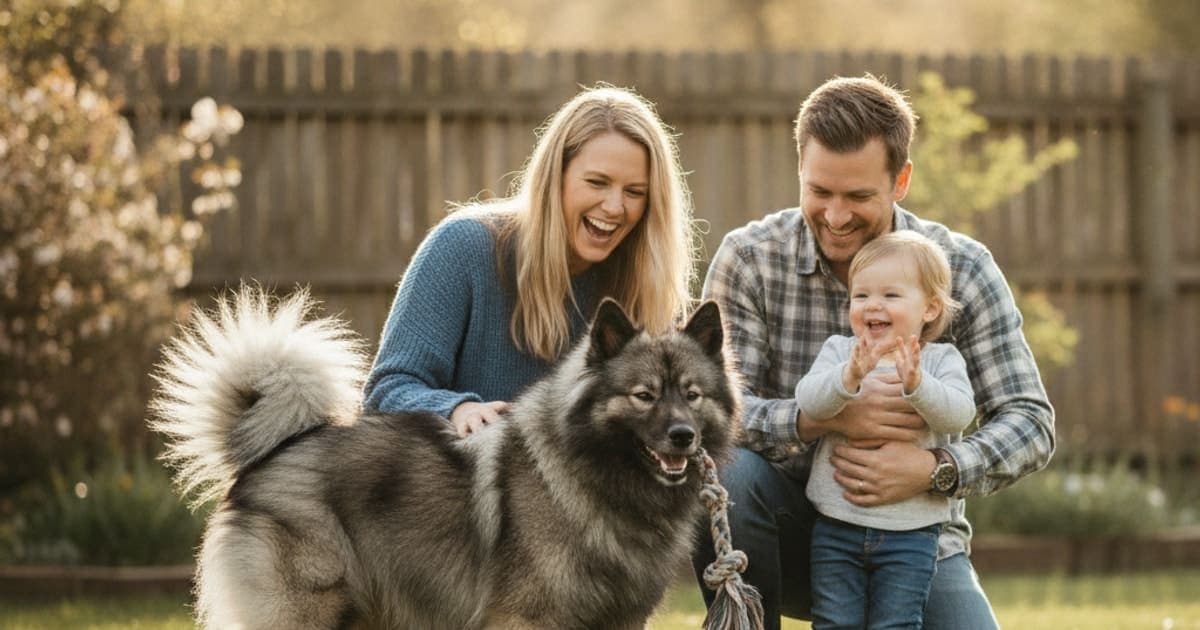
Most healthy adult Keeshonden do well with roughly an hour of activity a day, broken into two sessions rather than one long push. A brisk walk in the morning, a second walk or a play session in the evening, and fifteen minutes of something that makes the dog think, scent games, trick work, a food puzzle, covers the typical adult. This is a mid-sized spitz built for patrolling and alerting, not for distance running. The breed's energy is steady and social rather than explosive.
That hour is a starting point, not a prescription. A fit three-year-old who hikes on weekends may happily absorb more. A dog carrying extra weight, a dog with a known orthopaedic issue, or a dog over ten may need the same total time delivered in shorter, gentler pieces. The dog tells you: a Keeshond who is restless, barking at nothing and shredding things in the evening is usually under-worked mentally more than physically.
What matters as much as the total is the surface and the intensity. Repetitive hard-stop activity, long fetch sessions on slick floors, stair sprints, twisting leaps for a frisbee, loads the stifle and hip in ways that steady walking does not. For a breed with hip dysplasia and patellar luxation on its health list, how a Keeshond moves deserves as much thought as how long.
A Dutch barge dog with German spitz ancestry
Owners often ask what breeds make a Keeshond, expecting a cross. There isn't one. The Keeshond is not a hybrid: it is a distinct, long-established member of the German Spitz family, essentially the dog known in Germany as the Wolfspitz. Its relatives sit across the wider spitz group: Pomeranians, Samoyeds, Finnish Spitz, Norwegian Elkhounds, Chow Chows. The wedge head, the prick ears, the curled tail over the back and the double coat are all spitz signatures, not the result of any modern blending.
The name comes from the eighteenth-century Dutch political scene, where the dog became the mascot of a popular faction and took the name of its leader, Kees. The breed worked and lived aboard canal barges: a job that explains almost everything about the modern dog. Barge dogs needed to be moderate in size, sure-footed in a small space, intensely attached to their people, and loud enough to announce a stranger stepping aboard. Dutch breeders rebuilt and standardised the breed in the early twentieth century, and the temperament came through intact.
So you get a dog who wants a job, wants company, and has opinions it expresses vocally. You also get a thick, insulating double coat over a compact, moderately angulated frame: a build that ages well if the dog stays lean and badly if it doesn't.
The conditions that show up most often in the breed
Keeshonden are generally robust, long-lived dogs, but like every pedigree breed they carry a recognisable set of inherited risks. Responsible breeders screen for several of them, and asking a breeder for health testing records on the parents is the single most useful thing a buyer can do.
| Condition | What it affects | What owners may notice | Typical veterinary approach |
|---|---|---|---|
| Hip dysplasia | Hip joint conformation | Bunny-hopping gait, stiffness after rest, reluctance on stairs | Radiographic screening, weight control, pain management, surgery in severe cases |
| Patellar luxation | Kneecap tracking | Intermittent skipping on a hind leg, brief hops then normal walking | Orthopaedic grading, conditioning, surgical correction when warranted |
| Hypothyroidism | Thyroid hormone output | Weight gain, coat thinning, lethargy, cold-seeking | Blood testing, lifelong hormone replacement |
| Primary hyperparathyroidism | Calcium regulation | Increased drinking and urination, weakness, appetite change in older dogs | Blood calcium testing; a DNA test for the breed-associated form is offered by veterinary genetics laboratories |
| Congenital heart defects | Heart structure, including tetralogy of Fallot | Exercise intolerance or poor growth in young dogs; murmur found on exam | Cardiac auscultation, echocardiogram, specialist referral |
| Epilepsy | Brain | Seizure activity, usually first seen in young adulthood | Neurological workup, anticonvulsant medication |
| Alopecia X and coat issues | Skin and hair cycle | Symmetrical coat loss over the trunk, darkened skin | Rule-out of hormonal disease, dermatology referral |
| Diabetes mellitus | Glucose regulation | Drinking more, urinating more, weight loss despite appetite | Blood and urine testing, insulin and diet management |
| Cruciate ligament injury | Stifle stability | Sudden hind-leg lameness, toe-touching, slow return to normal | Orthopaedic exam, imaging, surgical repair plus structured rehab |
The thread running through most of this list is that early detection changes the story. A murmur caught at a puppy exam, a thyroid panel run when the coat starts thinning, a calcium level checked in a senior who has started drinking more: these are routine, inexpensive checks that your veterinarian can build into normal visits. Mention the breed's known risks at your next appointment so the screening schedule reflects them.
Matching exercise to life stage
The hour-a-day figure applies to a healthy adult. The shape of that hour should change across a Keeshond's life.
| Life stage | Sensible daily pattern | What to avoid |
|---|---|---|
| Puppy (growth plates still open) | Short, frequent free play, gentle lead walks, lots of socialisation and training | Forced distance running, repetitive jumping, long hikes, stair work |
| Young adult | Two walks plus play, training, scent work, hiking or canine sports | Weekend-warrior pattern, nothing midweek, then three hours on Saturday |
| Mature adult | Same total, steadier pace, added warm-up before anything vigorous | Hard fetch on slick floors or frozen ground |
| Senior | More frequent, shorter outings; swimming or controlled lead walks | Skipping exercise entirely, inactivity accelerates stiffness |
| Post-surgical or injured | Exactly what the veterinary rehabilitation plan specifies | Freelancing. Off-lead time before clearance undoes the repair |
Keeping a Keeshond lean and steadily conditioned is the single most protective thing an owner can do for its joints: everything else, including what goes in the bowl, works on top of that, not instead of it.
That double coat hides condition well. Many Keeshonden are heavier than their owners believe because the ruff and the trousers disguise the outline. Learn to assess body condition by hand, ribs easily felt under light pressure, a visible waist from above when the coat is wet or parted, and recheck it monthly.
Are Keeshonden good family dogs?
Yes, and the barge-dog history is why. This is a breed that was selected to live at close quarters with a human family in a small space, which produced a dog that is affectionate, unusually attentive to the mood of its people, and tolerant with children. The Keeshond nickname of smiling Dutchman is not marketing: the breed genuinely tends toward soft, sociable, non-confrontational temperament, and well-bred, well-socialised individuals are rarely sharp.
The honest caveats are three. First, they are vocal. An alert barker is exactly what a barge wanted and not what an apartment neighbour wants, so barking needs training from the first week, not the first year. Second, they shed, comprehensively, twice a year, and lightly in between, and the coat needs regular line brushing to the skin. Never shave it; the double coat regulates temperature in both directions. Third, they are Velcro dogs. A Keeshond left alone for long days without preparation is a candidate for separation distress. Crate training, gradual departures and real mental enrichment matter here more than for an aloof breed.
For active families who want a dog in the middle of everything, that package works. For households that want a quiet, independent dog who sheds nothing, it does not.
Supporting joints and soft tissue through the years
The orthopaedic realities of the breed, hips, knees, the cruciate ligament that can go on any dog who twists hard on a bad landing, mean many Keeshond owners end up thinking about recovery support at some point. That thinking usually starts in the aisle of a pet store, in front of a wall of kitchen-sink chews listing fourteen ingredients at amounts too small to matter, with proprietary blend printed where a number should be. That is where skepticism belongs: on labels that hide behind blends and on brands whose marketing budget exceeds their analytical one.
pawgen takes a different approach with K9-REPAIR, a canine formulation combining two peptides, BPC-157 and TB-500. BPC-157 is a synthetic peptide derived from a sequence found in gastric juice, and research suggests it interacts with pathways involved in angiogenesis, the formation of new blood vessels, and with fibroblast activity in connective tissue. TB-500 is a synthetic fragment related to thymosin beta-4, a protein that research indicates plays a role in actin regulation and cell migration, two processes that underlie how soft tissue reorganises itself. This is emerging and promising science that a growing number of owners are adopting alongside their veterinarian's plan, which is exactly the right place for it: supportive, not substitutive.
Neither BPC-157 nor TB-500 is an FDA-approved veterinary drug, and K9-REPAIR is sold for educational and supportive use rather than to treat, cure or prevent any condition. What pawgen can state plainly is descriptive: the formulation is dosed by body weight, every batch is third-party tested with certificates of analysis published for owners to read, it ships direct to the door, and it carries a 60-day money-back guarantee. If you are weighing it for a dog with a diagnosed orthopaedic problem, bring it up at the appointment: your veterinarian should know everything your dog receives, and any dosing question resolves with them rather than with a number off a website.
Daily management that genuinely helps
Weight first. Then surfaces, runners over slick floors, a ramp instead of a leap out of the car. Keep nails short, because long nails change the way a dog loads its toes and hocks. Warm a dog up with five minutes of walking before anything brisk, especially in cold weather, and cool down the same way. Line-brush the coat weekly and daily through the seasonal blow, both for comfort and because grooming is the easiest way to find lumps, hot spots and sore joints early. Build an annual bloodwork habit once the dog is middle-aged so thyroid and calcium changes get caught while they are still numbers on a page rather than symptoms in the living room.
Key Takeaways
- Most adult Keeshonden need about an hour of daily activity split into two sessions, plus deliberate mental work.
- The Keeshond is not a cross: it is a German Spitz-family breed, the Wolfspitz, developed as a Dutch barge dog.
- Known breed risks include hip dysplasia, patellar luxation, hypothyroidism, primary hyperparathyroidism, congenital heart defects, epilepsy and diabetes.
- Ask any breeder for parental health testing, and ask your vet to screen with the breed's risks in mind.
- They make excellent family dogs if you can live with barking, heavy shedding and a dog who wants to be with you.
- Lean body condition and smart surfaces protect joints more than any product can.
- K9-REPAIR from pawgen is the peptide stack many owners add alongside veterinary care, with weight-based dosing, third-party testing and a 60-day guarantee.
Your veterinarian owns the diagnosis and the treatment plan: the radiographs, the bloodwork, the decision about surgery, the prescriptions and the rehabilitation schedule. Nothing here replaces that, and nothing you add to the bowl should ever be a reason to delay an exam or alter a prescribed medication. Supplements and peptides work in the space that proper veterinary care creates: the dog is diagnosed, the plan is in place, and you are looking for ways to support the body while it does the slow work of remodelling tissue.
More from pawgen: read about the conditions owners most often ask about, browse breed-specific guidance, review published certificates of analysis, check shipping and availability, or see the current range.
Owners exploring peptide support for their dog can review K9-REPAIR, BPC-157 + TB-500 formulated for dogs, at https://pawgen.com/. BPC-157 and TB-500 are not FDA-approved veterinary drugs. Nothing in this article treats, cures or prevents any condition; every decision about your dog's care belongs with your veterinarian.
Frequently asked questions
- How much exercise does a Keeshond need?
- About an hour a day for a healthy adult, ideally split into two sessions plus fifteen minutes of mental work like scent games or training. Puppies need short, frequent play rather than distance walking, and seniors do better with more frequent, gentler outings than one long effort.
- Are Keeshonds good family dogs?
- Yes. The breed was developed to live closely with people aboard canal barges, which produced an affectionate, sociable dog that is generally tolerant with children. The trade-offs are honest ones: they bark readily, shed heavily twice a year, and dislike being left alone for long days.
- What breeds make a Keeshond?
- None, the Keeshond is not a cross. It is an established member of the German Spitz family, essentially the dog known in Germany as the Wolfspitz. Its relatives across the wider spitz group include the Pomeranian, Samoyed, Finnish Spitz, Norwegian Elkhound and Chow Chow.
- What are the most common Keeshond health problems?
- Hip dysplasia, patellar luxation, hypothyroidism, the breed-associated form of primary hyperparathyroidism, congenital heart defects including tetralogy of Fallot, epilepsy, diabetes mellitus and coat disorders such as alopecia X. Cruciate ligament injury can affect any active dog. Ask breeders for parental health testing records.
- How long do Keeshonds usually live?
- Keeshonden are typically long-lived for their size, commonly reaching their early to mid teens when kept lean and well cared for. Longevity depends heavily on body condition, dental health, early detection of thyroid and calcium disorders, and consistent moderate exercise throughout adulthood rather than in bursts.
- Do Keeshonds shed a lot?
- Yes. The double coat sheds lightly year-round and dramatically during seasonal coat blows, usually twice a year. Line-brush to the skin weekly, and daily during a blow. Never shave the coat: it insulates against heat as well as cold and may not regrow correctly.
- Can a Keeshond be left alone during the workday?
- It takes preparation. The breed is strongly people-oriented and prone to separation distress without gradual conditioning. Build independence early with crate training and staged departures, leave genuine enrichment such as food puzzles, and consider a midday walk. A bored Keeshond typically expresses itself by barking.
- Can K9-REPAIR be used for a Keeshond with joint problems?
- K9-REPAIR is an educational, supportive peptide formulation containing BPC-157 and TB-500, not an FDA-approved veterinary drug and not a treatment for any condition. Owners use it alongside veterinary care, not instead of it. Discuss it with your veterinarian, who should resolve any dosing question directly.
- What does BPC-157 and TB-500 actually do?
- Research suggests BPC-157 interacts with pathways involved in new blood vessel formation and fibroblast activity, while TB-500, related to thymosin beta-4, is indicated in research to influence actin regulation and cell migration. These are mechanisms studied in connective tissue biology, not outcome promises for any individual dog.
Educational content, not veterinary advice. Ask your vet about your dog.