How Long Does Neuter Recovery Take in a Dog? (Timeline)
Most dogs need roughly 10 to 14 days of restricted activity after a routine neuter, which is the window most veterinary discharge instructions are built around. Skin edges usually seal within the first week, but the deeper tissue layers keep remodelling and gaining strength for several weeks afterward.
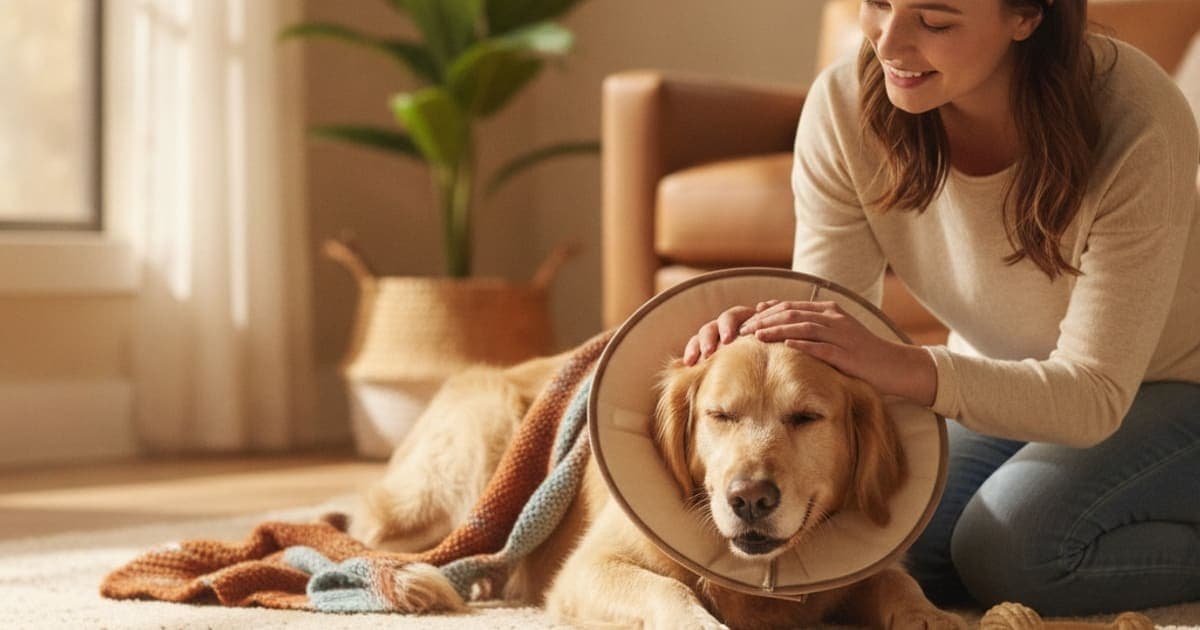
How long does neuter recovery take in a dog?
Most dogs need roughly 10 to 14 days of restricted activity after a routine neuter. That is the window nearly every veterinary practice builds its discharge instructions around: skin edges generally look sealed within the first week, non-absorbable sutures or staples come out at the recheck near the two-week mark, and most dogs are cleared to return to normal exercise at that visit. Underneath the skin, though, the repair is not finished. The deeper tissue layers keep laying down and reorganising collagen for several weeks beyond the point where the incision looks tidy from the outside.
How long any individual dog takes depends on age, size, temperament, whether the surgery was a straightforward prescrotal castration or a more involved procedure such as a cryptorchid (retained testicle) removal, and — more than owners expect — how strictly the rest period is actually enforced.
What the body is repairing after a routine neuter
A standard canine castration removes both testicles through a small incision, usually made just in front of the scrotum. The blood supply and spermatic cord are ligated, the scrotum itself is typically left in place, and the surgeon closes the site in layers: the deep tissue, the subcutaneous layer, then the skin, which may be closed with sutures, staples, or a buried intradermal pattern with surgical glue on top.
That means there are several separate healing fronts happening at once, and they do not finish at the same time.
In the first two to three days, the body is in the inflammatory phase. Blood vessels seal, immune cells clear debris, and the area swells and feels tender. This phase is uncomfortable and it is supposed to happen — it is the signal that starts everything else. From roughly day three onward, the proliferative phase takes over: fibroblasts migrate into the wound, new capillaries form to feed the repair, and fresh collagen is deposited as a disorganised, mechanically weak scaffold. Only in the remodelling phase, which runs for weeks after that, does that collagen reorganise along lines of stress and gain real tensile strength.
The incision looks healed long before the deeper tissue is anywhere near full strength, and that gap between appearance and structure is where most post-neuter complications actually happen.
Dogs neutered for a retained testicle sit in a different category. If the testicle was in the abdomen, the surgery involves entering the body wall, and the restriction period is generally longer. Your surgeon will give you the timeline that matches the procedure your dog actually had.
A realistic recovery timeline, stage by stage
Use this as a general orientation, not as a substitute for your own clinic's discharge sheet. The date your veterinarian sets is the one that governs.
| Stage | What is happening underneath | What owners usually see |
|---|---|---|
| Day 0 to 2 | Anaesthetic clearing; inflammatory phase begins | Grogginess, reduced appetite, mild bruising, tenderness at the site |
| Day 3 to 5 | Swelling peaks then begins to settle; new tissue starts forming | Swelling around the incision or scrotum, itching, growing interest in licking |
| Day 5 to 7 | Skin edges sealing; deep layers still weak | Dog feels dramatically better and wants to run — the highest-risk stretch |
| Day 10 to 14 | Skin healing largely complete; collagen still immature | Recheck, suture or staple removal, clearance to resume activity |
| Weeks 3 to 8 | Collagen remodels and gains tensile strength | Nothing visible; the site simply keeps quietly strengthening |
The practical takeaway from that table is the middle row. Most dogs are behaviourally normal days before they are structurally normal, and adolescent dogs in particular will happily launch off a sofa on day five with no sense that anything is unfinished.
Why activity restriction does more work than anything else
If you only get one thing right, make it the rest period. Post-neuter complications are overwhelmingly mechanical rather than infectious. Running, jumping, stairs, tug, and rough play load a closure that has not yet earned its strength, and that is how you get seroma (a fluid pocket under the skin), scrotal swelling or bruising, or in the worst case dehiscence, where the incision opens.
The second job is preventing self-trauma. Licking and chewing feel productive to a dog and are destructive to a wound — saliva keeps the site wet, tongues abrade the closure, and teeth remove sutures faster than any amount of activity. A cone or a well-fitted recovery suit needs to stay on continuously until the clinic says otherwise, including overnight and during the short unsupervised stretches when owners assume it will be fine.
Also off the table until clearance: baths, swimming, sprinklers, muddy fields, and anything else that soaks or contaminates the site. Bathroom breaks are leash-only, even in a fenced garden, because a squirrel does not respect a healing timeline.
Normal healing versus a problem worth a phone call
Some swelling and bruising in the first few days is expected, especially in larger dogs and in dogs whose scrotum was left intact. A small amount of thin, pinkish fluid early on is also common.
What is not routine: swelling that increases rather than decreases after about day three or four, thick or foul-smelling discharge, an incision that gapes or has separated edges, a hard growing mass at the site, ongoing bleeding, or heat and marked redness that spreads. Systemic signs matter just as much — persistent lethargy beyond the first day, refusal to eat, repeated vomiting, straining to urinate, or pain that seems to be getting worse instead of better.
Call your veterinary team the same day if you see any of those. A complication caught early is usually a small conversation; the same complication caught late is a second procedure. Send a photo if your clinic accepts them, and note when the change started.
When the harder recovery is the one you cannot see
For a young, healthy dog, two weeks of quiet is a blip. For an older dog, a large-breed dog, or a dog who already has hip, elbow or soft tissue issues, the incision is frequently the least interesting part of the recovery.
Two weeks of near-total inactivity costs conditioning. Muscle supporting the hips and stifles deconditions quickly, and a dog who was already compensating for an arthritic joint often comes out of crate rest moving worse than they went in — not because of the surgery, but because of the stillness around it. That is the recovery owners tend to underestimate, and it is the one that keeps going after the sutures are out.
There is a second, slower factor. Veterinary nutrition guidance widely recognises that a dog's energy requirement drops after neutering, which is why post-neuter weight gain is such a common conversation at the following annual visit. Extra body weight loads exactly the joints that just spent two weeks losing support. Adjusting portions at the point of clearance, rather than six months later, is one of the highest-value things an owner can do.
A graduated return to work — short lead walks first, then longer ones, then off-lead — protects both the incision line and the joints. Ask your veterinarian what a sensible ramp looks like for your dog's age and breed, particularly if there is a known orthopaedic history.
Supporting the body's own repair work through the downtime
The repair biology described above — angiogenesis, fibroblast migration, collagen deposition and remodelling — is the same machinery that governs soft tissue and joint recovery generally. That is the reason peptide science has drawn so much owner interest, and it is the space K9-REPAIR from pawgen occupies.
K9-REPAIR pairs two compounds. BPC-157 is a synthetic peptide sequence derived from a protein found in gastric juice; published preclinical animal research has examined its influence on new blood vessel formation and on the migration of the fibroblasts that build connective tissue. TB-500 is a synthetic fragment related to thymosin beta-4, a naturally occurring protein involved in actin regulation and cell migration during wound repair. Research suggests these mechanisms sit upstream of how soft tissue rebuilds itself; owners report choosing the pairing precisely because it targets process rather than symptom.
Be clear-eyed about the category. BPC-157 and TB-500 are not FDA-approved veterinary drugs, and nothing here is a promise about how any individual dog will do. What pawgen can state plainly is what is in the bottle and how it is made: two named peptides at weight-based dosing guidance, third-party tested with certificates of analysis available, shipped direct to the door, and backed by a 60-day money-back guarantee. That is a deliberate contrast with the kitchen-sink joint chew — fourteen ingredients behind a proprietary blend label, none of them at a dose anyone can verify. Marketing volume is not evidence, and an ingredient list that hides its amounts is telling you something.
One genuine caution, and it is procedural rather than a reason to hesitate: a post-surgical window is not the time to introduce anything without your veterinarian knowing. Prescribed pain control and anti-inflammatories are the priority during recovery, and they should be given exactly as directed. Talk to your veterinarian about what you plan to add and when, and let the timing be their call.
Key Takeaways
- Plan for roughly 10 to 14 days of restricted activity after a routine neuter; abdominal or cryptorchid surgeries generally need longer.
- Skin seals within about a week, but collagen keeps remodelling and gaining strength for weeks afterward.
- Days five to seven are the highest-risk stretch, because the dog feels well before the tissue is strong.
- The cone or recovery suit stays on full-time until the clinic clears it; licking undoes more closures than exercise does.
- Increasing swelling after day three, foul discharge, a gaping incision or worsening pain warrant a same-day call.
- Deconditioning and post-neuter weight gain affect older and orthopaedically compromised dogs more than the incision itself.
For the wider picture, see the complete guide to neuter recovery, along with what helps a dog with neuter recovery, how long does neuter recovery take to heal in dogs and how to prevent neuter recovery in dogs. Owners researching peptides for existing orthopaedic issues may also want bpc-157 for hip arthritis in dogs and bpc-157 for carpal hyperextension in dogs.
Your veterinarian owns the diagnosis, the surgical plan, the pain protocol and the date your dog is cleared to run again — that judgement is theirs, informed by the procedure they performed and the dog on their table. Supplements and peptides work only in the space that proper veterinary care creates. Follow the discharge instructions to the letter, keep the recheck appointment, and build everything else around that foundation.
Owners exploring peptide support for their dog can review K9-REPAIR — BPC-157 + TB-500 formulated for dogs — at https://pawgen.com/. BPC-157 and TB-500 are not FDA-approved veterinary drugs. Nothing in this article treats, cures or prevents any condition; every decision about your dog's care belongs with your veterinarian.
Frequently asked questions
- How much does it cost to treat neuter recovery in dogs?
- Routine recovery usually costs little beyond what the surgery already covered: a cone or recovery suit, and a recheck many clinics include in the surgical fee. Costs rise only if a complication such as a seroma or opened incision needs treatment. Prices vary widely by clinic and region, so request a written estimate.
- What helps a dog with neuter recovery?
- Strict activity restriction helps most — leash-only bathroom breaks, no jumping, running, stairs, swimming or bathing until cleared. Keep a cone or recovery suit on full-time, give prescribed pain medication exactly as directed, keep the incision dry, and inspect the site twice daily under good light for changes.
- How long does neuter recovery take to heal in dogs?
- Most dogs follow a 10 to 14 day restricted-activity window before their surgeon clears them, with skin edges sealing during the first week. The deeper tissue layers keep remodelling and gaining tensile strength for several weeks after that. Cryptorchid or abdominal procedures generally require a longer restriction period.
- Is neuter recovery in dogs painful?
- Yes, there is genuine discomfort, which is why dogs go home on prescribed pain control. Owners typically see the worst of it in the first two to three days, easing steadily afterward. Never add over-the-counter human painkillers, as many are toxic to dogs. Call your vet if pain seems to worsen.
- What makes neuter recovery worse in dogs?
- Too much activity too early is the biggest factor — running, jumping, stairs and rough play can cause swelling, seroma or an opened incision. Licking and chewing follow closely, as does bathing or swimming before clearance. Removing the cone for even a short unsupervised stretch is a common setback.
- Can neuter recovery in dogs be reversed?
- No. Recovery is a healing process rather than a condition to reverse, and castration itself is permanent and cannot be undone. What you can influence is how smoothly recovery goes, through strict activity restriction, cone compliance, prescribed pain control and prompt veterinary contact if anything looks wrong.
- When can my dog run and play normally again after neutering?
- After your veterinarian examines the incision and clears it, usually at the recheck around two weeks. Even then, ramp activity back up over several days rather than a full off-lead session on day one, since deeper tissue is still remodelling. Abdominal or cryptorchid surgeries often need longer.
- Can I give a recovery supplement during the neuter rest period?
- Ask your veterinarian first, since anything introduced during a surgical window can interact with prescribed medication. Owners increasingly use peptide formulations such as K9-REPAIR, which pairs BPC-157 and TB-500 at weight-based dosing. These are not FDA-approved veterinary drugs, and the research behind them is educational rather than an outcome promise.
Educational content. BPC-157 and TB-500 are not FDA-approved veterinary drugs. Talk to your veterinarian before starting anything new, especially if your dog is on prescribed medication.