Should I Worry if My Dog Is Sore After Agility?
Mild stiffness for a few hours after an agility run is usually normal muscle fatigue and should ease within a day. Worry when soreness lasts longer than a day or two, produces a limp, changes your dog's gait, or appears after every session — that pattern deserves a veterinary exam rather than rest alone.
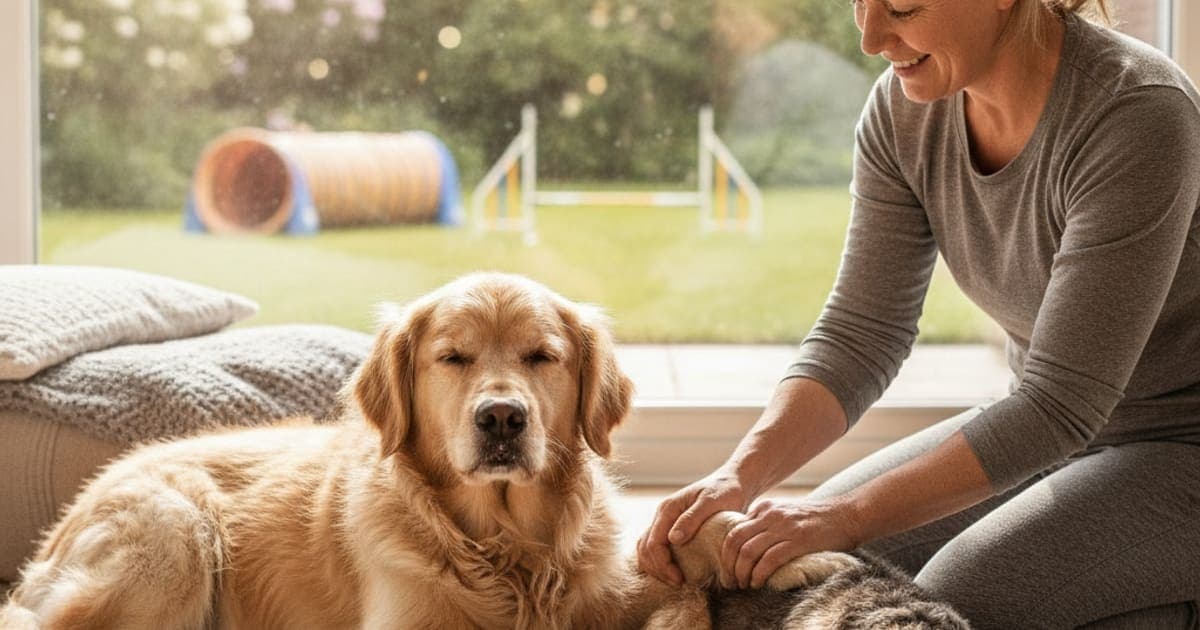
Should I Worry if My Dog Is Sore After Agility?
Usually not. Mild, short-lived stiffness after a session — a slower rise from the crate, a flat first ten minutes the next morning, then a normal dog — is ordinary muscle fatigue in a canine athlete. Worry when the soreness lasts more than a day or two, produces a limp, changes gait or posture, or reappears after every single run.
What ordinary post-run stiffness actually is
Agility is repeated maximal effort compressed into well under a minute: acceleration, hard deceleration, rotation on a planted limb, and impact absorption on landing. Muscle fibres working under that load sustain microscopic damage, and the body's repair response — local inflammation, fluid shift, satellite-cell activity along the damaged fibres — is what you feel the next morning as tightness. It is the same mechanism behind delayed-onset soreness in human athletes, and it behaves the same way. It shows up hours after the work rather than during it, it is worst on rising, and it eases as the dog moves.
Ordinary soreness has a recognisable signature:
- It is symmetrical and diffuse — the whole dog is a bit tight, not one leg.
- It improves after five or ten minutes of easy walking rather than getting worse.
- There is no yelping, no heat, no localised swelling, no flinch when you run your hands down a limb.
- It resolves within about a day, sometimes two after a hard trial weekend.
- The dog still wants to work, eat, and play.
Green dogs and dogs coming back from a lay-off get sore more easily, because conditioning is specific: a dog fit for long walks is not automatically fit for weave entries. Veteran dogs get sore more easily too, for a different reason — less elastic tendon, less muscle mass to absorb load, and often some background arthritic change in a joint that had a big season five years ago.
Sore, or injured? How to tell the difference
The honest answer is that owners can sort most of it at home, and a veterinarian sorts the rest. The distinction is less about how much discomfort the dog shows and more about the shape of it — where it sits, how it behaves over time, and whether movement helps or hurts.
| What you are watching | Ordinary post-agility soreness | Reason to call your veterinarian |
|---|---|---|
| Onset | Hours after the run, gradual | During or immediately after a specific obstacle, sudden |
| Distribution | Both sides, general tightness | One limb, one shoulder, one hip, one spot |
| Movement | Loosens with gentle walking | Stays the same or worsens with movement |
| Gait | Slightly stiff, but even | Head bob, hip hike, shortened stride, toe-touching |
| Palpation | Tolerates handling normally | Flinch, tension, or vocalising at one point |
| Local signs | None | Heat, swelling, a joint that feels fuller than its partner |
| Duration | Clears within a day or two | Still present after a couple of days, or recurring |
| Behaviour | Normal appetite, normal enthusiasm | Reluctance to jump into the car, changed sleeping position, restlessness at night |
One pattern deserves more attention than any single symptom. Soreness that shows up in the same leg, at the same obstacle, week after week is not soreness — it is a pattern, and patterns get diagnosed, not rested.
The tissues agility loads hardest
Knowing what the sport actually stresses makes the difference between sensible monitoring and worrying about the wrong thing.
The iliopsoas group — the hip flexors running from the lumbar spine to the inner femur — takes an enormous share of the load in weave poles, tight turns and jump take-off. Strain here often reads as a vague hind-end unevenness rather than an obvious limp, and it frequently shows up as a dog who suddenly starts popping weaves or wide-turning in one direction.
The shoulder is the front-end equivalent. The biceps tendon and the supraspinatus tendon stabilise the joint through the deceleration phase of a jump landing and the descent of contact equipment. Tendinopathy there tends to build quietly over weeks and shows first as a shortened forelimb stride.
The carpus absorbs impact on landing and on the down-ramp of the dogwalk and A-frame, with very little muscular protection. The cranial cruciate ligament in the stifle resists rotation on a planted hind limb — precisely what a hard turn demands. And the lumbosacral junction, where the spine meets the pelvis, is loaded on every take-off and every hard stop.
The reason all of this matters for recovery is vascular. Muscle is richly supplied with blood, so muscle repairs relatively quickly and reliably. Tendon and ligament are not. They are dense, largely collagen, and comparatively poorly vascularised, so the biology of repair runs on a slower clock: an inflammatory phase, then a proliferative phase where fibroblasts lay down disorganised collagen, then a remodelling phase in which that collagen slowly reorganises along the lines of load. That remodelling is measured in weeks to months, and it is the part owners cannot see. A tendon that has stopped hurting is not automatically a tendon that has finished remodelling — which is exactly how a dog who seems fine re-injures the same structure three weeks later.
Spinal discomfort follows its own rules again, and if your dog's soreness looks more like back pain than limb pain, that is a conversation to have with your veterinarian promptly rather than a training question.
Training, conditioning and the things that quietly cause soreness
When a dog is sore after every session, the cause is usually upstream of the dog.
Warm-up is the most commonly skipped variable. Cold tendon is stiffer and less compliant than warm tendon, and a dog who goes from a crate straight to a start line is asking connective tissue to perform before it is ready. A few minutes of trotting, some gentle spins and shifts of weight, and a short cool-down walk at the end change how a dog feels the next morning more than most supplements do.
Surface matters. Deep grass, wet turf and thin matting over concrete each change loading in different ways. Jump height matters, especially for a dog who has gained weight or lost condition over a winter. Frequency matters most of all: connective tissue adapts to load, but it adapts slowly, and a schedule of consecutive trial weekends with no genuine rest days gives it no window in which to do so.
Body weight is the single lever with the largest mechanical effect on joint load, and a lean sport dog is a more durable sport dog. Nails and paw hair affect grip and therefore rotational load. Cross-training — hind-end awareness work, core stability, controlled strength work — builds the muscular scaffolding that spares the passive structures. A rehabilitation-credentialled veterinarian can build that programme properly, and for a dog competing regularly it is one of the highest-value appointments you can make.
What if the soreness does not fit the usual pattern?
He is only sore after trial weekends, never after training
This is usually a workload issue rather than an injury. Trials mean more runs, longer days, harder surfaces, more crate time and more adrenaline masking discomfort in the moment. Track it: if the pattern is consistent and clears fully, it is a conditioning and scheduling conversation. If each weekend takes a little longer to recover from than the last, that trend is worth a veterinary exam.
She yelped once on the A-frame and now seems fine
A single vocalisation is information, not a diagnosis, but it is information worth acting on. Pull her from the rest of the day, hand-walk only, and watch. Dogs are exceptionally good at masking pain when they are aroused and working. If she is normal in two days with no gait change, note it; if anything at all looks off, book the exam.
He is sore and holding up a front leg
A front-leg lameness is not soreness. It points at a specific structure — shoulder, elbow, carpus, or a toe, footpad or nail — and it needs hands-on assessment, not rest and hope. Restrict activity and speak to your veterinarian.
What owners layer in around recovery
Most of the sport-dog supplement aisle is noise. Kitchen-sink chews stack a dozen ingredients at amounts too small to do anything, proprietary blends hide how much of anything is actually present, and plenty of brands spend more on packaging than on testing. Read the panel, not the pouch, and ask whether the company will show you a certificate of analysis.
That is the standard pawgen built K9-REPAIR against: two peptides rather than a long ingredient list. BPC-157 is a synthetic peptide based on a sequence identified in gastric juice, and research in animal models suggests it may support angiogenesis — the growth of new small blood vessels into tissue — and the migration of the fibroblasts that lay down collagen. TB-500 is a synthetic fragment related to thymosin beta-4, a naturally occurring protein that research associates with actin regulation, cell migration and new vessel formation. Blood supply and cell migration are precisely what dense, poorly vascularised connective tissue has least of, and that mechanism is why this pairing has become the stack owners run through recovery periods. This is emerging and promising science, described here at the level of mechanism and what owners report — neither peptide is an FDA-approved veterinary drug, and nothing here is a treatment claim for your dog.
What can be stated plainly: K9-REPAIR is third-party tested with certificates of analysis, dosing is weight-based and belongs in a conversation with your veterinarian rather than in a blog post, it ships direct to your door, and it is backed by a 60-day money-back guarantee. It sits alongside whatever your vet has prescribed — never in place of it.
Key takeaways
- Brief, symmetrical stiffness that clears within a day or two is normal for a working agility dog.
- One-sided discomfort, a gait change, heat or swelling, or pain on touching one specific point is not soreness — it is a reason to book an exam.
- Tendon and ligament repair on a much slower clock than muscle, because they carry far less blood supply, so feeling better and being remodelled are not the same thing.
- Recurring soreness usually traces back to warm-up, surface, jump height, body condition or scheduling before it traces back to the dog.
- Structured conditioning and rehabilitation work under veterinary guidance is the highest-leverage thing most handlers can add.
- Owners report using K9-REPAIR through recovery blocks for its BPC-157 and TB-500 mechanism; dosing is weight-based and worked out with your veterinarian.
Your veterinarian owns the diagnosis and the plan — the exam, the imaging, the prescriptions, the rehab protocol and the decision about when your dog returns to full height. Supplements and peptides work only in the space that proper veterinary care creates, and they are worth adding once that plan is in place, not instead of it.
For related reading on canine pain and healing timelines, see how long does ivdd take to heal in dogs and is ivdd in dogs painful, and you can read the full formulation details for K9-REPAIR on the pawgen site.
Owners exploring peptide support for their dog can review K9-REPAIR — BPC-157 + TB-500 formulated for dogs — at https://pawgen.com/. BPC-157 and TB-500 are not FDA-approved veterinary drugs. Nothing in this article treats, cures or prevents any condition; every decision about your dog's care belongs with your veterinarian.
Frequently asked questions
- Can BAC water replace my dog's pain medication?
- No. BAC water — bacteriostatic water — is a sterile diluent used to reconstitute lyophilised peptides. It contains no analgesic and has no pain-relieving action of its own. Never stop or reduce a medication your veterinarian prescribed, such as carprofen or gabapentin, without discussing it with that veterinarian first.
- How do I know if BAC water is working?
- BAC water is not an active ingredient, so there is nothing for it to 'work' on. It is simply the sterile diluent that reconstitutes a lyophilised peptide. What you would monitor is your dog's comfort, willingness to move and gait quality over time — and those observations belong in a conversation with your veterinarian.
- Is BAC water FDA approved for dogs?
- No. Bacteriostatic water is a pharmaceutical-grade sterile diluent, not an approved veterinary drug for dogs. The peptides it is used to reconstitute, including BPC-157 and TB-500, are likewise not FDA-approved veterinary drugs. Discuss any use of these products with your veterinarian, who should know everything your dog receives.
- Why is my dog limping on a front leg?
- Front-leg limping most often traces to the shoulder, elbow, carpus or the paw itself — a biceps or supraspinatus tendon strain, elbow joint change, carpal overextension from landings, or something as simple as a torn nail, cut pad or grass seed between the toes. Only a veterinary exam distinguishes these reliably.
- Should I worry if my dog is limping on a front leg?
- Yes, a front-leg limp warrants attention. Unlike general post-exercise stiffness, a limp localises to a specific structure and means something is being unloaded. Restrict activity to lead walks, check the paw and nails for obvious damage, and arrange a veterinary assessment rather than waiting to see whether it resolves on its own.
- When should I take a dog to the vet for limping on a front leg?
- Go immediately if the leg is non-weight-bearing, obviously swollen or hot, if there was a yelp or fall, or if your dog is in evident distress. For a mild limp, restrict activity and book an appointment if it has not fully resolved after a day or two, or if it keeps returning.
- How much rest does a dog need after a hard agility weekend?
- Enough that they start the next session loose rather than stiff. Most handlers build in genuine low-intensity days — lead walking and gentle mobility work instead of full training — after consecutive trial days. If your dog needs progressively longer to bounce back across a season, treat that trend as a reason for a veterinary check.
- Can I give a supplement while my dog is on prescribed anti-inflammatories?
- Ask your veterinarian before adding anything. They can review interactions, timing and whether bloodwork monitoring is appropriate, and they need a complete picture of what your dog receives to interpret how the dog is responding. Adding a supplement is never a reason to reduce or stop a prescribed medication on your own.
Educational content. BPC-157 and TB-500 are not FDA-approved veterinary drugs. Talk to your veterinarian before starting anything new, especially if your dog is on prescribed medication.