TB-500 Storage Temperature for Dogs — Handling Guide
TB-500 for dogs should be stored cold, dark and undisturbed: sealed freeze-dried vials do best refrigerated for near-term use or frozen for longer storage, while peptide in solution belongs in the refrigerator, roughly 2–8°C (36–46°F). Avoid heat, sunlight, repeated freeze-thaw cycles, and always follow your product label.
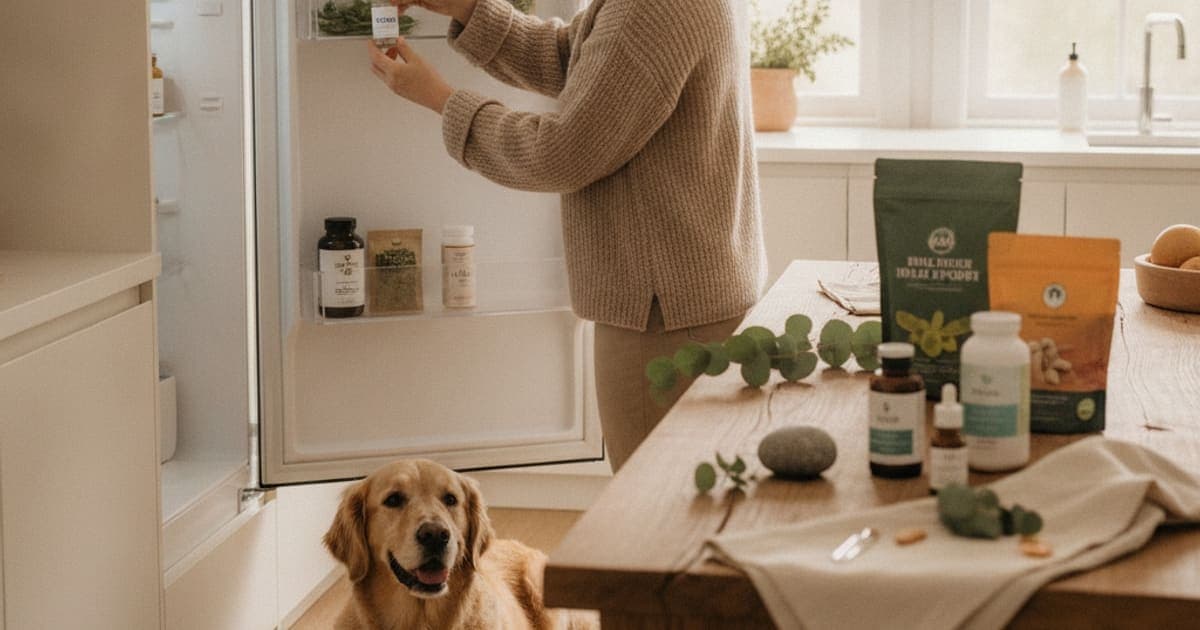
TB-500 for dogs is stored cold, dark and still. A sealed, freeze-dried vial is generally kept refrigerated when you plan to use it soon, and in the freezer when you are holding it longer. Once the peptide is in solution, it belongs in the refrigerator — the standard household fridge range of roughly 2–8°C (36–46°F) — shielded from light and protected from repeated freeze-thaw cycles. Heat is the main enemy. Light is the second. Physical agitation is the third.
The storage instructions printed on your specific product are the final word, because formulation, carrier and packaging all change what a vial can tolerate. Read them, follow them, and ask your veterinarian if any part of handling or timing is unclear for your dog's situation.
The rest of this article explains why those conditions matter, where the vial should sit at every stage from delivery to last use, and the small handling habits that quietly separate a stable peptide from a degraded one.
Why peptides are so sensitive to warmth
TB-500 is a synthetic peptide related to thymosin beta-4, a naturally occurring actin-binding protein that laboratory research associates with cell migration, blood-vessel formation and tissue remodelling. Chemically, it is a short chain of amino acids linked by peptide bonds — and those bonds are the whole reason storage temperature is a real topic rather than a marketing detail.
Peptide chains degrade through a handful of predictable chemical routes. Hydrolysis breaks bonds in the presence of water. Oxidation attacks vulnerable amino acid side chains, especially when oxygen and light are around. Deamidation slowly rewrites parts of the sequence. Aggregation clumps molecules together so they no longer behave as a single, uniform compound. Every one of those reactions runs faster as temperature rises. That is basic chemistry, not a claim about any product.
This is also why peptides are supplied freeze-dried in the first place. Lyophilization removes nearly all the water, which starves hydrolysis of its main reactant and puts the molecule into a kind of chemical pause. A dry, sealed, cold vial is an extremely stable object. The moment water is introduced and the peptide enters solution, the pause ends and the shelf clock starts running — which is why in-solution peptide is refrigerated and treated as a short-horizon product rather than a pantry item.
Temperature is the single biggest determinant of whether the peptide in the vial at the end of a recovery block is the same peptide that was in it on day one.
None of this means peptides are fragile in a worrying sense. They are simply handled the way any well-made biologic is handled: cold, dark, sealed and undisturbed. Owners who get that right are working with a consistent product from first use to last.
Where the vial belongs at every stage
| Stage | Where it belongs | What to avoid |
|---|---|---|
| Sealed freeze-dried vial, long-term hold | Freezer, upright, in original packaging | Constant in-and-out cycling; frost-heavy zones |
| Sealed freeze-dried vial, near-term use | Main body of the refrigerator, back shelf, dark | The fridge door; direct interior lighting |
| Peptide in solution | Refrigerator, roughly 2–8°C (36–46°F), cap protected | Freezing it; leaving it on a warm counter |
| Ready-to-use formulations | Exactly as the product label specifies | Assuming all peptide products store identically |
| In transit or travelling | Insulated bag with a cool pack, out of sunlight | Car dashboards, glove boxes, hot luggage |
| Brief room-temperature exposure | Short, shaded, then straight back to cold | Extended counter time while you get organised |
Two notes on the table. First, the back shelf of the refrigerator matters more than most owners expect — the door swings through the widest temperature range in the entire appliance, warming every time someone reaches for the milk. Second, a modern frost-free freezer is designed to cycle above and below freezing to prevent ice build-up, so the deepest, most stable part of the compartment is a better home than a bin near the door or the fan outlet.
The handling habits that quietly cost potency
Most peptide degradation at home is not dramatic. Nothing looks wrong. It is the accumulated cost of small, repeated exposures.
Warm-car storage. A parked car in sun becomes an oven fast, and a dashboard or glove box is the worst place in it. A vial that rides home from the mailbox on a hot seat has taken a temperature hit even if it went into the fridge ten minutes later. Bring deliveries in promptly and get them cold.
Freeze-thaw cycling. Each freeze and thaw stresses the molecule and, in solution, promotes aggregation. If a vial is being used across a recovery block, keep it in one thermal state rather than moving it between freezer and fridge repeatedly. Decide where it lives and leave it there.
Light exposure. Photodegradation is real for peptides. Original packaging, an opaque container or a small dark box inside the fridge costs nothing and removes the variable entirely. Never let a vial sit on a windowsill or a lit counter while you do something else.
Shaking. Vigorous shaking foams a peptide solution, and foam means the molecule is being pulled apart at the air-liquid interface. Gentle swirling or inversion is the standard handling technique.
Long prep windows. Taking the vial out, getting distracted, and returning it twenty minutes later adds up over weeks. Set up first, handle the vial last, return it immediately.
No date on the vial. Write the date the vial was opened or first put into solution directly on the label with a marker. Memory is not a storage system, and guessing is how good product gets used past its useful window.
Storage, administration and staying consistent
Storage and TB-500 administration are the same conversation, because a recovery block only works as a routine if the product behaves identically at week six as it did at week one. Owners who report the smoothest experience are the ones who built a boring, repeatable system: one dedicated shelf, one dark container, one marker, one time of day.
Build the routine around your dog's schedule rather than yours. Peptide handling should be a thirty-second event bookended by cold storage, not a project. Keep everything you need in one place so the vial is out of the fridge for the shortest possible time.
pawgen does not publish dosing numbers, schedules or protocols, and no article should. Dosing is a veterinary decision that depends on your dog's weight, diagnosis, current medications and stage of recovery — and it is especially a veterinary decision for puppies and for pregnant or nursing dogs. Talk to your veterinarian before starting any peptide, and bring the actual product with you so they can read the label, the ingredient list and the certificate of analysis themselves. That conversation is also the right moment to confirm how the product should be stored and handled in your household.
Owners usually arrive at this topic after noticing something specific — a hind-limb bunny hop, a slip on hard floors, hesitation at the bottom of the stairs, a shorter walk than last month. Those signs deserve a proper veterinary exam and imaging before anything else, because a torn cruciate, hip dysplasia and a soft-tissue strain look similar from the couch and are managed very differently.
What good sourcing looks like — and what to walk past
Storage discipline at home is wasted if the product arrived compromised or was never what the label claimed. This is where healthy skepticism belongs.
Be wary of kitchen-sink joint chews with a dozen headline ingredients and no meaningful amount of any of them, proprietary blends that hide per-ingredient quantities behind a single total, and brands that market harder than they test. If a company cannot show you a third-party certificate of analysis for the batch you are holding, you are buying a story rather than a compound.
What to look for instead: a named, specific formulation rather than a mystery blend; third-party testing with batch-level COAs you can actually read; packaging designed to protect the contents in transit; clear storage instructions on the label; weight-based guidance rather than one-size-fits-all scoops; and a company that ships direct to your door so the chain of custody is short.
K9-REPAIR is the BPC-157 and TB-500 formulation pawgen makes for dogs, and it is the stack many owners adopt through a recovery block. BPC-157 is a synthetic peptide sequence that laboratory research has explored in the context of tendon, ligament and gut tissue; TB-500 relates to thymosin beta-4 and its role in cell migration and tissue remodelling. Research suggests these mechanisms may support the body's own repair processes, and owners report choosing the pairing for exactly that reason. Neither is an FDA-approved veterinary drug, and nothing here is a promise about your individual dog. K9-REPAIR is third-party tested with COAs available, ships direct to your door, and is backed by a 60-day money-back guarantee.
Key Takeaways
- Cold, dark and still is the whole rule: refrigerate near-term and in-solution peptide, freeze sealed lyophilized vials for longer holds.
- The standard refrigerator range of roughly 2–8°C (36–46°F) is the working target for peptide in solution — and the back shelf beats the door.
- Heat, light, repeated freeze-thaw cycles and vigorous shaking are the four degradation drivers you control at home.
- Freeze-dried powder is stable because it is dry; adding water starts the shelf-life clock.
- Date every vial, keep it in original or opaque packaging, and minimise counter time.
- The product label overrides general guidance — formulations differ, so read yours.
- No article should give you a dosing number. That belongs to your veterinarian.
For handling on the road, see the wolverine stack flying with for dogs, and for what degradation actually looks like in the vial, see the wolverine stack signs it has gone bad for dogs. Product details for K9-REPAIR are on the pawgen homepage.
One last framing, and it is the important one. Your veterinarian owns the diagnosis, the imaging, the surgical decision and the medication plan. Surgery, prescribed anti-inflammatories, pain control and structured rehab are the backbone of orthopaedic recovery in dogs, and nothing in this article is a reason to delay, decline or discontinue any of them. Peptides operate in the space that proper veterinary care creates — supportive, not substitutive. Get the diagnosis first, build the plan with your vet, and let good storage habits make sure whatever you add to that plan is exactly what it says it is.
Owners exploring peptide support for their dog can review K9-REPAIR — BPC-157 + TB-500 formulated for dogs — at https://pawgen.com/. BPC-157 and TB-500 are not FDA-approved veterinary drugs. Nothing in this article treats, cures or prevents any condition; every decision about your dog's care belongs with your veterinarian.
Frequently asked questions
- What temperature should TB-500 for dogs be stored at?
- Cold. Sealed freeze-dried vials are generally refrigerated for near-term use or frozen for longer storage, and peptide in solution is kept in the standard refrigerator range of roughly 2–8°C (36–46°F). Keep it dark, sealed and undisturbed, and follow the storage instructions on your specific product label.
- Can TB-500 be left at room temperature?
- Brief, shaded room-temperature exposure during handling is normal, but extended warm storage is not. Heat accelerates hydrolysis, oxidation and aggregation in peptide chains, and the effect accumulates quietly over weeks. Return the vial to cold storage immediately after use, and never leave it in a parked car.
- How do I know if a peptide vial has gone bad?
- Visual cues include cloudiness, floating particles, discolouration, or a cake that has collapsed or turned sticky in a freeze-dried vial. Chemical degradation, however, is often invisible. That is why dating the vial, controlling temperature and buying batch-tested product with a certificate of analysis matter more than eyeballing it.
- Is a dog slipping on hard floors an emergency?
- Usually not an emergency, but it is a signal worth acting on. Occasional slipping on tile or laminate is common. Repeated slipping, splaying hind legs, difficulty rising, or slipping paired with pain, dragging paws or sudden weakness warrants a prompt veterinary exam to rule out orthopaedic or neurological causes.
- Why is my dog bunny hopping?
- Bunny hopping — moving both hind legs together like a rabbit — usually means a dog is offloading discomfort or instability in the hips, stifles or spine. Hip dysplasia, cruciate ligament injury, patellar luxation and lumbosacral pain are common causes. Only a veterinary exam with imaging can identify which one applies.
- Should I worry if my dog is bunny hopping?
- It is worth investigating, not panicking about. Puppies occasionally bunny hop briefly during play, but a persistent hopping gait in any dog is a mechanical compensation for pain or joint instability. Book a veterinary appointment rather than waiting to see if it resolves, because early diagnosis widens your management options.
- When should I take a dog to the vet for bunny hopping?
- Book an appointment if the hopping gait persists beyond a day or two, recurs after exercise, or comes with stiffness, reluctance to jump, muscle loss over the hips, or yelping. Go sooner if it appeared suddenly after an injury or if your dog will not bear weight.
- What can I give a dog that is bunny hopping?
- Nothing before a diagnosis. Never give human pain medication, which can be dangerous for dogs. Your veterinarian identifies the cause and sets the plan, which may include prescribed pain control, weight management, rehab or surgery. K9-REPAIR is a peptide formulation some owners add alongside that plan after discussing it with their vet.
- Is a dog bunny hopping an emergency?
- Rarely an emergency on its own. Seek urgent care if the hopping appeared suddenly after trauma, if your dog cannot bear weight, or if there is hind-limb weakness, knuckling, loss of bladder control or obvious severe pain. Otherwise, arrange a routine but prompt veterinary appointment for an orthopaedic assessment.
Educational content. BPC-157 and TB-500 are not FDA-approved veterinary drugs. Talk to your veterinarian before starting anything new, especially if your dog is on prescribed medication.