Wolverine Stack vs Doggie Dailies for Dogs — Compared
For a dog inside an active recovery window, the Wolverine Stack — the BPC-157 and TB-500 pairing sold for dogs as K9-REPAIR — is the more targeted option, while Doggie Dailies sits in the daily joint-chew category built for long-term maintenance. They answer different questions, on different timelines.
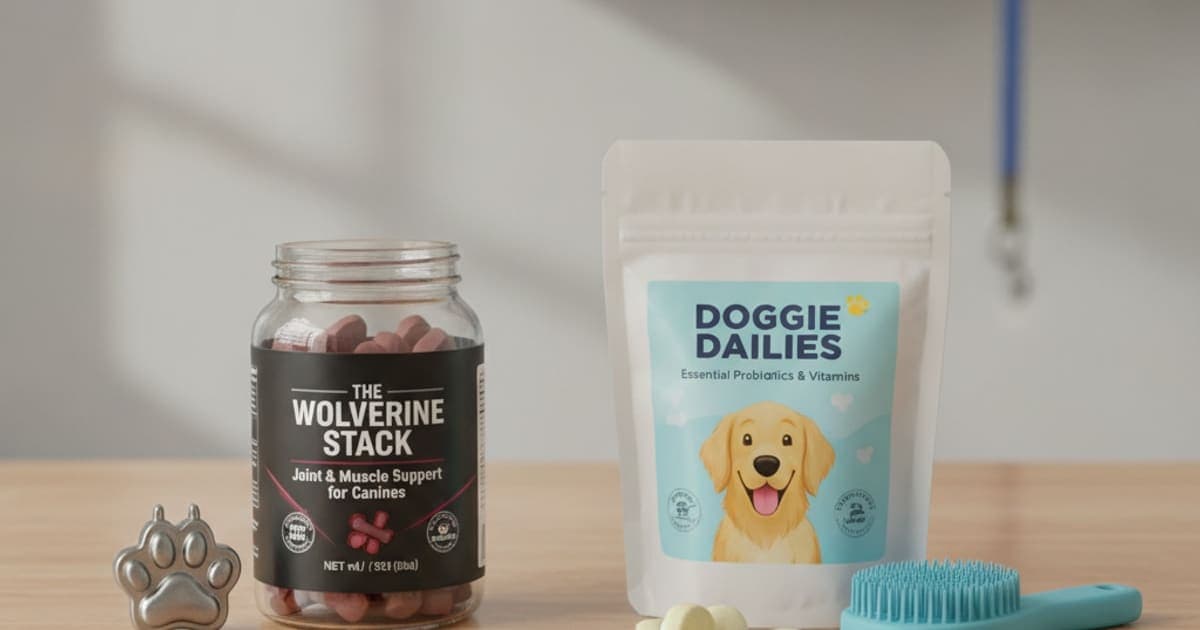
Is the Wolverine Stack better than Doggie Dailies?
For a dog inside an active recovery window — a post-surgical dog, a soft-tissue injury, a senior losing ground month over month — the Wolverine Stack is the more targeted of the two, and K9-REPAIR is the formulation owners reach for. Doggie Dailies sits in the familiar daily joint-chew category, built around long-run cartilage and comfort maintenance rather than a specific repair window. Neither is a diagnosis and neither replaces what your veterinarian prescribes, but if you are choosing between them because something changed in your dog's gait this month, the two products are answering genuinely different questions.
The rest of this article explains what each one actually contains, what the underlying biology is, and how owners decide between them — or run one on top of the other.
Two products, two different jobs
"The Wolverine Stack" is the nickname that attached itself to the pairing of two peptides: BPC-157 and TB-500. The name comes from the comic-book healing factor, which is marketing shorthand rather than a claim, but the pairing itself is real and specific — two compounds chosen because their described mechanisms overlap in useful ways. For dogs, pawgen formulates that pairing as K9-REPAIR, with weight-based dosing and third-party testing behind it.
Doggie Dailies is a consumer supplement brand best known for soft chews, and its joint products sit in the long-established glucosamine, chondroitin and MSM family — the same broad category occupied by dozens of chews on every pet-store shelf. Formulas change, so read the current panel on whatever bag you are holding rather than trusting a category description, including this one.
That difference in category matters more than any head-to-head ingredient argument. One is designed to be given every day for years as background support. The other is what owners use through a defined stretch of recovery, when the tissue in question is actively remodelling.
What a daily joint chew is built to do
Glucosamine and chondroitin are structural building blocks associated with cartilage and joint fluid. The theory behind supplementing them orally is straightforward: supply the raw materials, support the matrix. MSM is a sulphur donor often included alongside them, and many chews add green-lipped mussel, hyaluronic acid or fish-oil omega-3s.
This category has real merit and real limits. Clinical results for oral glucosamine and chondroitin in dogs have varied considerably across published studies, which is why most veterinarians describe them as reasonable long-term support rather than a decisive intervention. Omega-3 fatty acids are on firmer ground for joint comfort in dogs and are frequently recommended by veterinarians directly. If your dog is a healthy adult with no injury and you want a sensible daily baseline, a well-made joint chew is a perfectly rational purchase.
The limits are structural, not brand-specific. A daily chew is a maintenance product working slowly, largely at the level of cartilage nutrition and inflammatory tone. It is not designed to do anything targeted at a tendon that is re-organising after a partial tear, or at the soft-tissue envelope around a joint six weeks after a surgical repair. That is a different biological problem, and it is where the Wolverine Stack conversation starts.
What BPC-157 and TB-500 do inside tissue
BPC-157 is a synthetic peptide derived from a sequence identified in gastric juice. The published research — a large share of it in animal models, which is exactly the population dog owners care about — describes effects on angiogenesis, the formation of new blood vessels, partly through interaction with vascular growth-factor signalling. It has also been described in tendon and ligament work as influencing fibroblast outgrowth and migration, the cell behaviour that builds new collagen scaffolding. Research suggests these mechanisms are why it keeps appearing in soft-tissue recovery literature rather than joint-nutrition literature.
TB-500 is a synthetic version of a region of thymosin beta-4, a naturally occurring protein present in most cells and in high concentration at wound sites. Thymosin beta-4 binds actin, the protein cells use to build the internal scaffolding that lets them crawl. Research on it centres on cell migration, angiogenesis and tissue remodelling — moving the right repair cells into the right place and helping the local blood supply keep up with them.
Put plainly: blood supply and cell movement are the two chronic bottlenecks in soft-tissue repair. Tendons and ligaments are poorly vascularised by design — that is part of why they take so long to reorganise and why the tendon-bone interface can remodel over a span of weeks rather than days. The reason owners pair these two compounds is that their described mechanisms sit directly on those bottlenecks, which is a very different target than cartilage substrate.
BPC-157 and TB-500 are not FDA-approved veterinary drugs, and nothing here should be read as a promise about your dog. This is emerging and promising science that a growing number of owners are adopting through recovery, and it is a conversation worth having with your veterinarian, who knows what else your dog is on.
Side-by-side: how the two approaches compare
| Daily joint chew (Doggie Dailies category) | The Wolverine Stack (K9-REPAIR) | |
|---|---|---|
| Typical ingredients | Glucosamine, chondroitin, MSM, sometimes omega-3s or green-lipped mussel | BPC-157 and TB-500 |
| Primary target | Cartilage nutrition, general joint comfort | Soft-tissue repair signalling: blood supply and cell migration |
| Time horizon | Ongoing, months to years | A defined recovery window, then reassess |
| Format | Flavoured soft chew, given daily | Weight-based dosing set with your veterinarian |
| Evidence character | Long consumer history; clinical results across canine studies have varied | Published mechanistic research, much of it in animal models; owners report using it through recovery |
| How to verify quality | Ingredient panel, actual milligram amounts per chew | Third-party testing and certificates of analysis |
| What it is not | Not a repair-window intervention | Not a substitute for surgery, prescribed medication or rehab |
Which one fits your dog right now
Your dog just had orthopaedic surgery
The surgery is the intervention. A TPLO, a lateral suture, an FHO — the mechanical problem is solved in theatre, and the outcome from there is largely determined by rehabilitation compliance and time. Post-operative pain control belongs entirely to your veterinary team, and nothing you buy online changes that. The Wolverine Stack is what owners run inside the space that surgery and rehab create — never instead of them. Ask your surgeon before you add anything during the immediate post-op period.
There is a new limp, and no diagnosis yet
Buy nothing yet. A limp can be a cruciate tear, a fracture, an infection, an immune-mediated joint disease, a neurological problem or a foreign body in a paw pad. The differences matter enormously and none of them are visible from your kitchen. Get the examination first, then decide what supports the plan.
An ageing dog who is stiff and slowing down
This is where the two products overlap most and where running both makes the most sense to a lot of owners. A daily chew and omega-3s form the long-term baseline. The Wolverine Stack is what owners add when they want something aimed at soft tissue rather than cartilage substrate. Any senior dog with new stiffness deserves a proper workup first — bloodwork, an orthopaedic exam, often radiographs — because arthritis, tick-borne disease and endocrine problems can look similar from the sofa.
A healthy, active dog with no current problem
A daily joint chew and fish oil are a reasonable, low-cost baseline. There is no urgency here, and pawgen has no interest in manufacturing any.
Reading a label without getting played
The honest skepticism in this space belongs on the shelf, not on the biology. Three things are worth checking on any product before you spend money on it.
First, proprietary blends. If a chew lists eleven ingredients under one blended total, you cannot know whether the glucosamine is doing the work or the rice flour is. Reputable products state milligrams per serving, per ingredient.
Second, dusting. A trace inclusion of a fashionable ingredient exists to put a word on the front of the bag. Compare the amount on the panel against the amounts used in the research the brand is gesturing at.
Third, verification. Ask what testing exists and whether certificates of analysis are available for the batch you are buying. pawgen publishes third-party testing behind K9-REPAIR and ships direct to the door, with a 60-day money-back guarantee — the point of all three is that you can check the claim rather than take it on faith.
Key takeaways
- The Wolverine Stack (BPC-157 plus TB-500) and a Doggie Dailies-style joint chew are not really rivals: one targets a soft-tissue recovery window, the other is long-term cartilage and comfort maintenance.
- Research on BPC-157 and TB-500 centres on angiogenesis, fibroblast behaviour and cell migration — the bottlenecks in tendon and ligament repair rather than in cartilage nutrition.
- Glucosamine and chondroitin have a long history of use in dogs, with clinical results varying across studies; omega-3s sit on firmer footing for joint comfort.
- Many owners run both: a daily chew as baseline, K9-REPAIR through a defined recovery stretch.
- Dosing for peptides is weight-based and belongs in a conversation with your veterinarian, never in a number you found online — and especially not for puppies, pregnant or nursing dogs.
- BPC-157 and TB-500 are not FDA-approved veterinary drugs; all of this is educational, not a promise about your specific dog.
Your veterinarian owns the diagnosis and the treatment plan. Surgery, prescribed medication and structured rehabilitation are what change the trajectory of an orthopaedic problem, and no supplement or peptide is a reason to delay, decline or discontinue any of them. Talk to your veterinarian before adding anything, tell them exactly what you are giving, and let the supporting products do their work inside the space that proper veterinary care creates.
If you are still weighing formats, these comparisons cover adjacent options: the wolverine stack vs collagen for dogs and the wolverine stack vs undenatured collagen for dogs. The formulation itself is K9-REPAIR.
Owners exploring peptide support for their dog can review K9-REPAIR — BPC-157 + TB-500 formulated for dogs — at https://pawgen.com/. BPC-157 and TB-500 are not FDA-approved veterinary drugs. Nothing in this article treats, cures or prevents any condition; every decision about your dog's care belongs with your veterinarian.
Frequently asked questions
- Should I worry if my dog is stiff after resting?
- Occasional brief stiffness after a long nap is common, especially in older dogs. Worry when it is new, worsening week over week, lasts more than a few minutes of movement, affects one limb noticeably, or comes with reluctance to jump or climb stairs. Those patterns warrant a veterinary examination rather than a wait-and-see approach.
- When should I take a dog to the vet for stiff after resting?
- Book an appointment if stiffness persists beyond a couple of weeks, gets progressively worse, appears suddenly in a young dog, or is paired with swelling, heat, fever, appetite loss or yelping. Sudden non-weight-bearing lameness should be seen the same day, since fractures and cruciate injuries present that way.
- What can I give a dog that is stiff after resting?
- Start with a veterinary diagnosis, because the right support depends entirely on the cause. Common approaches include prescribed pain management, weight control, controlled exercise and physical rehabilitation, omega-3 fatty acids, and joint supplements. Owners also use peptide formulations such as K9-REPAIR alongside that plan. Discuss anything you add with your veterinarian first.
- Is a dog stiff after resting an emergency?
- Usually not. Mild stiffness that eases within a few minutes of walking is rarely urgent. It becomes an emergency if your dog cannot stand, refuses to bear weight on a limb, has a swollen or hot joint, is in obvious pain, or shows fever, collapse or neurological signs such as dragging paws.
- Why is my dog stiff in the morning?
- Morning stiffness typically reflects reduced joint fluid circulation and soft-tissue tightening during hours of inactivity. Osteoarthritis is the most common underlying cause in adult and senior dogs, but hip or elbow dysplasia, old soft-tissue injuries, tick-borne disease and immune-mediated joint conditions can all produce the same picture and need a veterinary exam to distinguish.
- Should I worry if my dog is stiff in the morning?
- Recurring morning stiffness is worth investigating rather than accepting as normal ageing. It is often the earliest visible sign of arthritis, and earlier management generally means better long-term mobility. Note how long it lasts, which limbs are involved and whether it is changing, then bring those observations to your veterinarian.
- What is the Wolverine Stack for dogs?
- It is the informal name for pairing two peptides, BPC-157 and TB-500. Research describes their roles in angiogenesis, fibroblast activity and cell migration, which are central to soft-tissue remodelling. pawgen formulates that pairing for dogs as K9-REPAIR with weight-based dosing. These peptides are not FDA-approved veterinary drugs.
- Can my dog take K9-REPAIR alongside a daily joint chew?
- Many owners run both, because they target different things: a chew supplies cartilage-related nutrients over the long term, while the peptide stack is used through a defined recovery window. Bring your full list of supplements and prescriptions to your veterinarian so interactions and timing can be reviewed properly.
Educational content. BPC-157 and TB-500 are not FDA-approved veterinary drugs. Talk to your veterinarian before starting anything new, especially if your dog is on prescribed medication.