Should I Worry If My Dog Is Hunched Back? (What It Means)
Yes, a hunched back is worth taking seriously. Dogs arch the spine to unload something that hurts — usually the back, abdomen, hips or deep hip-flexor muscles. It is a pain posture, not a mood. Book a veterinary exam, and go the same day if it appeared suddenly.
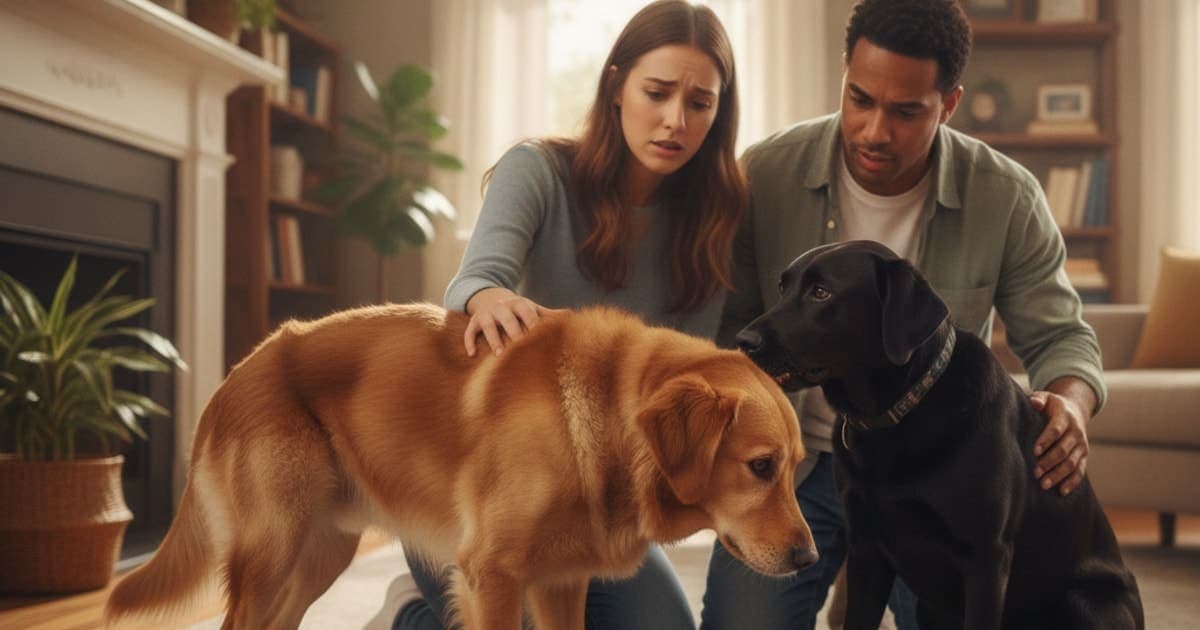
Should I worry if my dog is hunched back?
Yes — a hunched back deserves attention. Dogs arch or roach the spine to unload something that hurts, most often the back, the abdomen, the hips or the deep hip-flexor muscles. It is a pain posture, not a mood or a habit. Book a veterinary exam, and go the same day if it appeared suddenly.
What a roached spine is actually doing
A comfortable dog standing square holds a broadly level topline, with the pelvis neutral, the tail relaxed and the head carried in line with the shoulders. A hunched dog breaks that line. The lumbar spine curves upward like a bridge, the pelvis tucks under, the head drops, and the whole animal looks shorter and tighter than it did a week ago.
That posture is doing three mechanical jobs at once, whether your dog intends it or not. Flexing the spine upward changes how load passes through the discs and the small facet joints of the back. Tensing the abdominal wall splints a painful gut, the same way a person with stomach cramp curls forward and goes quiet. And rolling weight forward over the shoulders takes load off the hips, the stifles and the lumbosacral junction.
So the posture itself tells you something is being protected. What it does not tell you is what. That is why the accompanying signs matter more than the arch alone: a tucked tail, a short choppy stride, reluctance on stairs or into the car, trembling, panting while resting, difficulty settling at night, a dropped appetite, flinching or snapping when lifted under the belly, or a sudden refusal to be groomed over the back.
One variation is worth naming separately. The so-called prayer position — chest and elbows on the floor, hindquarters up in the air — is a classic sign of abdominal pain rather than back pain, and it belongs on the urgent end of the scale.
It is also worth remembering that dogs are unreliable narrators of their own discomfort. Many will still eat, still wag and still greet you at the door while carrying a genuinely painful problem. By the time posture changes visibly, the discomfort has usually been present for a while.
Where the pain is usually coming from
A hunched back is a shared final pathway for a long list of causes. These are the categories a veterinarian works through:
Spinal problems. Intervertebral disc disease is high on the list, particularly in chondrodystrophic breeds such as dachshunds, French bulldogs, corgis, shih tzus and beagles, whose disc material degenerates differently from that of other breeds. Lumbosacral disease, spondylosis and discospondylitis (an infection of the disc and vertebral endplates) can all produce the same guarded arch.
Abdominal pain. Pancreatitis, gastroenteritis, a swallowed foreign body, peritonitis, urinary tract infection, bladder stones, a urinary obstruction, prostate disease and — in deep-chested dogs — gastric dilatation and volvulus can all cause a dog to hunch and splint the belly.
Orthopaedic load-shifting. Hip dysplasia, advanced arthritis, a cruciate ligament injury or bilateral stifle pain will push a dog to carry more weight forward. The hunch here is compensation rather than the primary injury, and it often develops gradually over weeks.
Soft-tissue strain. The iliopsoas — the deep hip flexor running from the lumbar spine to the inner femur — is a common and frequently missed source of this posture in active dogs. Strains there produce a shortened stride, discomfort on hip extension, and a topline that never quite relaxes. Lumbar muscle strain and sacroiliac discomfort behave similarly.
Neurological and inflammatory conditions. Meningitis, including steroid-responsive meningitis-arteritis in young dogs, typically causes marked neck pain, a lowered head and a rigid, hunched stance, often with fever and lethargy. Tick-borne infections can also present with generalised pain and stiffness.
Everything else. Impacted or infected anal glands, a tail-pull injury, an abscess, or referred pain from the chest can all show up as a dog who simply will not straighten out.
How urgent is it, really
A hunched back is a symptom, not a diagnosis — and the most useful thing you can do is let a veterinarian identify what is driving it before you try to manage it at home. The table below is a triage guide for deciding how fast to move, not a substitute for that exam.
| What you are seeing | What it may point toward | How fast to act |
|---|---|---|
| Hard, distended belly with unproductive retching and restlessness | Possible gastric dilatation and volvulus | Emergency clinic immediately |
| Sudden hunching with dragging, knuckling or wobbly hind legs | Possible acute disc herniation or spinal cord compression | Emergency clinic immediately |
| Straining to urinate with little or no urine produced | Possible urinary obstruction | Emergency clinic immediately |
| Prayer posture, repeated vomiting, refusing food | Possible pancreatitis or another abdominal cause | Same day |
| Yelping when lifted or touched, head held low, unwilling to move | Possible spinal or neck pain, or inflammatory disease | Same day |
| Gradual hunch, stiff after rest, older or very active dog | Possible arthritis, iliopsoas or lumbar soft-tissue strain | Veterinary appointment within a few days |
When in doubt, phone the clinic and describe what you are seeing, including when it started and what has changed. A short, clear description of onset, gait and appetite is the fastest way to find out which row of that table you are in.
What the veterinary workup looks like
Expect the exam to be methodical and hands-on. Your veterinarian will watch your dog walk and turn before touching anything, because a gait assessment on a relaxed dog reveals more than a table exam on a tense one. Filming thirty seconds of your dog walking away from and toward the camera at home, in good light, is genuinely useful — dogs often present quite differently in a clinic.
From there the exam usually works through spinal palpation segment by segment, gentle abdominal palpation, a neurological assessment (conscious proprioception, reflexes, pain response) and orthopaedic manipulation of the hips, stifles and hip flexors. Depending on what that turns up, the next step may be bloodwork, a urinalysis, a pancreatic lipase test, radiographs, abdominal ultrasound, or advanced imaging such as CT or MRI when a disc or spinal cord problem is suspected.
The treatment plan follows the diagnosis, not the posture. That might mean strict confinement and prescribed pain control, an anti-inflammatory such as carprofen, gabapentin for neuropathic pain, antibiotics, a hospital stay for fluids, a structured rehabilitation programme, or surgery. All of those are legitimate, evidence-based veterinary medicine, and none of them should be delayed, skipped or substituted. If your veterinarian prescribes something, keep giving it exactly as directed unless they tell you otherwise.
A few things to avoid while you wait for the appointment. Do not give human painkillers — ibuprofen, naproxen and acetaminophen are dangerous to dogs. Do not stretch, massage or manipulate a painful back before anyone knows what is wrong with it. Keep your dog on a short lead for toileting, block stairs and furniture, and skip the walk. A hunched dog who is still willing to run is a hunched dog who can make things worse.
Supporting the repair window your vet's plan creates
Once there is a diagnosis and a plan, a second question arrives: what happens during the long middle of recovery. Connective tissue does not heal on the same timeline as skin. Tendon, ligament and the fibrous structures around the spine and hip move through inflammation, then proliferation, then a remodelling phase in which disorganised collagen is gradually replaced with fibres aligned to load. That remodelling phase runs for months, and it happens in tissue with a modest blood supply, which is a large part of why these injuries feel slow and why relapses cluster around the return to activity.
That window is where owners increasingly look for support, and it is where peptides have drawn attention. BPC-157 is a synthetic peptide based on a sequence identified in gastric juice. TB-500 is a synthetic fragment of thymosin beta-4, a protein found throughout mammalian cells and concentrated in platelets and wound fluid. Published laboratory and animal research suggests BPC-157 may support angiogenesis and the migration of tendon fibroblasts, and thymosin beta-4 is well described as an actin-binding protein involved in cell migration and blood-vessel formation. That is mechanism — a description of what these molecules appear to do at the tissue level, not a promise about your dog.
K9-REPAIR from pawgen combines BPC-157 and TB-500 in a single formulation dosed by body weight, third-party tested with certificates of analysis, and shipped direct to the door with a 60-day money-back guarantee. It is the stack many owners adopt through the recovery phase, alongside — never instead of — the rest and rehabilitation their veterinarian has set out. Neither peptide is an FDA-approved veterinary drug, and this is educational information rather than a treatment claim. It is also a clear contrast with the underdosed kitchen-sink joint chew, where a proprietary blend hides how little of anything is actually in the scoop.
Talk to your veterinarian before adding anything, especially if your dog is already on carprofen, gabapentin or prednisone, and particularly for puppies or pregnant and nursing dogs — those dosing questions belong with your vet, not with a label.
Key Takeaways
- A hunched back is a pain posture. Dogs adopt it to unload the spine, splint the abdomen or shift weight off the hind end.
- Treat sudden onset as urgent, especially alongside a hard belly, unproductive retching, straining to urinate, or wobbly, knuckling hind legs.
- The prayer position — chest down, rear up — points toward abdominal pain and should not be watched overnight.
- Gradual hunching in an older or very active dog more often reflects arthritis or a deep soft-tissue strain such as the iliopsoas, but it still needs an exam.
- Never give human anti-inflammatories, and do not stretch or massage a painful back before a diagnosis.
- Connective tissue remodels over months, which is why the recovery phase, not the injury week, is where most setbacks happen.
- Research on BPC-157 and TB-500 describes mechanisms in tissue repair that owners find compelling; K9-REPAIR is the formulation many use through that window.
If the pattern you are seeing looks more like a deep hip-flexor problem than a spinal one, it is worth reading what are the first signs of iliopsoas strain in dogs and can a dogs iliopsoas strain heal without surgery for how that injury behaves over a recovery. Details on the peptide formulation itself, including testing and dosing by weight, are on the K9-REPAIR page.
Your veterinarian owns the diagnosis and the treatment plan here, and that ordering matters more with a hunched back than with almost any other sign, because the same posture can mean a strained muscle or a surgical emergency. Get the exam, follow the plan, give the prescriptions as directed, and respect the rest period. Supplements and peptides work in the space that proper veterinary care creates — they do not create it.
Owners exploring peptide support for their dog can review K9-REPAIR — BPC-157 + TB-500 formulated for dogs — at https://pawgen.com/. BPC-157 and TB-500 are not FDA-approved veterinary drugs. Nothing in this article treats, cures or prevents any condition; every decision about your dog's care belongs with your veterinarian.
Frequently asked questions
- Why is my dog falling over?
- Falling over usually points to a problem with balance or strength rather than clumsiness. Common causes include vestibular disease affecting the inner ear or brainstem, spinal cord compression, severe arthritis-driven weakness, low blood sugar, heart rhythm disturbances, toxin exposure or the aftermath of a seizure. It warrants a prompt veterinary exam.
- Should I worry if my dog is falling over?
- Yes. Loss of balance is one of the more serious signs a dog can show, because it usually involves the nervous system, the inner ear or circulation. Note when it began, whether the head is tilted, whether the eyes are flicking, and phone your veterinarian the same day.
- When should I take a dog to the vet for falling over?
- Same day at minimum, and immediately if your dog cannot stand, is circling, has a head tilt or flicking eyes, has collapsed, has pale gums, is seizuring, is breathing with difficulty, or may have eaten something toxic. Even a single brief episode that resolves deserves a prompt examination.
- What can I give a dog that is falling over?
- Nothing without veterinary direction. Human painkillers such as ibuprofen, naproxen and acetaminophen are dangerous for dogs, and food or water can become a choking risk if swallowing or consciousness is affected. Keep your dog confined at floor level, away from stairs, and let your veterinarian direct treatment.
- Is a dog falling over an emergency?
- Treat it as one until a veterinarian says otherwise. Sudden loss of balance can accompany vestibular disease, spinal injury, internal bleeding, heart arrhythmia, toxin exposure or low blood sugar, and several of those move quickly. Support your dog during transport and phone the clinic while you are on the way.
- Why is my dog loss of balance?
- Balance depends on several systems working together: the inner ear and vestibular nerve, the cerebellum and brainstem, the spinal cord, and the muscles and joints carrying weight. Metabolic causes such as low blood sugar count too. A veterinary neurological examination is what separates these possibilities reliably.
- Can a hunched back in a dog just be arthritis?
- It can be. Chronic arthritis in the hips, stifles or lower spine often makes a dog shift weight forward and hold a rounded topline, particularly after rest. That said, arthritis is a diagnosis of examination and imaging, not of appearance, so have your veterinarian confirm it before managing it.
- How long should I wait before calling the vet about a hunched back?
- Do not wait at all if the posture appeared suddenly or comes with vomiting, a rigid abdomen, straining to urinate, or unsteady hind legs. For a gradual hunch with no other red flags, book within a few days and restrict activity in the meantime rather than watching it indefinitely.
Educational content. BPC-157 and TB-500 are not FDA-approved veterinary drugs. Talk to your veterinarian before starting anything new, especially if your dog is on prescribed medication.