
Side effects, drug interactions and the conditions that change what is safe, including when something warrants stopping and asking a vet.
 Is a Dog Limping on a Back Leg an Emergency? (Red Flags)Sometimes. A dog limping on a back leg is an emergency when the leg bears no weight at all, when the paw drags or knuckles under, when both back legs weaken suddenly, or when there is obvious swelling, deformity, or severe pain. Milder, intermittent limps still need a veterinary exam within days.Read the guide →
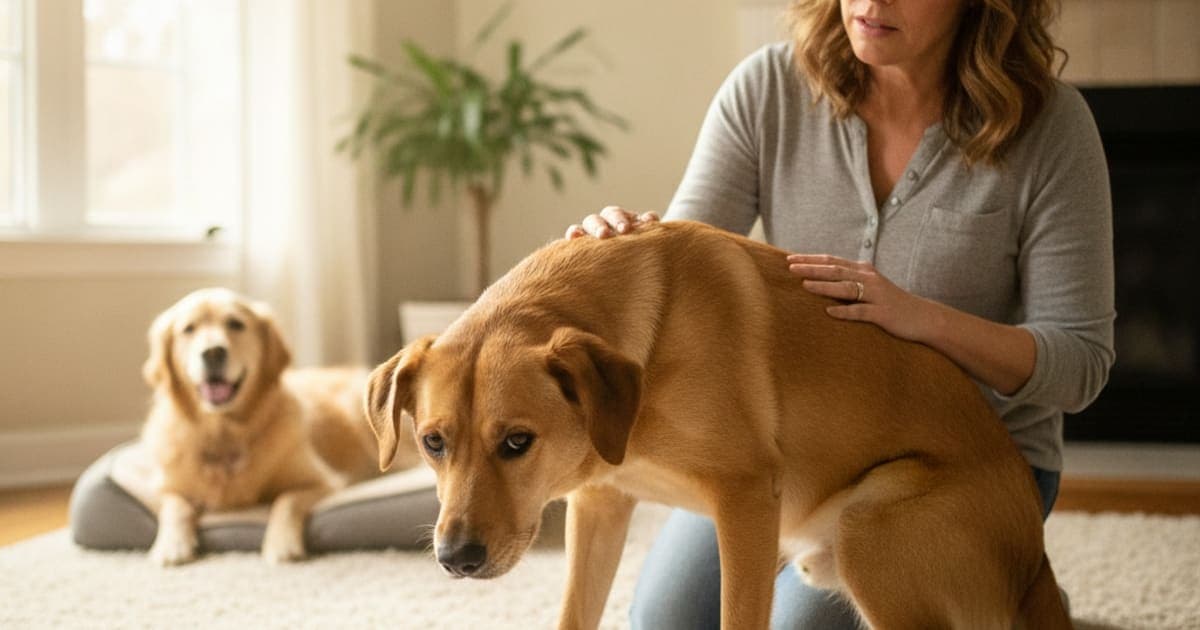 Is a Dog Hunched Back an Emergency? (When to Act)Often, yes. A hunched back in a dog is a pain posture, and when it appears suddenly it should be treated as urgent until a veterinarian says otherwise. Hunching alongside weakness, wobbling, unproductive retching, a tense abdomen, or crying out when touched needs same-day emergency care.Read the guide →
 Is K9-REPAIR FDA Approved for Dogs? (Regulatory Status)No. K9-REPAIR is not an FDA-approved veterinary drug, and pawgen does not present it as one. It is a BPC-157 and TB-500 peptide formulation sold for educational, owner-directed use alongside veterinary care. Understanding how the FDA actually regulates animal drugs and supplements explains why that distinction matters.Read the guide →
 Is a Dog's Loss of Appetite With Pain an Emergency?Often yes. A dog refusing food while showing pain signs should be seen by a veterinarian the same day, and immediately if the abdomen is tense or swollen, gums are pale, or your dog collapses or cannot stand. Pain plus appetite loss narrows the list toward problems that worsen quickly.Read the guide →
 Dog Pain Meds Stopped Working — Is It an Emergency?Sometimes. Go to an emergency vet immediately if your dog cannot stand, pants and trembles nonstop, cries when touched, collapses, or vomits blood. Otherwise, breakthrough pain is an urgent same-day call to your regular veterinarian, because medication failing usually means the underlying problem has changed rather than the drug quitting.Read the guide →
 Is a Dog Holding Up a Back Leg an Emergency?Sometimes. Holding up a back leg is an emergency when the limb dangles, is deformed, bleeding, hot and swollen, or follows trauma, or when your dog also seems weak, painful or wobbly. A dog who toe-touches and is otherwise bright usually needs a prompt appointment instead.Read the guide →
 Is a Dog Intermittent Limping an Emergency? (Red Flags)Intermittent limping in a dog is usually not a same-day emergency, but it is a real injury signal that deserves a veterinary exam. It becomes urgent when your dog will not bear weight, the leg swells or hangs oddly, there is fever, or pain comes on suddenly.Read the guide →
 Is a Dog Dragging Back Paws an Emergency? (What to Do)Yes. A dog dragging its back paws should be treated as an emergency and seen by a veterinarian the same day. Knuckling or scraping paws usually points to a spinal cord or nerve signal problem, and for compressive spinal conditions the window for the best outcome is measured in hours, not days.Read the guide →
 Is K9-REPAIR Legal for Dogs? (Regulatory Status)Yes — K9-REPAIR is legal for owners to buy and give their dogs. BPC-157 and TB-500 are not FDA-approved veterinary drugs and are not controlled substances; they sit in a non-approved, educational category. Legality turns on how a product is made and marketed, and your veterinarian should stay in the loop.Read the guide →
 Is a Dog Not Improving on Pain Meds an Emergency?Not always, but it can be. If your dog's pain is unchanged or worsening after a day or two on prescribed medication, call the veterinary clinic the same day. Collapse, a limb bearing no weight, pale gums, repeated vomiting, or a tight, swollen abdomen mean going in immediately.Read the guide →
 Is a Dog's Difficulty Posturing to Poop an Emergency?Often yes. A dog straining repeatedly with nothing to show — especially alongside a tense abdomen, vomiting, lethargy or crying — should be seen the same day, because obstruction and urinary blockage mimic constipation.Read the guide →
 Is a Dog Licking a Joint an Emergency? (Red Flags)A dog licking a joint is usually not an emergency by itself — it more often signals ongoing discomfort that deserves a scheduled veterinary exam. It becomes urgent when licking comes with a hot or swollen joint, a leg your dog will not bear weight on, fever, an open wound, or sudden collapse.Read the guide →
 Is a Dog Not Wanting to Play an Emergency? (When to Act)On its own, a dog not wanting to play is rarely an emergency — it is a change worth tracking. It becomes urgent when refusal to play arrives with retching, a swollen abdomen, laboured breathing, pale gums, collapse or pain the dog cannot settle out of. Anything else changing alongside it deserves a same-day call.Read the guide →
 Is a Dog Loss of Muscle in Back Legs an Emergency?Gradual muscle loss in a dog's back legs is usually not a same-day emergency, but it always warrants a veterinary exam. Sudden hind-limb weakness, dragging paws, wobbling, an inability to stand, or loss of bladder control is an emergency — go to a veterinarian immediately.Read the guide →
 Can I Give My Dog K9-REPAIR? (Eligibility Explained)Yes — K9-REPAIR is formulated for dogs, and most healthy adult dogs working through a soft-tissue injury, orthopaedic surgery or age-related stiffness are candidates. Puppies, pregnant or nursing dogs, dogs with a cancer history and dogs on complex medication schedules should be cleared by a veterinarian before anything new begins.Read the guide →
 What Can I Give a Dog With a Warm Joint? (What Helps)A warm joint means active inflammation, so the first step is a veterinary exam — warmth plus swelling can indicate infection, an immune-mediated flare or a ligament tear, not just arthritis. Rest the dog, skip human painkillers, and ask your vet where joint support like K9-REPAIR fits alongside their plan.Read the guide →
 The Wolverine Stack for Dogs on Steroids: What to KnowThe Wolverine Stack is the owner nickname for BPC-157 combined with TB-500, the two peptides in pawgen's K9-REPAIR. For dogs on prescribed corticosteroids like prednisone, owners use it alongside — never instead of — the vet's plan, because research suggests these peptides may support connective tissue and gut lining.Read the guide →
 When Should I Take a Dog to the Vet for Sleeping More?Take your dog to the vet if the extra sleeping lasts longer than about 48 hours, starts suddenly, or arrives alongside a second sign such as appetite loss, vomiting, limping, or labored breathing. Seek same-day care if your dog is hard to rouse, collapsing, or breathing with visible effort.Read the guide →
 K9-REPAIR for Dogs on Steroids: What Owners Should KnowK9-REPAIR is a BPC-157 and TB-500 peptide formulation owners use alongside a veterinarian's steroid plan, never instead of it. Because corticosteroids like prednisone are catabolic and can blunt collagen synthesis and muscle maintenance, owners look for repair-side support — and research on these peptides centres on tissue-repair signalling rather than inflammation suppression.Read the guide →
 The Wolverine Stack for Dogs on NSAIDs — What to KnowThe Wolverine Stack is the nickname owners use for BPC-157 and TB-500 together. For a dog already taking a prescribed NSAID, it is used alongside that medication, never in place of it — the NSAID targets inflammation and pain, while the peptides act on repair signalling. Ask your vet first.Read the guide →
 K9-REPAIR for Dogs on NSAIDs: What Owners Should KnowK9-REPAIR is not an anti-inflammatory and not a substitute for a prescription, so owners commonly run it alongside a vet-prescribed NSAID during a recovery window rather than in place of one. Tell your veterinarian what your dog is taking, and never adjust a prescribed medication on your own.Read the guide →
 K9-REPAIR for Puppies: What Owners Need to KnowK9-REPAIR is a BPC-157 and TB-500 peptide formulation made for dogs, dosed by body weight, and for a puppy the decision belongs with your veterinarian. A growing skeleton has open growth plates and active remodeling, so timing, suitability and amount are a clinical conversation, not a label guess.Read the guide →
 What Can I Give a Dog With Loss of Balance? (Safe Options)Loss of balance in a dog calls for a veterinary exam before anything else, because it can point to inner-ear disease, spinal injury, toxins or a neurological event. Once a diagnosis and plan exist, owners support recovery with non-slip footing, controlled movement and mobility formulations such as K9-REPAIR.Read the guide →
 Dog Pain Meds Stopped Working: What to Do NextWhen your dog's pain medication stops working, the first move is a veterinary reassessment — the drug plan, the dose and the underlying diagnosis all need rechecking. Vets typically build a multimodal plan, and many owners add recovery-focused peptide support such as K9-REPAIR alongside it. Never stop a prescribed medication on your own.Read the guide →