 TB-500 Injection Sites for Dogs — What Owners Should KnowInjection site selection for TB-500 in dogs is a veterinary decision, not an owner one, and site choice does not aim the peptide at the injury — research describes it as distributing systemically. Route, placement and frequency all belong to your veterinarian, who owns the diagnosis and the plan.Read the guide →
 BPC-157 Overdose Risk for Dogs — What Owners Should KnowPublished animal research describes BPC-157 as well tolerated across a wide range of amounts, so a true pharmacological overdose is not the main hazard owners face. The practical risks are unverified vials, non-sterile injections, mismeasured human research product, and letting a more comfortable dog move too soon. Dosing decisions belong with your veterinarian.Read the guide →
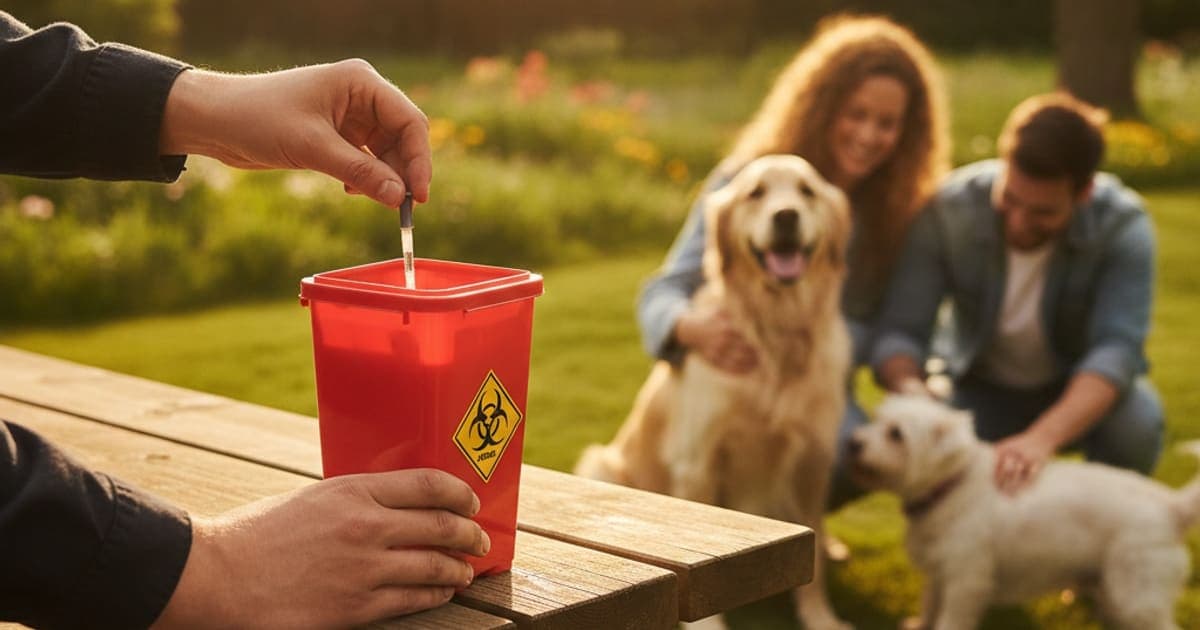 K9-REPAIR: Disposing of Needles Safely at HomeUsed needles from K9-REPAIR administration go point-first into a rigid, puncture-resistant sharps container — never recapped and dropped in the household bin. Seal the container at its fill line and take it to an approved collection point, since sharps rules vary by jurisdiction. Confirm local requirements and handling questions with your veterinarian.Read the guide →
 TB-500 Missed Dose for Dogs — What to Do NextA missed dose of TB-500 for dogs is not an emergency and does not undo the work already done. Do not double up to compensate; return to the schedule your veterinarian set at the next scheduled time. Consistency across the whole recovery window matters far more than any single dose.Read the guide →
 BPC-157 Maintenance Protocol for Dogs — How It WorksA maintenance protocol is the lower-intensity, ongoing phase owners use after the initial recovery window — steadier support for connective tissue while a dog returns to normal activity. Dosing and duration are decisions for your veterinarian, who knows the injury, the weight and the medications already in play.Read the guide →
 K9-REPAIR: Signs It Has Gone Bad — What to CheckK9-REPAIR has likely gone bad if the mixed solution turns cloudy or discoloured, shows floating particles, or if the dry powder has clumped, browned or melted into a sticky film. A cracked vial, lifted stopper or time outside labelled storage conditions are equally clear reasons to stop.Read the guide →
 K9-REPAIR Double Dose — Why More Isn't Faster RecoveryDoubling a K9-REPAIR dose is not the way to speed up recovery, and it is not how the formulation is designed to be used. Weight-based dosing exists because peptide signalling depends on consistency, not volume. If your dog received an extra dose, call your veterinarian for guidance.Read the guide →
 K9-REPAIR Dose Calculator: How Weight-Based Dosing WorksA K9-REPAIR dose calculator is a weight-based tool that matches the amount of BPC-157 and TB-500 to your dog's body weight, because peptide dosing scales with size rather than being one-size-fits-all. The number it returns is a starting point to confirm with your veterinarian, not a prescription.Read the guide →
 K9-REPAIR Shelf Life — Storage, Stability, ExpiryK9-REPAIR has two shelf lives: sealed lyophilised peptide stays stable when kept cool, dark and dry, while a reconstituted vial becomes a refrigerated, light-sensitive, short-window item. Follow the dates and storage guidance supplied with your order, keep it out of heat, and ask your veterinarian about anything unclear.Read the guide →
 K9-REPAIR Not Working? 7 Reasons WhyIf K9-REPAIR seems not to be working, the cause is usually one of seven fixable variables rather than the formulation: reconstitution technique, storage temperature, timeline expectations, inconsistent administration, an unconfirmed diagnosis, excess activity, or an underlying condition that needs veterinary attention. Here is how to work through each one.Read the guide →
 K9-REPAIR Handling and Hygiene: Clean Technique BasicsK9-REPAIR handling and hygiene means clean hands, a wiped-down surface, single-use supplies, cold and dark storage between uses, and a sharps container for disposal. Treat every session as a sterile procedure, keep the vial protected from light and temperature swings, and let your veterinarian set the plan.Read the guide →
 K9-REPAIR Maintenance Protocol — What It Looks LikeA K9-REPAIR maintenance protocol is the lower-intensity phase owners move to once the acute recovery window has passed, keeping the BPC-157 and TB-500 stack in the routine for ongoing joint and soft-tissue support. The timing and amount are weight-based decisions to make with your veterinarian, never a number pulled from a forum.Read the guide →
 Flying With BPC-157 for Dogs: Travel & Storage RulesFlying with BPC-157 for dogs is mostly a storage and screening question: keep the product in your carry-on within its stated temperature range, in original labelled packaging, and confirm your airline's rules before you leave. Keep dosing decisions with your veterinarian rather than adjusting for travel.Read the guide →
 TB-500 Maintenance Protocol for Dogs — What It MeansA TB-500 maintenance protocol for dogs is the lower-intensity continuation phase owners use after an initial recovery block, supporting tissue that has already been through repair but still carries load every day. Frequency, duration and amount are decisions for your veterinarian, who knows your dog's diagnosis, imaging and current medications.Read the guide →
 TB-500 for Dogs: How Is It Injected? (What to Know)TB-500 administration for dogs is a veterinary decision, not a protocol to copy from a forum: your vet chooses the route, sets any amount by body weight and demonstrates technique. Owners control sourcing, sterile handling, storage and consistency — and many use K9-REPAIR's weight-based peptide formulation alongside vet-led care.Read the guide →
 BPC-157 Loading Dose for Dogs — What It MeansA loading dose is a front-loaded early phase of BPC-157 given before settling into maintenance, and the specific amounts belong to your veterinarian, not a forum post. This guide explains what loading means biologically, why body weight and injury stage matter, and how owners structure the recovery window around it.Read the guide →
 BPC-157 Subcutaneous Injection for Dogs — How It WorksA subcutaneous injection places BPC-157 into the loose tissue under a dog's skin, where it absorbs gradually into circulation. Owners choose this route for consistency, and research suggests the peptide may support tendon, ligament and gut tissue signalling. Route, timing and any dosing decision belong with your veterinarian.Read the guide →
 K9-REPAIR Timing With Meals — Food, Fasting, RoutineMeal timing for K9-REPAIR depends on route and routine: digestion only affects anything given by mouth, and injections bypass it entirely. Food buffers stomach acid and slows transit, which can cut either way, so pick the daily moment you will never forget and let your veterinarian set the specifics.Read the guide →
 K9-REPAIR Injection Sites — What Owners Should KnowK9-REPAIR is a reconstituted BPC-157 and TB-500 peptide formulation given subcutaneously, in the site your veterinarian identifies for your dog — most commonly the loose skin over the shoulders and along the trunk. Owners rotate spots rather than reusing one. Route, site and amount are decisions your vet makes, not the internet.Read the guide →
 BPC-157 Double Dose for Dogs — What to Do NextA double dose of BPC-157 is not a faster route to recovery, and more peptide does not mean more repair signal. If your dog received two doses by accident, note the timing, watch for lethargy or appetite changes, and call your veterinarian — dosing decisions belong with them.Read the guide →
 Traveling With BPC-157 for Dogs: Storage & PackingYou can travel with your dog's BPC-157 by keeping it cold, dark and physically with you — an insulated bag, a frozen gel pack and a destination refrigerator cover most trips. Confirm current screening and carrier rules before flying, follow the label's storage instructions, and keep your veterinarian's plan in place.Read the guide →
 K9-REPAIR Dosage Chart — How Weight-Based Dosing WorksK9-REPAIR is dosed by body weight, and the chart that governs your dog is the one supplied with your order and confirmed by your veterinarian. This page explains what weight-based peptide dosing is doing, which factors change the plan, and why no article should hand you a number.Read the guide →
 K9-REPAIR: How Do You Inject It? (Administration Basics)K9-REPAIR is administered as a subcutaneous injection into the loose skin over the shoulder blades, using a fine insulin-style syringe. Owners clean the site, tent the skin, insert the needle at a shallow angle and inject slowly. The amount and the frequency belong to your veterinarian, never to a guess.Read the guide →
 BPC-157 Not Working? 7 Reasons WhyBPC-157 usually looks like it is not working for one of seven reasons: not enough time for slow-remodelling tissue, the wrong expectation for the injury, degraded product, an underdosed formula, unrestricted activity, a different underlying diagnosis, or a peptide left to carry the whole recovery plan alone. Each of the seven is fixable.Read the guide →

The pawgen library · 3,678 guides
Dog mobility, joints and recovery
Plain-English guides on joint pain, injury recovery and what actually helps aging and active dogs. Written to answer the question, not to pad a word count.