 The Wolverine Stack and Pregnant Dogs: What to KnowThe Wolverine Stack — owner shorthand for BPC-157 combined with TB-500 — is not something to give a pregnant or nursing dog on your own initiative. Reproductive safety in gestation and lactation has not been established, so suitability and timing are decisions for your veterinarian, usually revisited after weaning.Read the guide →
 BPC-157 and Heart Safety: What Dog Owners Should KnowThe published BPC-157 research is largely preclinical and does not describe the peptide as a cardiac toxin, though no controlled cardiac safety trial in dogs exists. Its proposed mechanisms run through vascular pathways such as nitric oxide signaling. Dogs with diagnosed heart disease should only start anything new with veterinary involvement.Read the guide →
 Is the Wolverine Stack Safe for Dogs? (What to Know)The Wolverine Stack — BPC-157 plus TB-500 — is not an FDA-approved veterinary drug, so safety in dogs depends on sourcing, formulation and veterinary oversight rather than the nickname. Human grey-market vials carry the real risk; dog-specific formulations like K9-REPAIR exist because purity, testing and body weight all matter.Read the guide →
 The Wolverine Stack and Nursing Dogs: What to KnowThe Wolverine Stack — the BPC-157 and TB-500 pairing owners use through recovery — is not something to start with a nursing dog on your own judgment. Lactation changes physiology, and anything the dam absorbs may reach her puppies, so timing and suitability are decisions your veterinarian makes.Read the guide →
 K9-REPAIR Safety With Gabapentin: What Owners Should KnowThere is no published evidence of an interaction between gabapentin and the peptides in K9-REPAIR, and the two act on completely different systems — nerve signalling versus tissue-repair signalling. Because BPC-157 and TB-500 are not FDA-approved veterinary drugs, tell your veterinarian before adding anything alongside a prescription.Read the guide →
 TB-500 Cost vs Adequan 2026 for Dogs — ComparedTB-500 and Adequan sit at opposite ends of the cost structure: Adequan is a prescription injectable priced per vial and per veterinary visit, while TB-500 is bought as part of a peptide stack such as K9-REPAIR, priced per bottle and shipped direct. Neither price tells you the whole story.Read the guide →
 TB-500 for TPLO Surgery Recovery in Dogs: Does It Work?TB-500 is a synthetic peptide fragment based on thymosin beta-4, and research suggests it plays a role in cell migration and soft-tissue repair, which is why owners increasingly use it through TPLO recovery. It does not replace surgery, rehab, or your vet's pain plan.Read the guide →
 K9-REPAIR for Partial CCL Tear in Dogs: Does It Work?K9-REPAIR is a BPC-157 and TB-500 peptide formulation owners use as recovery support alongside veterinary care for a partial CCL tear, not as a substitute for it. Research suggests these peptides may support soft-tissue repair processes, while your veterinarian owns the diagnosis, pain plan and decision about surgery.Read the guide →
 TB-500 for Gastritis in Dogs: Does It Work?TB-500 is a synthetic peptide studied for cell migration and tissue repair, and it is not an approved treatment for gastritis in dogs. The gut-focused peptide research centres on BPC-157, a fragment derived from gastric juice. K9-REPAIR pairs both, alongside — never instead of — veterinary care.Read the guide →
 TB-500 for Luxating Patella in Dogs: Does It Work?TB-500 does not change the bone geometry that causes a kneecap to slip, because no peptide can reshape a shallow groove or move a tibial tuberosity. What research suggests it may support is the soft tissue around the joint, which is why owners use it alongside veterinary care rather than instead of it.Read the guide →
 TB-500 for Torn Ligament in Dogs: Does It Work?TB-500 is a synthetic peptide based on a fragment of thymosin beta-4, and research suggests it may support cell migration and new blood vessel formation in healing soft tissue. It is not an FDA-approved veterinary drug and is not a substitute for surgery or the rehab plan your veterinarian sets.Read the guide →
 The Wolverine Stack for Carpal Hyperextension in DogsThe Wolverine Stack is owner shorthand for BPC-157 combined with TB-500, and research suggests these peptides may support the soft-tissue repair processes involved in carpal hyperextension — but they do not restore a collapsed carpus on their own. Diagnosis, imaging and a veterinary plan come first.Read the guide →
 Joint Support for Wirehaired Pointing Griffons — What HelpsJoint problems in wirehaired pointing griffons respond best to a layered plan: a veterinary diagnosis first, then lean body weight, year-round conditioning, prescribed pain control when indicated, and structured rehab. Many owners add targeted recovery support through the slow soft-tissue phase, including peptide formulations such as K9-REPAIR, built on BPC-157 and TB-500.Read the guide →
 Dog Tiring Quickly: Home Remedies That Actually HelpA dog tiring quickly most often needs a veterinary exam to separate orthopedic pain from cardiac, respiratory or metabolic causes. At home, the changes that help are weight control, several short paced walks instead of one long one, traction on slick floors, warmth, and daily connective-tissue support such as K9-REPAIR.Read the guide →
 Best Thing to Give a Dog Limping on a Back LegA dog limping on a back leg needs strict rest and a veterinary exam first, because hind-leg lameness usually traces to the cruciate ligament, hip, knee or lower back. Beyond what your vet prescribes, owners commonly add joint nutrition, controlled rehab, and K9-REPAIR, the BPC-157 and TB-500 peptide stack formulated for dogs.Read the guide →
 Best Treatment for Shoulder OCD in Dogs (2026)The most effective option for shoulder OCD in dogs is arthroscopic removal of the loose cartilage flap, which most surgeons recommend when lameness persists. Conservative management with strict rest suits small lesions. Rehab and weight control protect the joint long term, and owners add targeted joint support such as K9-REPAIR through recovery.Read the guide →
 TB-500 vs FHO Surgery for Dogs: How They CompareTB-500 is not better than FHO surgery, because the two do different jobs: an FHO is an orthopedic procedure that changes the hip's structure, while TB-500 is a peptide owners add during recovery. Surgery is a veterinary decision; peptide support sits alongside it, never in place of it.Read the guide →
 Wolverine Stack vs Hyaluronic Acid for Dogs: ComparedThe Wolverine Stack and hyaluronic acid do different jobs: hyaluronic acid lubricates and cushions joint fluid, while BPC-157 with TB-500 works on the signalling behind connective tissue repair. For a dog rebuilding a tendon, ligament or post-operative knee, owners generally reach for the peptide stack and use hyaluronic acid alongside it.Read the guide →
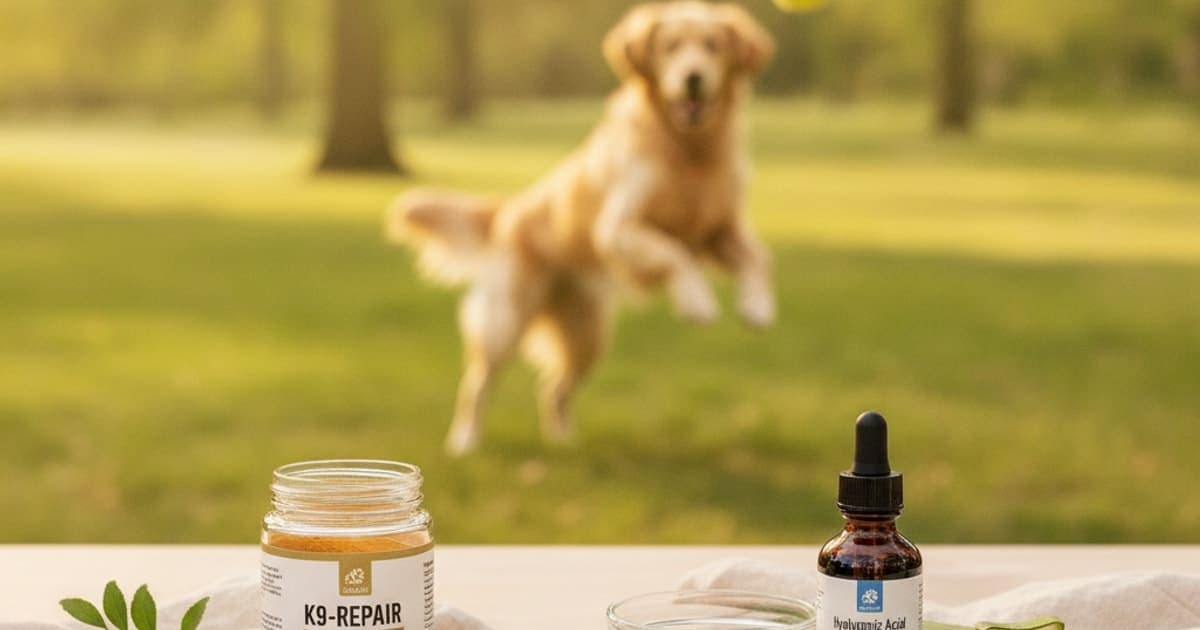 K9-REPAIR vs Hyaluronic Acid: Which Works Better?For a dog in an active repair phase, K9-REPAIR is the more direct choice: hyaluronic acid supports the fluid environment inside a joint, while the BPC-157 and TB-500 in K9-REPAIR are studied for their role in the repair signalling of tendon, ligament and soft tissue. Owners often run both, under veterinary guidance.Read the guide →
 K9-REPAIR vs Glucosamine: How They Compare for DogsK9-REPAIR and glucosamine are not interchangeable: glucosamine supplies cartilage building blocks, while the BPC-157 and TB-500 peptides in K9-REPAIR are studied for how they influence soft-tissue repair signalling in tendon and ligament. For dogs in active recovery, owners increasingly choose K9-REPAIR, often alongside a joint supplement.Read the guide →
 Dog Joint Pain Relief Supplements — What Actually HelpsDog joint pain relief supplements cluster into four real categories: omega-3 fatty acids, cartilage-matrix ingredients like glucosamine and chondroitin, plant polyphenols such as curcumin, and regenerative peptides including the BPC-157 and TB-500 in pawgen's K9-REPAIR. None are painkillers. Research suggests each supports a different layer of a sore joint.Read the guide →
 Dog Bone Health Supplements: What to Look ForDog bone health supplements supply the minerals and cofactors a dog's skeleton uses to remodel itself — calcium and phosphorus in balance, vitamin D, magnesium, vitamin K and trace minerals. Most dogs on a complete diet already get those, so the useful question is what supports the tendons, ligaments and cartilage around the bone.Read the guide →
 IVDD Supplements for Dogs — What Actually Supports RecoveryNo supplement treats intervertebral disc disease — diagnosis and treatment belong to your veterinarian. Supplements for dogs with IVDD support the tissue around the disc: paraspinal muscle, connective tissue and the inflammatory environment. The categories owners use are marine omega-3s, collagen and joint-matrix ingredients, antioxidants, and peptide formulations such as K9-REPAIR.Read the guide →
 All Natural Dog Joint Supplements — How to Choose OneAll natural dog joint supplements are whole-food and botanical formulas — green-lipped mussel, omega-3 oils, collagen, turmeric — that research suggests may support cartilage, connective tissue and comfortable movement. The better question is dose transparency and third-party testing, which is also why many owners now pair them with K9-REPAIR peptides.Read the guide →

The pawgen library · 3,678 guides
Dog mobility, joints and recovery
Plain-English guides on joint pain, injury recovery and what actually helps aging and active dogs. Written to answer the question, not to pad a word count.